That persistent musty smell in your basement, or maybe those unexplained allergy flare-ups that only seem to happen at home? These are often the first clues. Think of them as your home’s way of telling you it's time to find professional mold testing near me—a critical step for protecting your health long before any visible spots ever appear.
When To Call A Professional Mold Inspector
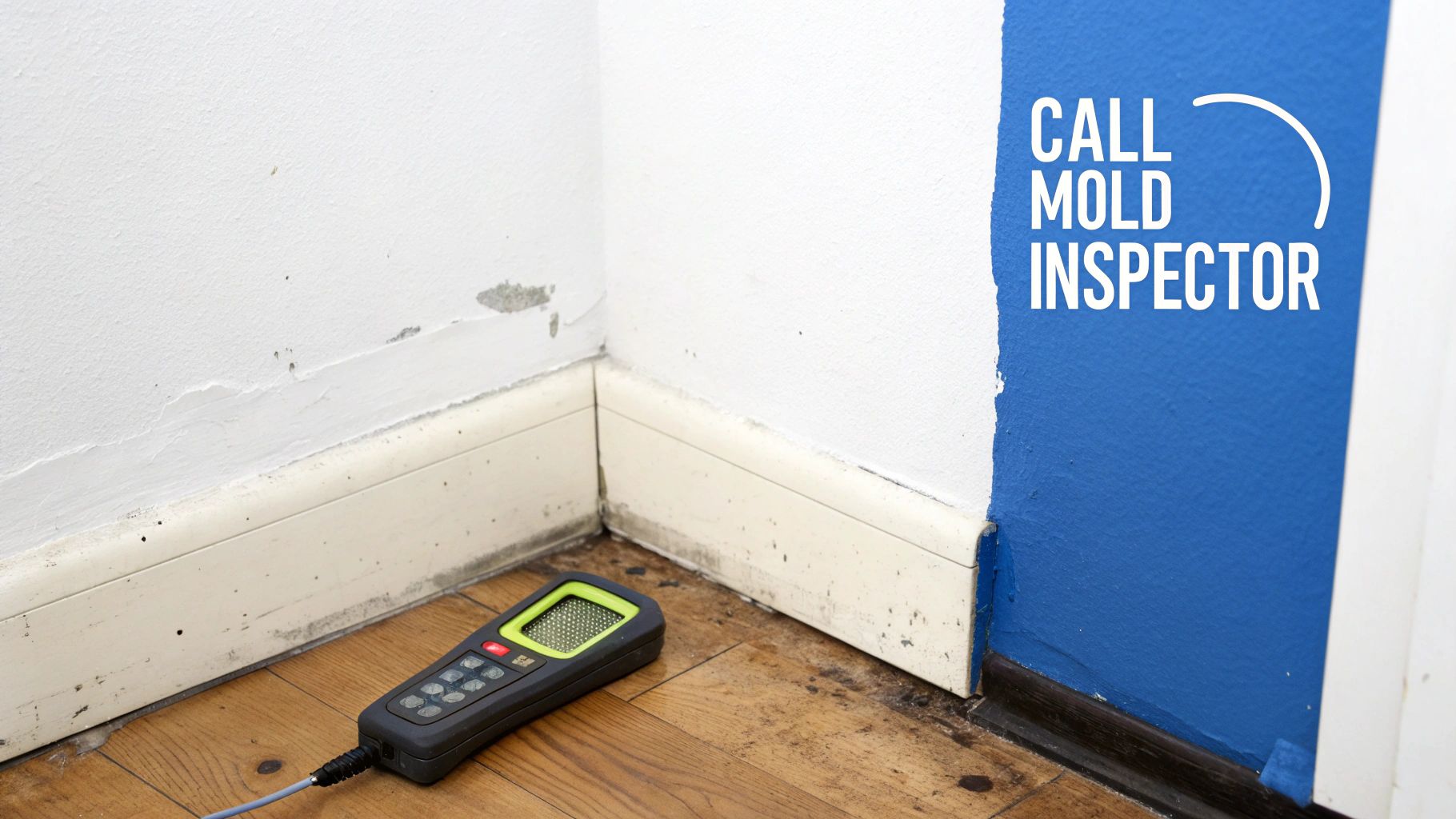
A lot of homeowners assume mold testing is only for when you see big, fuzzy black patches crawling up a wall. The truth is, the most important time to call an inspector is often when you just suspect a problem but can't see it. Hidden mold loves to grow for months, sometimes years, behind drywall, under flooring, or deep inside an HVAC system.
I remember a client who couldn't figure out why their toddler's asthma symptoms got so much worse every time they were in the playroom. There were no visible signs of mold, and they were completely stumped. We came in and did an air quality test, which revealed a high concentration of Aspergillus spores. It turned out they were coming from a slow, hidden leak behind a baseboard—something they never would have found on their own.
Telltale Signs Beyond The Obvious
Your senses and your health are usually the most reliable tools you have for detecting a hidden mold issue. Don't brush these red flags aside:
- A Persistent Musty Odor: If you’re smelling something earthy or damp that just won't go away, that’s the classic calling card of microbial growth. It's an even bigger clue if the smell is stronger in specific areas, like a closet or basement. You can learn more about how to know if that musty smell is mold in our detailed guide.
- Unexplained Health Symptoms: Constant stuffiness, headaches, sneezing, or irritated eyes that magically seem to get better when you leave the house? That points directly to poor indoor air quality, and mold is a very common cause.
- Evidence of Water Damage: Water intrusion—past or present—is the number one cause of mold. Be on the lookout for old water stains, peeling paint, warped floorboards, or even just condensation on your windows.
For many people, the decision to test really comes down to peace of mind. If you’re buying a new home or have family members with compromised immune systems, knowing your indoor air is clean is just invaluable.
The statistics are pretty sobering. Roughly 1 in 5 U.S. homes contains mold, and the link to respiratory problems is even more alarming. Some data suggests that about half of all asthma cases are made worse by mold exposure. A professional inspection takes you from suspicion to certainty and gives you a clear path forward.
How To Find And Vet A Local Mold Professional

When you google "mold testing near me," you're going to get hit with a lot of options. The real challenge is knowing how to sift through that list to find a true professional. You're looking for an expert who will give you accurate, unbiased data—not just sell you a service.
Here's the single most important thing to remember: find a company that only performs testing and inspections. It's a massive red flag if a company offers both testing and remediation. Why? It's a glaring conflict of interest. They have a direct financial incentive to "find" a problem, which can lead to overblown results and push you toward expensive, unnecessary removal work. Always, always choose an independent inspector.
Look For The Right Certifications
Credentials aren't just fancy letters after a name; they're proof of rigorous training and a commitment to high industry standards. Any inspector worth their salt will hold certifications from respected, third-party organizations.
Don't hesitate to ask a company which credentials their inspectors have. A couple of the most reputable ones you'll want to see are:
- ACAC (American Council for Accredited Certification): This organization offers top-tier certifications like the Certified Microbial Investigator (CMI). It's one of the gold standards in the industry.
- IICRC (Institute of Inspection, Cleaning and Restoration Certification): While widely known for remediation, their certifications for inspection and testing are also a strong sign of deep expertise.
A certified professional genuinely understands the science behind mold growth, knows the correct protocols for sampling, and can accurately interpret complex lab data. These aren't just nice-to-have skills—they're essential for a reliable assessment.
Key Questions To Ask Before You Hire
Once you have a shortlist of a few certified, independent inspectors, it's time to pick up the phone. A quick conversation can reveal everything you need to know. Have a list of questions ready to go so you can gauge their expertise and professionalism.
A professional inspector will welcome your questions. If a company seems evasive or can't provide clear answers about their process, insurance, or certifications, consider it a major red flag and move on.
Here’s what you should be asking every single time:
- Can you provide proof of insurance? This is non-negotiable. They need to have both General Liability and Errors & Omissions (E&O) insurance to protect you and your property.
- What does your inspection process involve? A thorough answer should include a visual assessment, moisture mapping, thermal imaging, and collecting air and surface samples as needed.
- Do you provide a detailed report with lab results? A professional report isn't just a pass/fail. It should include specific spore counts, identify the types of mold found, and provide photos and clear, actionable next steps.
- Do you offer same-day or priority inspections? This is critical if you're in the middle of a real estate transaction or dealing with an urgent health concern.
Taking these steps ensures the expert you hire is truly qualified to give you the answers and peace of mind you need. For a deeper look at what a complete assessment should include, check out our guide to a professional mold inspection near me. Choosing the right person for the job is the most important step toward a healthier home.
What To Expect During The Mold Inspection
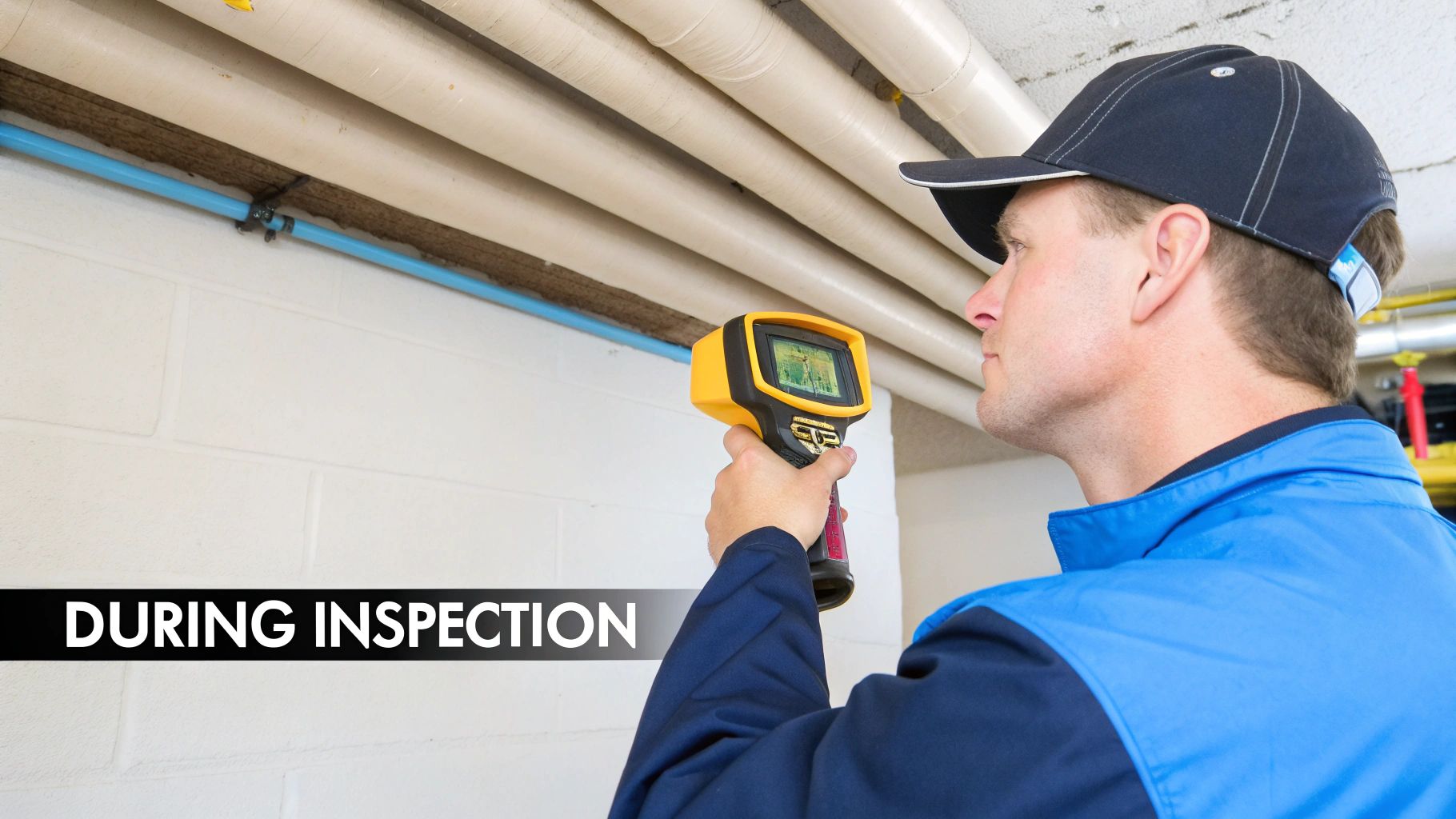
When our certified inspector arrives, think of it less like a simple walkthrough and more like detective work. A professional mold inspection is a systematic investigation into your home's environmental health, and it goes far beyond just spotting visible mold.
It always starts with a conversation. Your inspector will want to hear about any past water damage, musty odors you've noticed, or specific health concerns. They'll then walk through your property, looking for subtle clues—peeling paint, warped baseboards, faint water stains—that often point to hidden moisture problems. This initial assessment sets the stage for the high-tech part of the job.
Using Technology To See The Unseen
The real expertise in professional mold testing comes from using advanced tools to find what the naked eye can’t. We rely on specialized equipment to pinpoint hidden moisture because moisture is the fuel for mold growth. It's not about finding mold; it's about finding the water that allows it to thrive.
This is where the right tools become invaluable:
- Moisture Meters: These handheld devices have probes we press against drywall, wood, and concrete to get an instant moisture reading. A high number on a seemingly dry wall is a major red flag for a hidden leak.
- Thermal Imaging Cameras: Using infrared technology, these cameras show us temperature differences on surfaces. A cool spot on an interior wall might mean trapped moisture from a plumbing leak, guiding us to a problem area that would otherwise be completely invisible.
This technology allows for a non-invasive way to map out potential problem zones without tearing into walls unnecessarily. You can learn more about the complete mold inspection process in Santa Barbara, CA to feel even more prepared for our visit.
Collecting The Right Kind Of Evidence
After identifying potential problem areas, the next step is often collecting samples for lab analysis. This is a critical step that gives us scientific data on what’s actually in your air and on your surfaces. The type of samples we take depends entirely on the situation at hand.
Here’s a breakdown of the different sampling methods a professional might use and what each one is designed to uncover.
Common Types Of Mold Samples An Inspector Might Take
| Sample Type | How It Works | When It Is Used |
|---|---|---|
| Air Sample | An air pump draws a specific volume of air through a collection cassette. | To compare indoor spore counts to outdoor levels, or when a musty odor is present but no mold is visible. |
| Tape Lift Sample | A special piece of clear tape is pressed against a surface with suspected visible mold. | To identify the specific species of a visible mold growth. It's great for getting a quick, direct ID. |
| Swab Sample | A sterile cotton swab is wiped across a surface to collect a sample. | Useful for testing irregular or hard-to-reach surfaces where a tape lift isn't practical. |
Lab analysis of these samples confirms which mold types are present. Allergenic molds like Cladosporium, Aspergillus, and Penicillium are the most common culprits we find, but only a lab report can tell us for sure.
This scientific approach ensures we’re not just guessing. By combining visual clues, moisture data, and lab-analyzed samples, the inspector pieces together a complete picture of your home’s condition, providing you with clear, data-backed answers.
Breaking Down Mold Testing Costs And Timelines
When you think you might have a mold problem, two big questions immediately pop into your head: "How much is this going to set me back?" and "How long will this take?"
Getting a handle on the typical investment and timeline for a professional mold inspection helps you plan and takes the stress out of the unknown. There's no single flat fee for this kind of work, because the final cost is tied directly to the specifics of your property.
For a basic mold inspection in a smaller home or apartment, you're generally looking at a starting range of $300 to $600. This usually covers the comprehensive visual walkthrough, moisture mapping, thermal imaging, and a couple of samples to get a baseline (typically one from inside and one from outside for comparison). From there, the price can go up based on a few key factors.
Key Factors Influencing Your Final Cost
The size of your property is the biggest variable. It's just going to take more time and effort to thoroughly inspect a 4,000-square-foot house with an attic, multiple floors, and a crawl space than it will a small condo.
The number of samples we need to take also plays a huge role. If the initial look-around reveals a few different areas of concern—say, that musty smell in the basement and a suspicious water stain in an upstairs bathroom—your inspector will recommend collecting more samples. Each extra sample adds to the total, usually $75 to $150 per sample, since each one has to be analyzed separately by the lab. For a deeper dive, check out our complete guide on the cost of a mold inspection.
Investing in a thorough inspection with the right number of samples is crucial. Skimping here can leave you with an incomplete picture. You want a full, data-driven report on your home's air quality to plan an effective remediation.
Mapping Out The Inspection Timeline
The good news is, the whole process is surprisingly efficient. Here’s how it usually plays out from the moment you call us to the moment you get clear, actionable results:
- On-Site Inspection: A really thorough visual and tech-assisted inspection of a standard-sized home typically takes about 1 to 3 hours.
- Lab Analysis: Once we've collected the samples, they're sent overnight to an accredited third-party lab. The scientists there usually need 1 to 2 business days to complete the analysis.
- Report Delivery: As soon as we get the lab results back, we jump on it. We compile everything into a detailed, easy-to-read report that you can expect in your inbox within 24 hours of the lab finishing its work.
All in all, you can have definitive answers about what's going on in your home in just a few business days.
This quick turnaround is so important. Homeowners are taking these issues more seriously than ever, which is reflected in the growing global demand for mold remediation. The market was valued at USD 1,340.3 million in 2025 and is projected to hit USD 1,751.9 million by 2032. You can read the full research about mold remediation market growth on coherentmarketinsights.com. This data just underscores that getting prompt, accurate testing is a smart move and the first step in a well-established process for protecting your home.
Reading Your Lab Report and Planning What’s Next

After the on-site inspection, you’ll get a detailed lab report. Honestly, it can look a bit like a foreign language at first, packed with scientific names like Chaetomium or Stachybotrys and columns of numbers listed as "spores/m³". Don't let it intimidate you. This data is exactly what we need to get a clear picture of your home's air quality.
The key is comparing your indoor air samples to the outdoor "control" sample we took. Mold is everywhere in our natural environment, so seeing zero spores is completely unrealistic. What we're really looking for is a significant imbalance. Are the spore counts inside your home dramatically higher than outside? Or are we finding specific types of water-damage molds indoors that simply aren't in the outdoor air?
Translating Spore Counts Into Action
Those numbers on the page tell a story. While there are no official federal standards for "safe" mold levels, years of experience in this industry have given us clear benchmarks to work with. For instance, a slightly elevated count of a common outdoor mold like Cladosporium might not be a major concern, especially if it was a high-pollen day when we took the sample.
On the other hand, finding even a moderate level of a toxigenic mold like Stachybotrys chartarum (the infamous "black mold") is an immediate red flag. That points directly to a significant indoor water problem that needs to be addressed right away. For a deeper dive, our guide to understanding mold test results can help you make sense of every line.
Your inspector's job isn't just to hand you a confusing document. It's to translate this scientific data into a practical, easy-to-understand summary. They should clearly explain if the levels are normal for our area or if they point to an active indoor mold colony that requires action.
Charting Your Path Forward
Based on the lab results and what we found on-site, your report will outline clear next steps. The path forward really depends on the severity and location of the problem.
-
For Minor Issues: If a small, contained area—like under a sink with a minor plumbing leak—shows slightly elevated levels, the fix might be straightforward. The recommendation would likely be to repair the leak and have the affected materials professionally cleaned.
-
For Significant Contamination: If the report confirms high mold concentrations, especially in multiple areas or within your HVAC system, the next step is professional remediation. Your inspection report essentially becomes the roadmap for the remediation company, showing them exactly where to focus their efforts.
The Final, Crucial Step: Post-Remediation Verification
After any remediation work is finished, there's one last step that you should never skip: post-remediation verification, sometimes called a clearance test. We come back out and take a new set of air samples.
This final test is your ultimate peace of mind. It provides scientific proof that the remediation was successful and that your home's air quality has returned to a normal, healthy state. Without it, you're just crossing your fingers and hoping the job was done right. This step ensures you can truly breathe easy in your home again.
Common Questions About Local Mold Testing
When you’re staring down a potential mold problem, a lot of questions start bubbling up. That's completely normal. Getting clear, straightforward answers is the key to feeling confident about the next steps. We hear the same questions from homeowners all the time, so let's walk through them.
Are DIY Mold Testing Kits A Good Alternative?
It's tempting to grab a cheap DIY kit from the hardware store, but honestly, they’re notoriously unreliable. These kits are often just a petri dish that can’t tell the difference between a few harmless spores that blew in through an open window and a dangerous colony growing behind your walls.
This leads to two big problems: false positives that cause unnecessary panic, or worse, false negatives that give you a false sense of security while a serious issue goes unchecked.
A professional inspection is in a completely different league. It combines lab-analyzed samples with a critical eye, thermal imaging, and moisture detection to find the actual source of the problem—something a store-bought kit simply can't do.
How Long Does A Professional Mold Inspection Usually Take?
For a typical single-family home, you can expect a detailed mold inspection to take between 1 and 3 hours.
Of course, this can change depending on a few things. The size of your property and the complexity of its layout play a big role. If we need to suit up to get into tight attics or crawl spaces, or if there are multiple areas of concern that require extra samples, it might take a bit longer. Our inspectors are methodical for a reason—being thorough is the only way to make sure we don’t miss a single thing that could affect your home and your health.
Remember, the goal of a professional inspection isn't just to find mold. It's to find the source of the moisture that's feeding it. This is the only approach that truly solves the problem for good.
What Should I Do If The Test Finds Mold?
If your lab report comes back confirming elevated mold levels, the next step is professional remediation. It is a firm industry best practice—and our strong recommendation—to hire a separate, certified remediation company from the one that did your testing.
Why? This division of labor prevents any conflict of interest. It ensures the remediation plan is based purely on the scientific data from your report, not on a company trying to sell you a bigger cleanup job.
Your detailed inspection report will serve as a precise roadmap for the remediation team. After they’ve done their work, a follow-up "clearance test" is absolutely essential. This final check verifies that the mold has been successfully removed and confirms that your home's air quality has returned to a safe, normal level.