That musty smell that just won't go away? It's more than just a nuisance—it’s often your home's way of telling you there's a hidden mold problem. If you've had any recent water damage, noticed some weird stains on the walls, or you're dealing with allergy symptoms that don't make sense, it's probably time to search for professional mold testing services near me. A real test is the only way to know for sure what's going on behind your walls.
When To Call For Mold Testing Services
Knowing when to call in a professional can feel like a guessing game. But certain situations are clear red flags that you need an expert opinion.
Think of it this way: a professional mold test is like a diagnostic exam from a doctor for your house. A DIY kit from the hardware store is like taking your temperature at home—it might tell you there's a fever, but it can't tell you why. A professional assessment pinpoints the exact cause, the specific type of mold, and how bad the "illness" really is. Getting that detailed diagnosis is the first and most critical step toward finding the right cure.
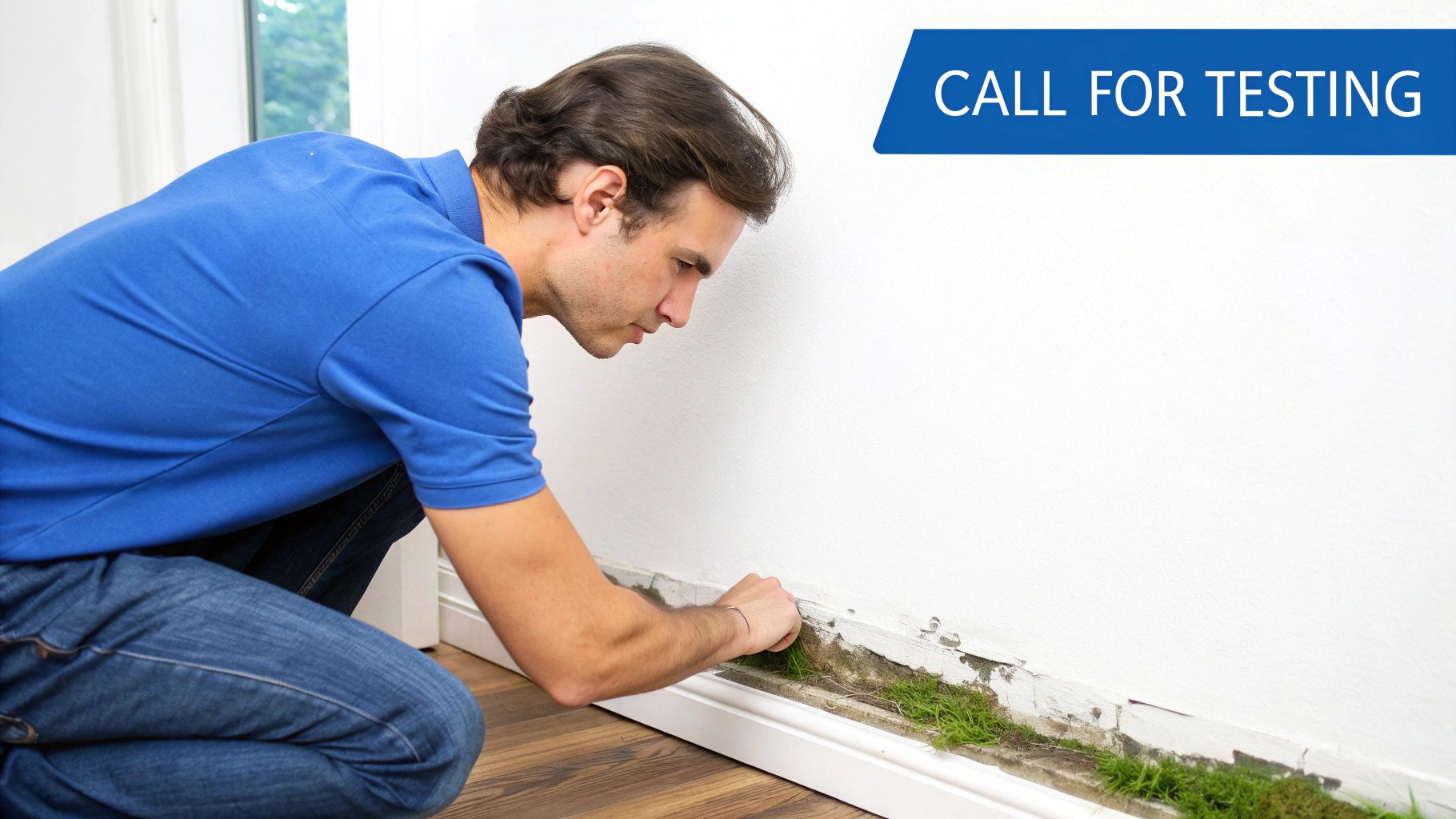
Key Scenarios That Demand An Expert Opinion
It’s tempting to ignore those early signs, but letting it go allows a small issue to mushroom into a serious health hazard and a very expensive structural problem. You should get an inspection on the books right away if you find yourself in these situations.
This table breaks down the most common reasons homeowners give us a call.
Key Scenarios That Require Professional Mold Testing
| Symptom Or Situation | Why Professional Testing Is Recommended |
|---|---|
| After Water Damage | After a flood, burst pipe, or roof leak, mold can start growing in as little as 24-48 hours, often hidden out of sight. |
| Visible Discoloration | Seeing black, green, or white spots on walls or ceilings means you need to know the species and how far it has spread. |
| Unexplained Health Symptoms | If allergy-like symptoms (coughing, headaches, rashes) get better when you leave the house, it's a huge red flag. |
| During Real Estate Transactions | A pre-purchase or pre-sale mold inspection protects your investment by uncovering hidden issues before you sign. |
When you see any of these signs, it's best not to wait. A professional can give you clear answers and a solid plan to move forward.
The stakes are higher than most people realize. Mold affects nearly 20% of U.S. homes and can seriously aggravate respiratory conditions. Getting a timely test doesn't just protect your family's health; early detection can slash long-term remediation costs by up to 50%.
For a deeper dive into what to look for, check out our guide on the 8 critical signs of mold in your house.
What Happens During A Professional Mold Inspection
When you call in a professional for mold testing, you’re not just getting a quick look-around. You're bringing in a scientific investigator to figure out exactly what's going on in your home's environment. The whole point is to move beyond what you can see and use data to uncover the root cause of any mold issue, not just the obvious symptoms.
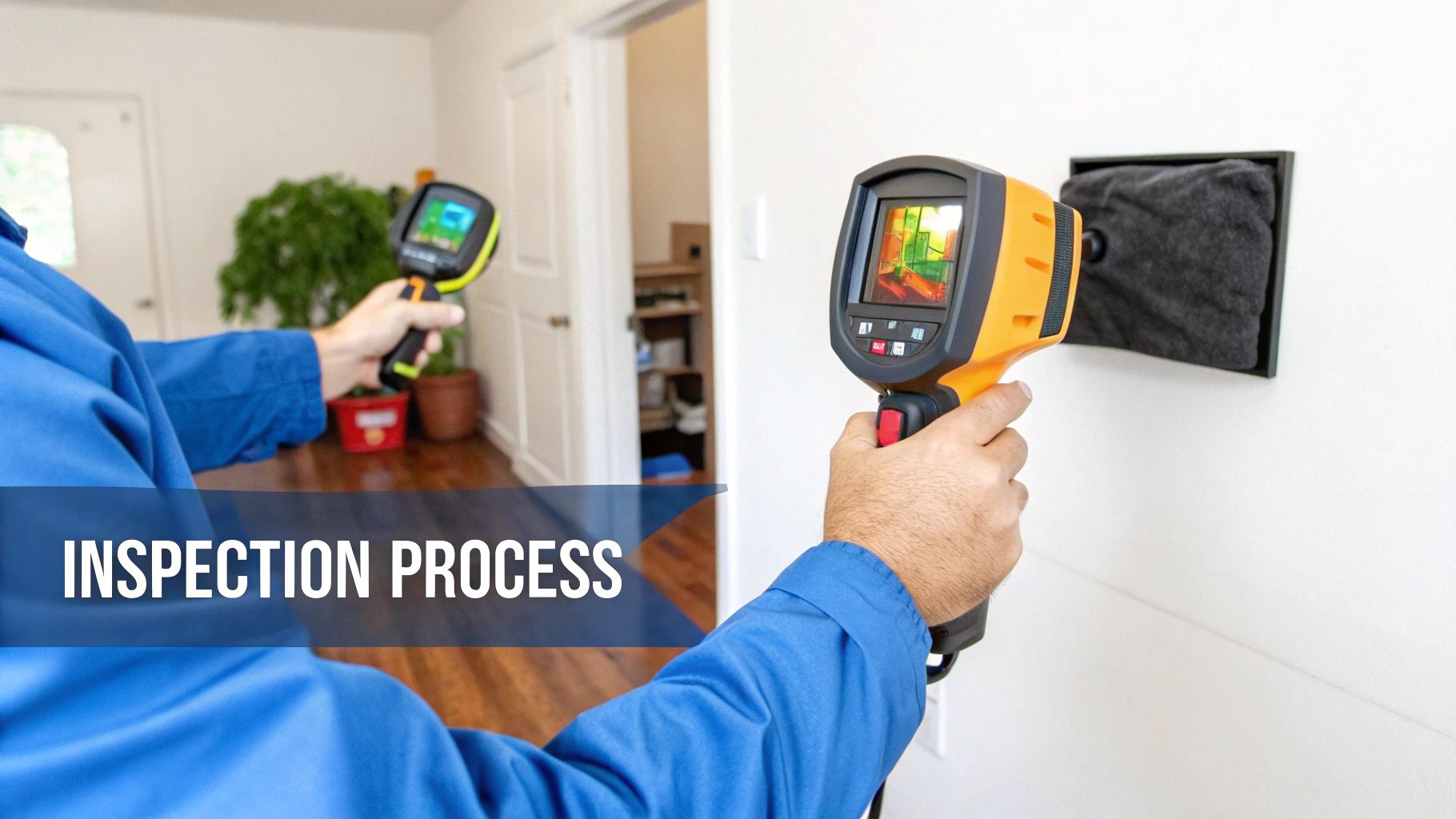
The process kicks off with a detailed visual assessment. A certified inspector will walk through your property with you, listening to your concerns and keeping an eye out for tell-tale signs like water stains, musty odors, or visible growth.
But the real detective work is about finding what you can't see.
Uncovering Hidden Moisture Sources
Mold’s number one need is moisture, and our primary mission is to hunt down its hidden sources. Think of it like giving your house an x-ray. Our inspectors use specialized tools to peek behind walls and under floors without causing a bit of damage, pinpointing the precise source of the problem.
This advanced gear is what separates a guess from a real diagnosis:
- Moisture Meters: These handy devices give us a direct reading of the moisture content in materials like drywall, wood, and concrete. This tells us instantly if an area is wet enough to be a breeding ground for mold.
- Thermal Imaging Cameras: An infrared camera is our secret weapon. It spots subtle temperature differences on surfaces. Since wet spots are usually cooler, the camera can reveal hidden leaks or condensation inside a wall that would otherwise be completely invisible.
By mapping out these moisture zones, we can see exactly where mold is likely growing and, more importantly, why. This step is absolutely critical for creating a remediation plan that solves the problem for good, not just for a few months.
Collecting The Right Samples For Analysis
Once we understand the moisture situation in your home, the next step is to collect samples for a certified lab to analyze. This isn't a one-size-fits-all process. Different types of samples tell different parts of the story, and together they create a full picture of your home's indoor air quality.
An expert inspection is a systematic investigation. We combine visual evidence with scientific data from moisture meters and lab samples to build a complete picture of your home’s environmental health, leaving no stone unturned.
Every sampling strategy is tailored to what we find on your property. If you want a closer look at how we approach this, you can learn more about our specific mold inspection process in Santa Barbara.
Types Of Mold Samples Collected
Each sample provides a unique piece of the puzzle, helping us build a comprehensive profile of any contamination.
- Air Samples: This is the most common and crucial type of sample. The inspector takes samples from inside the areas you're worried about, plus an outdoor "control" sample for comparison. This tells us the concentration and types of mold spores you and your family are actually breathing.
- Surface Samples: If there's visible growth, we’ll take a direct sample using a sterile swab or a special tape lift. This lets the lab definitively identify the exact species of mold growing on that surface.
- Cavity Samples: Sometimes, we strongly suspect mold is hiding behind a wall. In these cases, we may create a tiny, discreet opening to take an air sample from inside the wall cavity, which will either confirm or rule out hidden growth.
This multi-pronged approach ensures we don't miss a thing. It gives you the clear, accurate data you need to make informed, confident decisions about your home’s health and safety.
Why Local Experts Just Get It When It Comes to Mold
When you type "mold testing services near me" into a search bar, you're looking for more than just proximity. You're looking for someone who understands the unique environment your home is in, and that’s a massive advantage.
A national chain might have a one-size-fits-all playbook, but a local expert knows the specific climate patterns, humidity swings, and even the common building quirks in our area that invite mold to move in. It’s like having a home-field advantage; they’ve seen it all before and know exactly where to look for trouble spots specific to our coastal communities.
The Advantage of Local Knowledge
An inspector who lives and works here brings more than just technical skills to the table. They understand the regional construction trends and architectural shortcuts that often lead to moisture problems down the road.
Just recently, we got a call from a homeowner who was frustrated after a national company failed to solve their recurring mold problem. Our inspector took one look and immediately recognized the issue was tied to a type of foundation construction common in older Santa Barbara homes—something an out-of-towner would easily miss. By spotting this unique local detail, we found the real moisture source and saved the client from another round of expensive, ineffective work. It's a perfect example of how local insight delivers better, more accurate results.
Choosing a local mold testing service means you're hiring someone with a deep understanding of your area’s specific environmental and construction challenges. This specialized insight leads to a more accurate diagnosis and a more effective, long-term solution.
Faster Responses and Real Accountability
Beyond their specialized knowledge, local companies offer practical benefits that the big guys just can't match. When you're dealing with a potential mold emergency, you need someone who can get there—fast. Local pros can often be on-site much quicker, assessing the situation before it gets any worse.
More importantly, a local business lives and dies by its reputation in the community. They’re your neighbors, and they have a vested interest in providing great service and maintaining their good name. That built-in accountability means you get dedicated, personal attention from a team that genuinely cares about the health of your home and family. For more on finding the right team, our guide on what to look for in a mold inspection near you has some great tips.
How To Understand Your Mold Test Results
So, the lab report is back, and it's filled with scientific jargon that feels like a foreign language. Words like Aspergillus and Stachybotrys, next to columns of numbers, don't mean much on their own. Let's act as your personal translator and break down what those results really mean for you and your home.

Think of the key metric on your report—the spore count—like the daily pollen count you see on the weather channel. Just like there's always some pollen floating around outside, it’s perfectly normal to have a low level of mold spores inside your home.
The real goal is to figure out if your home’s indoor "pollen count" is way higher than the levels outside. A major spike is a dead giveaway that an active, indoor mold colony is pumping spores into your air.
Reading The Data: Spore Counts And Baselines
The first thing you’ll notice is a side-by-side comparison of your indoor air samples and the outdoor "control" sample we took. In a healthy home, the indoor spore counts should be pretty similar to, or even lower than, what’s happening outside.
The most important takeaway is the relationship between indoor and outdoor spore counts. If indoor levels of a particular mold are drastically higher, it's a clear sign of an internal growth source that needs to be addressed.
When those indoor numbers are elevated, it points directly to an active mold problem hiding somewhere inside. This is exactly why professional mold testing services near me are so valuable—they give us the hard data needed for an accurate diagnosis.
Identifying The Mold Types
Your report will also list out the specific types of mold we identified. It's important to remember that not all molds are created equal. Some are common allergens that might make you sneeze, while others can be far more hazardous to your health.
To give you a better idea, here’s a quick rundown of some common molds we find and what they might mean for your home.
Common Molds Found In Homes And What They Mean
| Mold Type | Common Location | Potential Significance |
|---|---|---|
| Aspergillus/Penicillium | Very common, found on damp building materials, in dust, and on food. | Often allergenic and can trigger asthma or other respiratory issues in sensitive individuals. |
| Cladosporium | Typically grows on surfaces in areas with high humidity, like bathrooms or around windows. | One of the most common outdoor molds, but elevated indoor levels can cause allergy-like symptoms. |
| Stachybotrys chartarum | Known as "black mold," it requires constant moisture and grows on materials high in cellulose, like wet drywall or wood. | This is a toxigenic mold that can produce mycotoxins, warranting immediate and professional remediation. |
Knowing these differences helps us figure out the right game plan. Finding Stachybotrys, for example, usually calls for a much more urgent and specialized remediation approach than dealing with common allergenic molds.
The demand for these kinds of detailed assessments is on the rise. The global mold remediation service market is projected to hit USD 1,751.9 million by 2032, with North America leading the charge thanks to growing public health awareness. As the CDC often points out, mold exposure can cause anything from a stuffy nose and cough to more severe reactions, which is why professional testing has become so essential.
By getting a handle on these core components, you can read your report with confidence. For a deeper dive, check out our complete guide to understanding mold test results. This knowledge empowers you to ask the right questions and take control of the next steps toward a healthier home.
The Path From Mold Testing To Remediation
Getting a lab report that confirms mold in your home can feel overwhelming, but it’s actually the first empowering step. Think of that positive test as a clear diagnosis; professional remediation is the proven cure. Knowing the roadmap from diagnosis to a clean bill of health can turn that initial anxiety into a feeling of control.
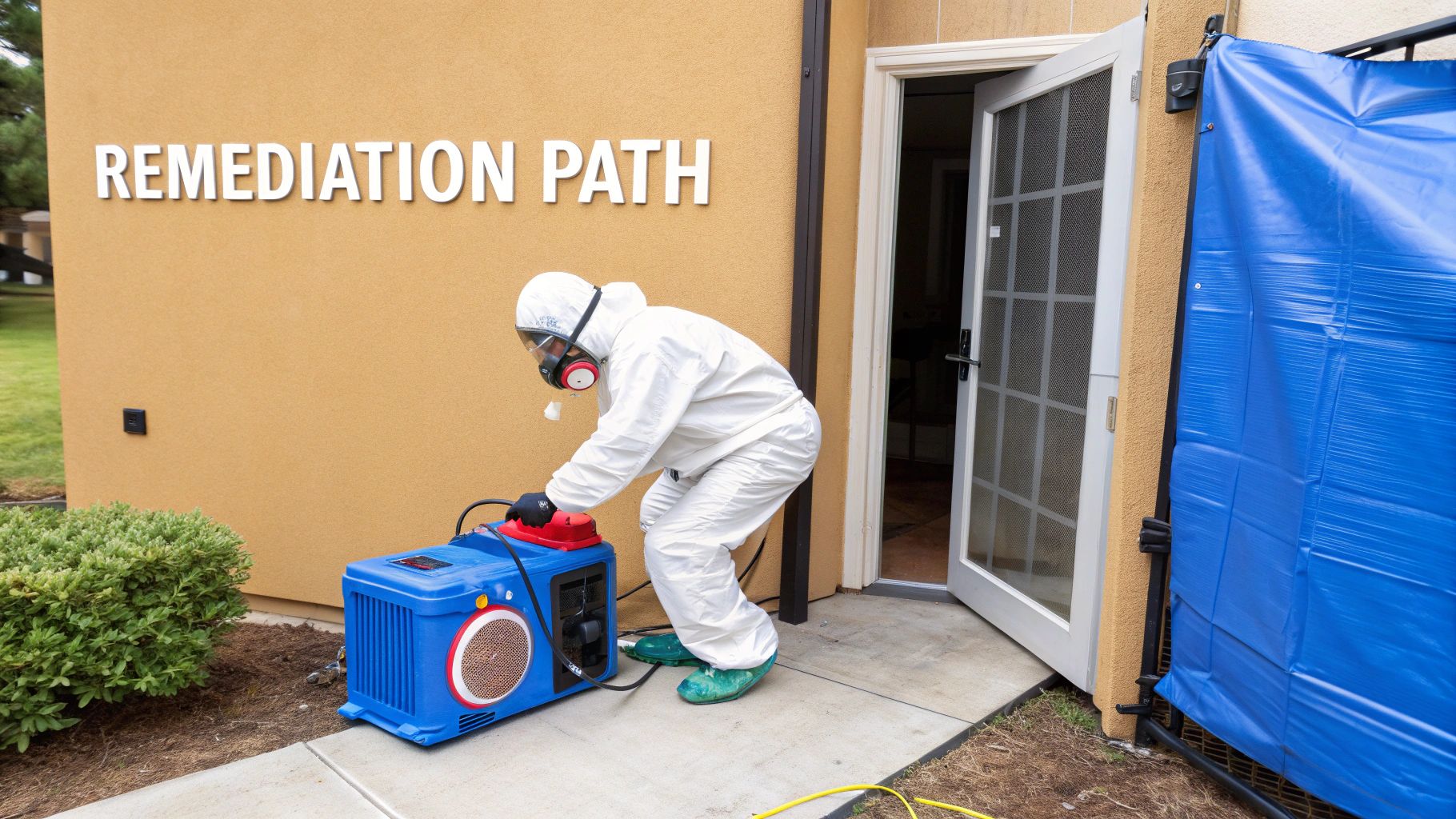
The process kicks off with containment. Before a single piece of contaminated material is touched, a professional remediation team seals off the affected area from the rest of your house. They’ll use heavy-duty plastic sheeting and negative air pressure machines to create an isolated, controlled environment.
This step is critical. It’s a lot like a surgeon creating a sterile field in an operating room—the goal is to stop mold spores from escaping during removal and contaminating other parts of your home through doorways or the HVAC system.
Safe Removal And Deep Cleaning
Once the containment zone is secure, the real work begins. This is where you see the sharp difference between simply removing mold and professionally remediating it. It’s never enough to just wipe down a surface. Any porous, contaminated materials—think drywall, insulation, or carpet—have to be carefully removed, double-bagged, and disposed of following strict industry regulations.
After the damaged materials are gone, the team brings in specialized equipment for a deep clean of everything left behind.
- HEPA Vacuuming: These aren't your average vacuums. High-Efficiency Particulate Air (HEPA) vacuums are powerful enough to capture microscopic mold spores from every nook and cranny inside the contained area.
- Antimicrobial Treatments: Next, surfaces are treated with EPA-registered antimicrobial agents. This kills any lingering mold and helps prevent it from making a comeback.
- Air Scrubbing: To finish, industrial-grade air scrubbers run for hours, sometimes days, to continuously filter the air and capture any airborne spores that remain.
This multi-step approach gets to the root of the problem, which is vital for a lasting solution. Understanding this is key, and you can learn more in our guide on mold removal versus remediation.
Remediation is a science, not just a cleaning job. It requires a methodical, multi-step approach to ensure the mold is not only removed but that the conditions allowing it to grow are permanently corrected.
Final Clearance: The Proof Of Success
The last, and arguably most important, step is clearance testing. After all the remediation work is done and the area has been meticulously cleaned, an independent third-party mold testing professional—like our team at Pacific Mold Pros—returns to take a new round of air and surface samples.
This isn’t just a box-ticking exercise; it's your concrete proof that the job was done right and your home is safe again. Those new samples are sent to the lab for analysis. The goal is to see that the indoor spore counts have dropped back to normal, healthy levels that are comparable to the outside air.
Only a passing clearance test can officially close out the project. This rigorous standard of verification is a big reason why the mold abatement service market is expected to hit USD 15.8 billion by 2025.
Your Mold Testing Questions Answered
When you think you might have mold, the questions start piling up fast. What’s this going to cost? How long will it take? What happens next? Sometimes, the uncertainty can feel just as stressful as the mold itself.
Getting straight answers is the first step to getting your peace of mind back. Here, we're tackling the most common questions we hear from homeowners who are looking for professional mold testing services near me. Let's clear the air.
How Much Do Professional Mold Testing Services Cost?
The cost of a professional mold inspection isn't one-size-fits-all, but most homeowners can expect to invest somewhere between $300 for a basic visual check to over $700 for a deep-dive assessment that includes multiple lab samples. The final number really depends on the size of your home and how complex the situation seems.
Think of it less as an expense and more as an investment in getting it right the first time. A professional diagnosis makes sure you're targeting the actual problem, which can save you thousands in remediation costs down the line. You'll avoid paying for work you don't need or, even worse, missing a hidden leak that just brings the mold right back. At Pacific Mold Pros, we give you a clear, upfront quote so there are no surprises.
Are DIY Mold Test Kits A Reliable Alternative?
That cheap DIY mold test kit from the hardware store can be really tempting, I get it. But honestly, they have some serious blind spots that can either give you a false sense of security or send you on a wild goose chase.
These kits are pretty good at one thing: confirming that mold spores exist in your home. The problem? Mold spores exist everywhere, all the time. The kits can't tell you what kind of mold you have, how concentrated it is in the air, or—and this is the most important part—where the moisture source feeding it is.
A DIY kit is like a thermometer that tells you there's a fever but offers zero diagnosis. A professional assessment is the full workup from a doctor, using specialized tools and experience to find the root cause and prescribe the right cure.
Worse yet, they are notorious for false positives. That little petri dish will almost always grow something, leaving you with scary-looking results but no real answers. Professional testing gives you the data and context you need to actually solve the problem for good.
How Long Does The Entire Mold Testing Process Take?
We know that when you're worried about mold, you want answers yesterday. Our entire process is built to be efficient without cutting any corners on accuracy.
The on-site inspection and sampling part usually takes about 1 to 3 hours for a typical home. In that time, our certified inspector will do a thorough visual walkthrough, use moisture detection tools to find hidden wet spots, and collect any necessary air or surface samples.
Once we have the samples, they're sent off to an accredited, third-party lab for analysis. That part of the process usually takes 2 to 3 business days. All in, from the moment we step into your home to you holding a detailed report with clear findings and recommendations, you're looking at a timeline of about 3 to 5 business days. This quick turnaround means you can get started on a solution without any frustrating delays.
What Should I Do To Prepare For A Mold Inspection?
Getting ready for our visit is simple, but a few small steps can make a big difference in the accuracy of our tests. The goal is to see your home's environment in its normal, everyday state.
Here’s a quick checklist to follow:
- Keep Windows and Doors Closed: For at least 24 hours before we arrive, try to keep all outside doors and windows shut. This helps stabilize the indoor air, which is critical for getting an accurate air sample.
- Turn Off Air Purifiers and Fans: Please turn off any air purifiers, humidifiers, dehumidifiers, or strong fans in the house. These can throw off the natural distribution of mold spores and skew the results.
- Provide Clear Access: Make sure we can easily get to any areas you're concerned about, like basements, attics, crawl spaces, or the cabinets under your sinks.
- Don't Clean or Disturb It: It might be tempting, but please resist the urge to clean or wipe away any visible spots you think might be mold. We need to see and sample the area exactly as it is to make a proper assessment.