It’s an alarming discovery for any renter: finding mold growing in your home. The good news is, if you're a tenant in California, you have a legal right to a safe and healthy home. This isn't just a friendly suggestion—it’s a core part of your lease agreement, even if the words aren't written down. Landlords are legally on the hook to fix conditions that make a home unlivable, and a serious mold problem absolutely falls into that category.
Understanding Your Rights When You Find Mold
Discovering mold can feel like a huge, overwhelming problem, but you're not powerless. California law gives you a strong foundation to stand on. The most important concept you need to grasp is the implied warranty of habitability.
Think of it as a silent, built-in promise from your landlord that your rental is fit to live in from the day you move in until the day you leave.
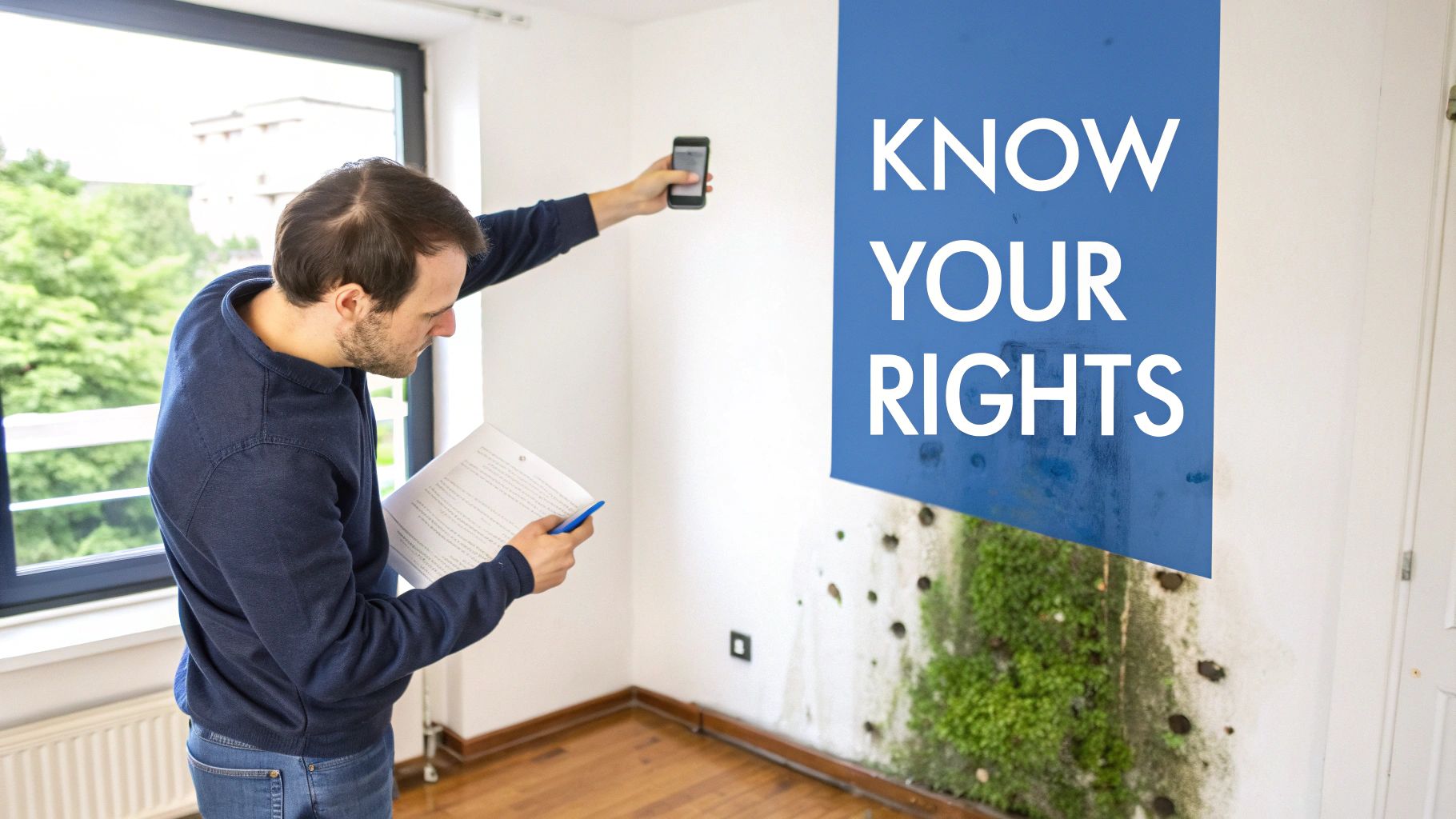
This "promise" is serious business, backed by state law, primarily California Civil Code § 1941.1. This is the code that spells out the bare minimum conditions a property must meet to be considered livable.
What Makes a Home Uninhabitable?
So, where does mold fit in? When mold shows up, it directly challenges that warranty of habitability. A tiny patch of mildew in the shower grout probably won’t legally render your home uninhabitable. But extensive mold climbing up the walls, spreading across ceilings, or hiding in the structure because of a leaky roof or bad plumbing? That’s a different story.
The law is focused on any condition that puts the life, health, safety, or welfare of tenants at risk. Mold fits that description perfectly.
To make it simple, here’s a quick-reference table that breaks down your core rights and your landlord's duties when mold crashes the party.
Your Core Rights and Landlord Obligations for Mold
| Your Right as a Tenant | Landlord's Obligation |
|---|---|
| To live in a safe, sanitary, and habitable home. | To maintain the rental property in a livable condition. |
| To have visible mold treated as a serious health hazard. | To address conditions defined as "substandard" by law, including mold. |
| To have the source of the mold (e.g., a leak) repaired. | To repair the underlying water intrusion causing the mold growth. |
| To be free from conditions that endanger your health. | To ensure the property doesn't threaten the tenant's health or safety. |
| To take legal action if the landlord fails to act. | To respond to written notices for repairs in a timely manner. |
This table lays out the fundamental give-and-take. Your landlord provides a safe home, and you pay rent. When one side of that bargain is broken, the law provides a path forward.
The implied warranty of habitability acts as your shield. It confirms you shouldn’t have to pay full rent—or any rent, in some cases—for a home that puts your health on the line. A significant mold infestation is a clear breach of this fundamental agreement.
This guide will walk you through the exact, practical steps you can take to enforce these rights. We'll cover everything from documenting the mold and properly notifying your landlord to understanding your options—like withholding rent or taking them to court—if they drag their feet. Your health and peace of mind come first, and knowing your legal protections is the first step toward getting your home safe again.
Your Landlord's Legal Duty to Fix Mold Problems
California's "implied warranty of habitability" is the baseline promise that your rental is safe and livable. But when it comes to mold, specific state laws give that promise real teeth. These aren't vague suggestions—they're legal statutes that spell out exactly what your landlord must do.
Getting familiar with this legal foundation does more than just inform you; it gives you the confidence to communicate clearly and effectively.
The most important law to know is California Health and Safety Code § 17920.3. This is the game-changer. It officially lists "visible mold growth" as a condition that makes a home legally "substandard." That isn’t just an opinion—it’s a legal fact.
Once mold is present, your home is, by definition, below the state's required standard of living. This simple truth completely changes the dynamic. Your complaint is no longer a simple maintenance request; it's a formal notice about a substandard housing condition.
The Source of the Mold Is What Matters Most
California law makes a crucial distinction: it all comes down to the origin of the moisture feeding the mold. A landlord’s responsibility kicks in when the mold is growing because of a problem with the building itself. Think of it like a leaky boat—if there’s a hole in the hull and water gets in, it’s the captain’s job to patch it.
In a rental property, that translates to problems like:
- Leaking Roofs or Walls: Any water getting in from outside is a sign of a structural failure.
- Faulty Plumbing: This covers everything from a slow drip under the kitchen sink to a major pipe burst hidden in a wall.
- Poorly Sealed Windows: Gaps around windows that let rain seep in are squarely the landlord's problem.
- HVAC System Issues: A leaky air conditioning unit can create the perfect chronic moisture source for mold.
These are all clear-cut examples of landlord responsibility because they fall under the basic duty to maintain the property’s structure and systems.
However, the responsibility can shift if the mold is a direct result of a tenant's actions—or lack thereof. This is often called "tenant-created" mold. For instance, if you constantly let your bathroom steam up without ever using the fan or cracking a window, any resulting surface mold could be your responsibility to clean. Similarly, if you overflow the bathtub and don't clean it up or report it, you could be on the hook for the damage.
Key Takeaway: The law focuses on the cause, not just the effect. A landlord is required to fix mold that grows from their failure to maintain the property, which is almost always the case with significant mold problems.
Knowing the Law Is Your Best Protection
Being able to reference these legal standards is incredibly powerful. When you send that notice to your landlord, you aren't just saying, "Hey, there's some mold here." You are officially informing them that their property has a "substandard housing condition" as defined by state law, and they have a legal duty to fix it.
To get a deeper understanding of these obligations, check out our detailed article on landlord responsibility for mold in California. This knowledge empowers you to state your case clearly, confidently, and with the full weight of the law on your side.
Your Step-by-Step Action Plan for Mold
Finding mold in your rental can feel overwhelming, but having a clear game plan turns panic into productive action. Knowing what to do—and just as importantly, what order to do it in—is the key to protecting your health and your legal rights. Think of this section as your practical checklist for the moment you spot trouble.

You're essentially building a case. Even if it never ends up in court, having solid, organized evidence forces your landlord to take the situation seriously. Each step you take adds another piece to that puzzle, creating a paper trail that’s hard to ignore.
Step 1: Document Everything Immediately
Before you touch anything, grab your phone. It’s your most important tool right now. Your first job is to become a detective and create a powerful visual record that speaks for itself.
The goal here is to capture the problem from every possible angle. Don't rush this part; be thorough.
What to Document:
- Photos and Videos: Take clear, well-lit pictures of all visible mold. Shoot a video panning across the entire affected area to show the full scope of the problem. Get shots from a distance, then move in for close-ups.
- Time and Date Stamps: Make sure your phone’s camera settings include a time stamp. If not, make a written note of the exact date and time you took the photos and videos. This creates an undeniable timeline.
- Detailed Notes: Write down exactly where you found the mold. Describe its appearance (color, texture), measure its size, and note any musty smells. Also, document any potential water sources nearby, like a slow drip under the sink, condensation on a window, or a damp spot on the drywall.
This documentation is your leverage. It proves when you discovered the issue and shows its severity, making it much harder for a landlord to downplay your complaint later. If you’ve had a recent leak, knowing how to check for mold after water damage can help you spot the less obvious signs.
Step 2: Provide Formal Written Notice
A quick text or a phone call simply won't cut it. To officially start the clock on your landlord's legal duty to respond, you must provide a formal written notice. This is a non-negotiable step that activates your rights as a tenant in California.
Keep the letter professional and stick to the facts. This isn't the time for emotional language; it's about clear, direct communication.
Your notice must include:
- Your name, full address, and unit number.
- The date the letter is written.
- A clear statement that you are requesting repairs for a mold issue.
- A detailed description of the mold's location and size, referencing the photos you took.
- A mention of the suspected water source, if you've found one (e.g., "the mold appears to be coming from a leak behind the toilet").
- A formal request for the landlord to fix the problem within a "reasonable time," as the law requires.
- Your signature.
Crucial Tip: Send this notice via certified mail with a return receipt requested. This gives you a legal document proving your landlord received your complaint and on what date. Keep a copy of the letter and the receipt in a safe place.
Step 3: Understand the Repair Timeline
Once you've sent that letter, the ball is in your landlord's court. But for how long? California law says landlords must make repairs within a "reasonable time."
While the law doesn't define this with a single magic number, 30 days is the standard timeframe legally considered reasonable for most habitability issues. If the mold poses an immediate or severe health threat, that timeline can be much shorter.
This is precisely why your written notice is so critical—it officially starts that 30-day countdown. Tenant rights around mold are strong in California, and this timeline is a cornerstone of your legal protection. In fact, mold complaints are a major issue, making up roughly 10-15% of all habitability violations reported in major California cities between 2018 and 2023. If your landlord fails to act within this window, you gain access to powerful remedies like withholding rent or using the "repair and deduct" option.
Following these steps methodically builds the foundation you need to enforce your rights. By documenting everything and communicating formally, you put yourself in the strongest possible position to get the problem solved and make your home safe again.
What to Do When Your Landlord Fails to Act
So, you’ve done everything by the book. You found the mold, documented it carefully, and sent your landlord a formal, written notice. But the 30-day clock has run out, and… crickets. Your landlord has gone silent, leaving you in a home that’s still a health hazard.
This isn’t just frustrating; it’s a direct violation of your rights as a California tenant. When polite communication hits a dead end, the law gives you some powerful tools to force your landlord's hand. These aren’t aggressive moves—they are your legal remedies to ensure you have a safe, habitable home.
Think of it like a chess match. Your landlord just missed their turn, and now it’s time for you to make a strategic move.

Option 1: The Repair and Deduct Remedy
One of the most direct options you have is the "repair and deduct" remedy, outlined in California Civil Code § 1942. This law lets you take charge by hiring a professional to fix the mold problem yourself and then subtracting the cost from your next rent check.
But there’s a catch, and it's a big one.
Crucial Limitation: You can only deduct an amount up to, but not more than, one full month's rent. You’re also limited to using this option no more than twice in any 12-month period.
This makes "repair and deduct" a fantastic tool for smaller, contained mold issues. Say a minor leak under your sink caused a patch of mold on the cabinet, and the repair costs $400. This is a perfect scenario. You’d pay the contractor, then simply deduct that $400 from your rent and give your landlord a copy of the invoice.
Option 2: Withholding Rent
For a serious mold infestation that makes your home unsafe or flat-out unlivable, you can escalate to a more powerful option: "rent withholding." This is your legal right to stop paying rent until your landlord finally makes the necessary repairs.
While this strategy definitely gets a landlord’s attention, it’s also risky if you don’t do it correctly. You can't just stop sending checks.
To protect yourself from an eviction lawsuit, you must set the full rent amount aside. The best way to do this is by opening a separate bank account, often called an escrow account, and depositing your rent there on time, every month.
Why is an escrow account so important?
- It proves good faith: It shows a judge you aren't just trying to live rent-free. You’re withholding payment for a valid reason: the property is uninhabitable.
- It’s your legal shield: If your landlord tries to evict you for non-payment, you can show the court that the money is ready and waiting as soon as they fix the mold.
- It maintains your leverage: It proves you’re ready and able to hold up your end of the lease the moment your landlord holds up theirs.
Without putting the rent in escrow, a judge is far more likely to see it as a simple failure to pay, which could lead to a quick eviction.
Option 3: Taking Your Landlord to Court
If your landlord still won't budge, or if you've suffered financial losses or health issues because of the mold, your final move is to sue. For most mold disputes, small claims court is the ideal place to go, as you can seek monetary damages without needing to hire a lawyer.
You can sue for a range of costs, including:
- Rent Abatement: Getting a retroactive rent reduction for the time your apartment was in an unsafe condition.
- Property Damage: The cost to replace personal items ruined by mold, like furniture, clothes, or electronics.
- Health-Related Expenses: Reimbursement for medical bills from illnesses caused by mold exposure.
Untreated mold can slash a property's value by 10-20%, and mold-related lawsuits cost California landlords millions every year. This financial risk is your leverage, especially when you have solid proof and a clear grasp of your rights.
Before you take any of these steps, having undeniable evidence is key. This is where a professional can make all the difference. To build the strongest case, many tenants find that hiring an expert for mold testing in Santa Barbara or Ventura provides the proof needed to get a landlord to finally act. A certified inspection report turns your complaint into a documented, scientific fact they can't ignore.
Using a Professional Mold Inspection to Prove Your Case
When you’re stuck in a mold dispute with your landlord, it often devolves into a frustrating "he said, she said" battle. Your landlord might glance at a discolored wall and wave it off as "just a little mildew." But you know better—your persistent cough and that musty smell are telling a completely different story.
In these situations, your most powerful tool isn't a heated argument; it's cold, hard, scientific proof.
This is exactly where a professional mold inspection changes the game. It elevates the conversation from subjective opinions to objective facts. While your landlord’s quick look is just that—a look—a certified inspector delivers an unbiased, evidence-backed assessment of what's really going on. This isn’t just about confirming the mold you can see; it’s about uncovering the problems you can’t.
What a Professional Inspection Actually Uncovers
Think of a certified mold inspector as a detective for your home's environmental health. They bring in specialized tools and proven techniques to find not just the mold itself, but its hidden sources and the true extent of the problem. It’s a process that goes far beyond a simple visual check.
A thorough inspection from a pro typically involves:
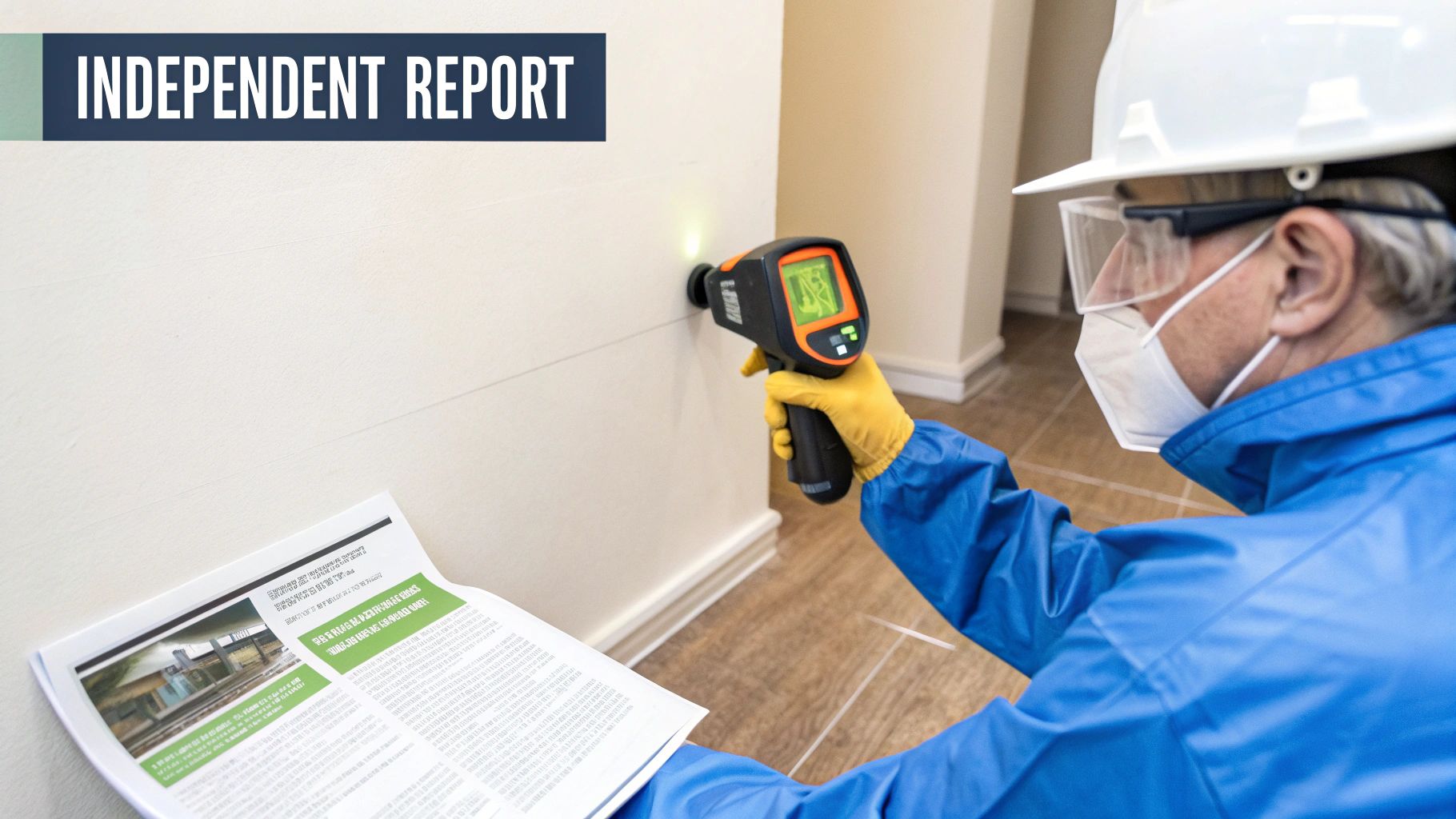
- Moisture Mapping: Using moisture meters, inspectors can detect elevated moisture levels hiding inside walls, under floors, and in ceilings—precisely where mold loves to grow unseen.
- Thermal Imaging: Infrared cameras are a game-changer. They can reveal subtle temperature differences in building materials, often pointing directly to hidden leaks or water damage that's feeding the mold.
- Air and Surface Sampling: Samples are carefully collected from the air and from affected surfaces. These are then sent off to an accredited laboratory for a detailed analysis.
This scientific approach is what gives the final report its undeniable authority. The lab results don’t just say "mold"; they identify the specific types present (like the notorious Stachybotrys chartarum, or black mold) and quantify the spore levels in your air.
An independent mold inspection report is your ultimate proof. It creates a detailed, scientific record of the problem, its cause, and its severity, making it nearly impossible for a landlord to downplay the issue or deny their responsibility.
Turning Evidence into Action
After the inspection, you’ll receive a comprehensive report that serves as an official record of the contamination. This document is far more than just a piece of paper; it’s your leverage. It outlines the lab findings, the inspector's professional observations, and often includes a detailed protocol for proper remediation.
This report strengthens your position in a few critical ways:
- It Validates Your Claim: The report officially confirms the mold's presence and severity, backing up your written notices to the landlord with hard data.
- It Pinpoints the Cause: By identifying the moisture source—a leaky pipe, a roof issue—the report clearly demonstrates that the problem stems from a structural failure, which is the landlord's responsibility to fix.
- It Creates Legal Pressure: Handing your landlord a scientific report from a certified professional is a clear signal that you are serious and prepared to escalate the matter. It’s a powerful tool in negotiations and becomes invaluable evidence if you have to go to small claims court.
When you invest in professional mold inspection services, you're really investing in clarity and proof. This detailed documentation removes all the ambiguity, giving you the undeniable evidence needed to enforce your tenant rights and compel your landlord to take action. It ensures your home is made safe based on scientific fact, not a landlord's casual opinion.
The Health Risks of Mold Exposure in Your Home
That musty smell or ugly stain on the wall? It’s not just a nuisance—it’s a direct threat to your family’s health. The fight for a mold-free home is about much more than property damage or legal squabbles. It's about protecting the people you care about most. When you understand the very real health consequences of mold exposure, you see why taking quick, decisive action is so critical.
When mold grows, it releases tiny spores into the air. Once you breathe them in, they can set off a whole range of health problems. For many people, it starts small, feeling a lot like seasonal allergies: a nagging cough, constant sneezing, itchy eyes, or a runny nose that just won't quit.
But for more vulnerable people, the impact can be far more serious.
From Allergies to Serious Illness
Living with mold day in and day out can turn those minor irritations into chronic health conditions. It's especially dangerous for certain groups who are more susceptible to mold’s toxic effects.
- Children and the Elderly: Their immune systems are either still developing or starting to weaken, making them less equipped to fight off the constant assault of mold spores.
- Individuals with Asthma: Mold is a well-known asthma trigger, often leading to more frequent and much more severe attacks.
- People with Compromised Immune Systems: For anyone already dealing with a health condition, mold exposure can open the door to serious respiratory infections.
The connection between damp, moldy homes and poor health is crystal clear. In fact, health problems caused by mold are a major driver of tenant activism in California. Studies have shown that a staggering 37% of asthmatic children living in damp, moldy homes experience worse symptoms. It's no wonder California tenants can sue for damages when mold leads to medical bills—courts have awarded averages of $10,000-$50,000 in some cases.
Connecting Your Health to Your Legal Claim
If you or your family members start feeling sick after you've found mold, it's time to connect the dots. Those health issues can become a powerful part of your legal claim for damages against a landlord who failed to act.
Key Takeaway: Your health problems aren't just a personal struggle; they are evidence. Documenting every doctor's visit, diagnosis, and medical bill related to mold-triggered illnesses builds a rock-solid case. It shows the real-world harm caused by your landlord's failure to provide a safe, habitable home.
Keeping a simple log of symptoms and appointments creates a clear timeline, linking your declining health directly to the mold in your home. This documentation elevates your complaint from a simple repair request to a serious claim for damages that can cover medical bills, lost wages, and even pain and suffering.
To get a better handle on the specific dangers, you can learn more about the health risks of mold exposure in our detailed guide. This knowledge is your best tool for protecting your family and holding your landlord accountable.
Common Questions About Mold and Your Rights
When you're dealing with a mold problem, it's easy to feel overwhelmed. You have questions, and you need clear answers. Here’s a straightforward look at the most common concerns we hear from tenants, so you know exactly where you stand.
Can My Landlord Evict Me for Complaining About Mold?
Absolutely not. California law is crystal clear on this: it's illegal for a landlord to retaliate against you for exercising your rights.
If you report a serious issue like mold or use a legal remedy like "repair and deduct," your landlord cannot try to evict you, hike up your rent, or cut back on services for a full 180 days. This is a critical protection designed to let you report unsafe conditions without worrying about losing your home.
Could I Get Blamed for Causing the Mold?
It’s possible, but it's not the norm. A landlord's job is to maintain the building's integrity—that means fixing leaky pipes, a faulty roof, or cracks in the foundation. Those are the usual suspects behind a mold problem.
However, if your actions directly led to the mold, you could be held responsible. This might happen if you let a bathtub overflow and never reported it, or if you consistently created extreme moisture without any ventilation (like never using the bathroom fan). The best way to protect yourself is to report any water leaks or moisture issues the moment you spot them.
What if the Mold Is in a Shared Area Like a Laundry Room?
Your landlord’s responsibility doesn’t stop at your front door. They are legally required to keep all common areas—hallways, laundry rooms, lobbies, garages—safe and habitable for every tenant.
Mold in a shared space is a health hazard for everyone and often signals a bigger moisture problem in the building. Report it with the same formal, written notice you would for an issue inside your own apartment.
Your landlord’s responsibility isn’t confined to the four walls of your apartment. The entire property, including all common areas, must be maintained in a safe, habitable, and mold-free condition.
Does My Landlord Have to Pay for a Hotel During Repairs?
If the mold is so bad that you can't safely live in your apartment while it's being removed, then yes, your landlord is likely on the hook for the cost of temporary housing. This usually means a reasonably priced hotel or similar accommodation.
This is often something you'll need to negotiate, so get the agreement in writing before you pack a bag. If your landlord refuses to cover it, you may be able to recover those costs later in small claims court as part of your damages.