You know that smell. You walk into a room, maybe the basement or the laundry area, and it hits you—a distinct, musty, earthy scent. It's like a damp forest floor or old, wet laundry that's been sitting too long.
That smell is the classic calling card of mold. More often than not, that persistent odor is the very first clue you have of a hidden problem.
Decoding the Unmistakable Smell of Mold
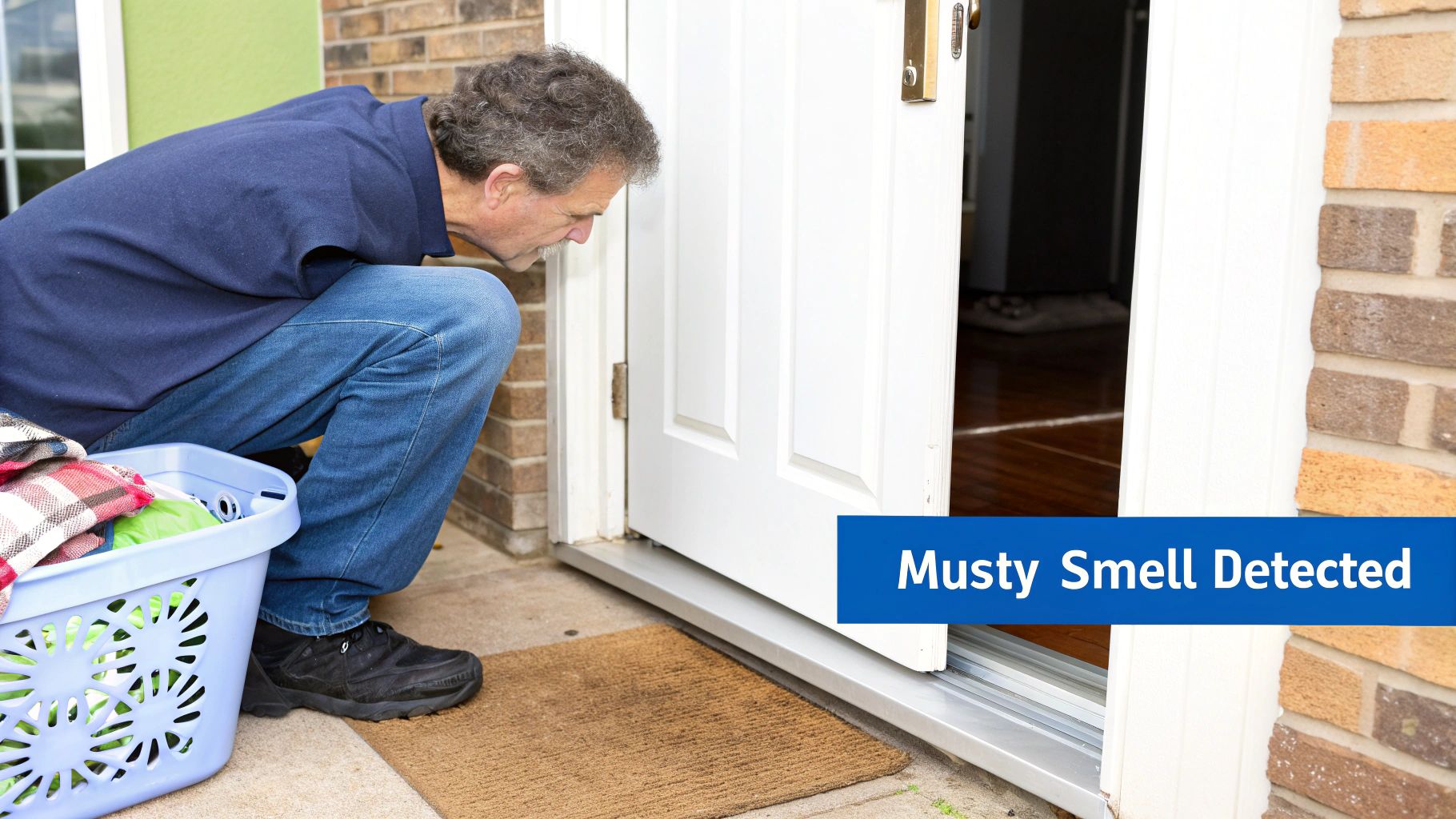
Here’s a common misconception: you’re not actually smelling the mold itself. What you're smelling are the gassy byproducts it releases as it feeds on organic materials in your home.
Think of it this way: as a mold colony digests its food source—whether that's drywall, wood, or even dust—it essentially "exhales" chemical compounds into the air.
These airborne gases are called microbial volatile organic compounds (mVOCs). They're the true source of that signature musty aroma and act as your nose's built-in early warning system.
Your Nose Is a Powerful Mold Detector
Never underestimate your sense of smell. It can be an incredibly effective tool for sniffing out a potential mold issue, especially in humid coastal areas like ours where moisture is a constant battle. The human nose is remarkably sensitive to the compounds mold pumps out.
In fact, research has pinpointed specific mVOCs as the primary culprits behind that classic "moldy" smell. In one study, 44% of participants identified a particular compound's scent as a "mold smell," while another 40% called it "musty"—and they could detect it at incredibly low levels.
This means even a faint but persistent musty odor is a strong signal that an active mold colony might be growing somewhere nearby, often completely out of sight.
Common Mold Scents and Their Sources
While "musty" is the general term, different conditions and mold types can produce slight variations in the smell. Learning to recognize these can help you play detective and start tracking down the source of the problem.
To make it easier, here's a quick guide connecting the smells you might notice to common household analogies and the places you're likely to find the issue.
Common Mold Scents and Their Sources
| Odor Description | Common Analogy | Potential Source Location |
|---|---|---|
| Musty and Damp | Wet laundry left in the washer | Basements, bathrooms, under leaky sinks, or anywhere with ongoing moisture. |
| Earthy or Soil-Like | Damp soil or decomposing wood | Crawl spaces, leaky window sills, or areas where moisture is interacting with wooden structures. |
| Stale or Dusty | A closed-off, forgotten room | Attics, inside wall cavities, or any area with poor ventilation and an accumulation of damp dust. |
This table should give you a head start, but remember, any persistent, unusual smell warrants a closer look.
Understanding how to know if that musty smell is mold is the first real step toward protecting your home and your health. If you've got an odor that just won't go away, no matter how much you clean or air out the space, it’s a clear sign that something’s not right. Trust your nose—it's usually telling you the truth.
The Science Behind Why Mold Creates Odors
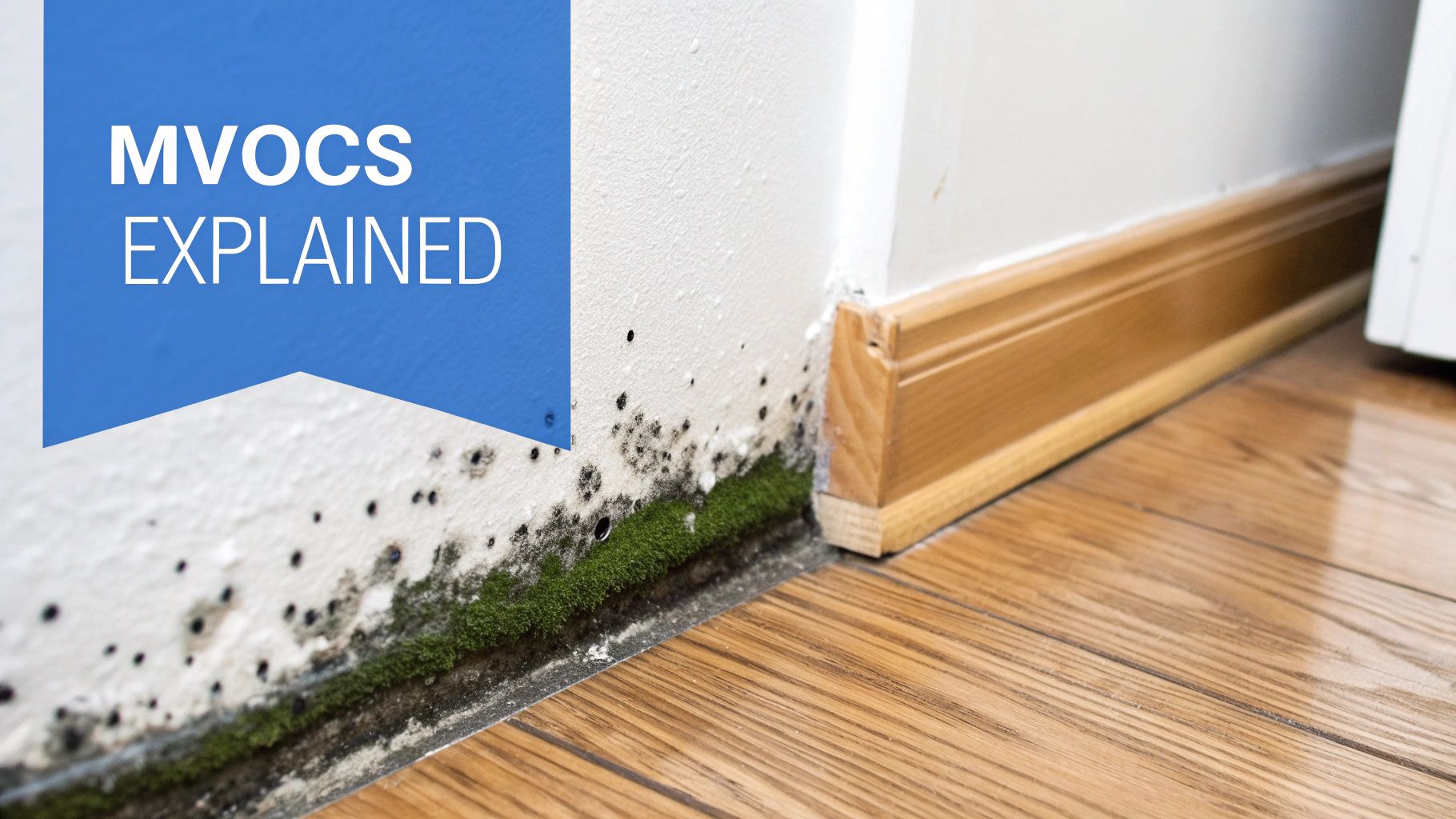
That musty odor you’re noticing isn't just a random smell—it’s the direct result of a living process happening right inside your home. Think of a mold colony as a tiny, invisible factory that needs to eat to survive and grow. Its preferred food sources are the very organic materials your home is built with.
As mold feasts on things like drywall paper, wood, or even dust, it’s actively digesting them. And just like any living thing, that digestive process creates waste. For mold, this waste is released as a cocktail of gases known as microbial volatile organic compounds (mVOCs).
Those invisible gases are what hit your nose when you ask, "what does that mold smell like?" A stronger odor usually means the mold colony is more active and has spread further.
The Role of Moisture and Growth
So, what gets this whole process started? Moisture.
Dormant mold spores are practically everywhere, all the time, but they’re harmless until they find water. Think of moisture as the "on" switch for the mold factory.
Once water is introduced, those spores wake up, start growing, begin to feed, and release those smelly mVOCs. This is exactly why you often notice a musty smell right after a plumbing leak, a flood, or even just a period of high humidity—the water has officially kicked the production line into gear.
A musty odor isn't just unpleasant; it's a chemical signal that mold is actively consuming parts of your home and releasing byproducts into the air you breathe.
Understanding this connection is the first step. That smell confirms you have an active, growing problem that an air freshener will only mask, not solve.
Why Different Molds Can Smell Different
The specific scent you detect can also vary. Different mold species consume different materials, and in turn, they release their own unique combinations of mVOCs. One type of mold growing on damp wood might have an earthy scent, while another feasting on wet drywall could smell sharp and acrid.
The science here is surprisingly complex. Researchers have identified over 200 different mVOCs that create mold's signature aromas, including compounds like 2-methylfuran and oct-1-en-3-ol. A key 2020 study pinpointed certain chloroanisoles as primary culprits, finding that 57% of participants could detect them at incredibly low concentrations. Even more telling, the study found that homes with this distinct odor had 3.5 times higher levels of fungal biomarkers, confirming significant contamination. You can explore the full findings to see just how closely these smells are tied to a building's health.
Ultimately, this whole process explains why you should never ignore a persistent musty smell. It’s your home’s alarm system, telling you that a hidden biological process is underway that could be impacting your property and your indoor air quality.
Why That Moldy Smell Is a Health Red Flag
That musty, damp smell isn't just unpleasant—it's your body's built-in alarm system, warning you that you might be breathing in something harmful. When you can smell mold, it means you're inhaling a mix of microscopic mold spores and gassy byproducts called mVOCs, both of which can wreak havoc on your health.
Think of it like invisible dust. Even though you can’t see the individual particles, they’re floating in your air and entering your lungs with every single breath. For many people, this constant exposure can trigger a wide range of symptoms, turning their own home into a source of chronic illness.
This is exactly why learning "what does mold smell like" is so closely tied to protecting your family. The smell itself is your confirmation that an active biological process is underway, releasing contaminants directly into the air you breathe.
Who Is Most at Risk?
While anyone can be affected by poor indoor air quality, some people are far more vulnerable to the effects of mold exposure. Their bodies may react more strongly or simply have a harder time fighting off the irritation caused by airborne spores and their chemical byproducts.
Groups at a higher risk include:
- Children and the Elderly, whose immune systems are either still developing or have naturally weakened over time.
- Allergy and Asthma Sufferers, who can experience severe flare-ups, wheezing, and major breathing difficulties.
- Individuals with Compromised Immune Systems, like those undergoing chemotherapy or living with an autoimmune disorder.
For these sensitive groups, even low levels of mold can lead to significant health problems, making quick action absolutely essential. You can learn more by reading our detailed guide on the specific health risks of mold exposure.
The musty smell you're noticing is created by a chemical cocktail, with a key compound being geosmin. The human nose is so sensitive it can detect geosmin at incredibly low levels—which explains why even a tiny, hidden patch of mold can make an entire room stink.
This extreme sensitivity is nature's alarm bell. In the United States, it's estimated that over 50 million Americans suffer from mold-related health issues each year. Inhaling mVOCs is frequently linked to symptoms like dizziness, persistent headaches, and nausea, which can be especially severe for those with weakened immune systems. You can read more about the science behind mold odors and their health impacts to get the full picture.
Ignoring that smell means ignoring a direct threat to your family's health.
Finding Common Mold Hiding Spots in Your Home

Okay, you’ve got a handle on what mold smells like. Now it’s time to put on your detective hat and follow that scent through your home. That musty, earthy odor is your number one clue, pointing you straight toward hidden moisture and the mold colonies that love it.
Mold is sneaky. It doesn't grow out in the open where you can see it; it prefers dark, damp, and quiet corners. This means the biggest problems are almost always out of sight. To sniff out the source, you have to know where mold likes to hide.
Prime Locations for Hidden Mold Growth
Let's think like mold for a second. Where does moisture hang around without drying out? Those are the high-risk zones where your search should begin. This is especially true here in coastal areas like Ventura and Santa Barbara, where humidity is practically a roommate.
Your investigation should zero in on a few key areas known for creating the perfect storm for mold growth.
Remember, a mold smell is a direct result of moisture. If you can trace the odor to its strongest point, you'll almost always find a source of unwanted water, whether it's from a slow leak, condensation, or high humidity.
This link between scent and moisture is your most reliable tool. Use it to guide your search and pinpoint problem spots before they blow up into major issues.
Your Mold-Sniffing Checklist
Grab a good flashlight and start by inspecting these usual suspects. Trust your nose—it will lead you to where that musty smell is most concentrated.
Here are the top places mold loves to set up shop:
- Under Sinks: Kitchen and bathroom sinks are notorious for slow drips from pipes and drains. That dark, closed-off cabinet traps every bit of moisture, creating a perfect breeding ground.
- Around Windows and Doors: Condensation is a big one, especially in cooler weather when it pools on windowsills. Poorly sealed frames are another culprit, letting rainwater seep in and soak the surrounding drywall and wood.
- In Bathrooms: Beyond the sink, check the base of the toilet, behind tiles with cracked grout, and in shower corners that never seem to dry. A weak or nonexistent exhaust fan is often the root cause.
- Behind Appliances: That fridge with the ice maker, your dishwasher, and the washing machine all have water lines that can spring a leak. It’s worth the effort to pull them out and check the wall and floor behind them.
If you’ve followed the smell, checked all these spots, and are still coming up empty, the mold might be hiding inside a wall, your crawlspace, or even your HVAC system. Our guide on how to detect mold has more advanced tips for these tricky situations. When an odor is persistent but invisible, it's often a sign that the problem is embedded within your home's structure, and it’s time for a more professional approach.
When to Stop Searching and Call a Professional

You’ve done your detective work. You’ve sniffed around the bathrooms, peered under sinks, and checked the usual suspects, but that musty smell just won’t quit. A persistent odor that you can't pin down almost always means the problem has moved beyond a simple DIY fix.
Knowing when to hang up your detective hat and bring in an expert is a crucial step in protecting both your property and your family's health.
Think of it this way: a small, visible patch of mold on a shower tile is like a weed you can pull yourself. Easy enough. But a stubborn musty smell with no obvious source? That’s like discovering deep roots snaking unseen beneath the surface. You need professional tools and expertise to find and remove the entire problem without causing more damage.
Clear Signs You Need Expert Help
While a proactive search is always a great first step, certain red flags indicate the issue has graduated to a professional level. If you're experiencing any of the following, it's time to make the call.
These situations signal that the mold source is likely hidden, extensive, or in a hard-to-reach area where specialized equipment is absolutely necessary.
Here are the key triggers that mean it's time to stop guessing:
- You Smell Mold but Can't Find It: This is the #1 reason people call us. A strong mold smell without a visible source almost always points to mold growing inside walls, under flooring, or deep within your HVAC system.
- Your Allergies Flare Up at Home: If you or your family members experience chronic allergy symptoms—sneezing, coughing, itchy eyes, or headaches—that seem to magically disappear when you leave the house, it's a huge indicator of an indoor air quality problem.
- You've Had a Major Water Incident: After a big event like a flood, burst pipe, or significant roof leak, mold can grow with alarming speed in saturated materials. It’s essential to have a professional assess the area to ensure everything has been properly dried and remediated.
The Problem with DIY Test Kits
It’s tempting to grab a DIY mold test kit from the hardware store. They seem like a quick and cheap solution, right? Unfortunately, these kits often provide misleading or incomplete results.
They might confirm the presence of mold spores—which are almost always present in the air everywhere—but they fail to tell you the important stuff: the type, the concentration, or, most critically, the exact location of the source.
A professional assessment goes far beyond what a store-bought kit can offer. It's a comprehensive diagnostic process designed to uncover the "why" and "where" of your mold problem, not just the "what."
A certified inspector uses advanced tools like thermal imaging cameras to detect hidden moisture behind walls and moisture meters to trace the full extent of water damage. This approach gives you a complete picture, ensuring no hidden pockets of mold are left behind to cause problems later.
If you're ready to get definitive answers, a professional mold inspection service is the only way to truly understand the scope of the issue. Making that call ensures you move forward with accurate information, safeguarding your home and your family's health effectively.
Your Next Steps for a Mold-Free Home
If you've started noticing that distinct musty, earthy smell, your nose is telling you something important. It's a clear signal that it’s time to take action. Ignoring it won't make it go away; in fact, it allows the underlying moisture issue to get worse, potentially harming your home’s structure and your family’s well-being.
Taking decisive steps now is the best way to get your peace of mind back. For homeowners in Santa Barbara and Ventura counties, our team at Pacific Mold Pros makes the process straightforward and stress-free.
Our Professional Process
Your path to a healthier home starts with a simple phone call. We'll schedule a comprehensive inspection where our certified technicians come to your home with advanced diagnostic tools. Using things like thermal imaging and moisture mapping, we can pinpoint the exact source of the problem, even if it's hiding behind a wall or under the floor. We don’t just look; we investigate.
Once on-site, we can collect air and surface samples to be analyzed by a certified lab. This is a crucial step that tells us exactly which types of mold are present and at what concentration levels. Afterward, you’ll get a detailed, easy-to-understand report that lays out our findings and gives you clear, actionable recommendations.
Our commitment is our Breathe Easy Guarantee, which ensures you get a transparent and accurate assessment from start to finish. We combine our deep local expertise with friendly, responsive service to guide you every step of the way. While we handle the technical side, you can learn more about practical steps in our guide on how to get rid of a mold smell.
Still Have Questions About That Moldy Smell?
Even when you know what to sniff for, it’s normal to have a few lingering questions. What does that smell really mean for your home and your health? Let's tackle some of the most common questions we hear from homeowners trying to get to the bottom of a mysterious musty odor.
"The Smell Comes and Goes. Is It Still a Problem?"
Absolutely. In fact, a smell that plays hide-and-seek is often a dead giveaway for a hidden moisture problem that’s tied to specific conditions.
Think about it: you might only catch that musty whiff after a big rainstorm or on a particularly humid day. That’s because the extra moisture "wakes up" a dormant mold colony, kicking its production of those stinky mVOCs into high gear. The mold is still there even when you can’t smell it—it's just waiting for the right conditions to ramp up again. Consider it a clear warning sign that something isn't right.
"Can I Just Use an Air Purifier to Get Rid of the Smell?"
An air purifier might feel like a quick fix, but it's really just masking the symptom, not solving the problem. A good purifier with a HEPA filter can definitely trap some airborne mold spores and dial down the intensity of the smell, but it does absolutely nothing to stop the source.
It's like putting a bucket under a leaky pipe. Sure, you're catching the drips for now, but the pipe is still broken. As long as that mold has a source of moisture, it will keep growing and releasing odors. The only permanent solution is to find the mold and have it professionally removed.
"If I Can't Smell Anything, Does That Mean My Home Is Mold-Free?"
Not necessarily. While a musty smell is one of the most reliable clues you have, the absence of an odor isn't a guaranteed all-clear. Some types of mold produce very little scent, especially when they're just getting started.
Plus, if mold is growing deep inside a wall or is sealed off behind a vapor barrier, the smell might not have a chance to reach your living space yet. If you have other red flags—like visible water stains, peeling paint, or nagging allergy symptoms that only seem to act up at home—it's always smart to trust your gut and get a professional inspection.