You’ve probably seen it in movies—that cool "heat vision" effect that lets heroes see things no one else can. What if you could use that same idea to find hidden problems in your home before they turn into expensive disasters?
That’s exactly what infrared thermography does. It’s a non-invasive way to spot hidden moisture and potential mold issues by seeing subtle temperature differences in your walls, ceilings, and floors. It gives us a roadmap to the invisible, revealing cold spots that almost always point to water intrusion—the number one ingredient for mold growth. It’s a game-changer for protecting your property without having to tear things apart just to see what’s going on.
Seeing The Unseen: How Infrared Technology Works
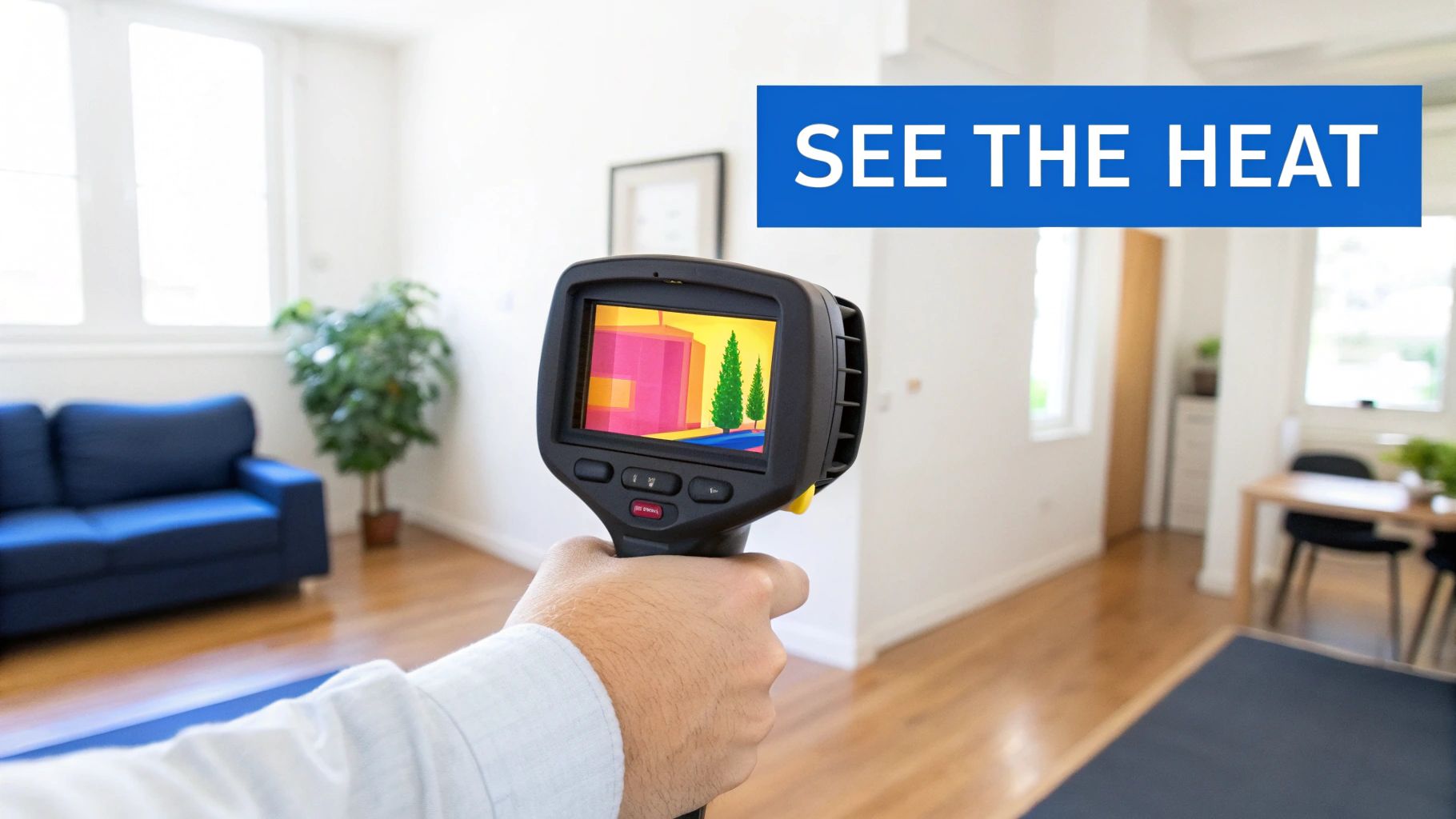
Think of it this way: every single surface in your home, from the drywall to the hardwood floors, gives off a certain amount of thermal energy. An infrared camera is designed to read that energy, not visible light. It then translates those readings into a visual map of different temperatures.
This whole process is completely safe and passive. The camera isn't blasting rays or anything like that; it's simply capturing the heat that’s already there. On the screen, warm areas show up as bright reds and oranges, while cooler spots appear as blues and purples.
Finding Problems Before They Get Out of Hand
So, how does this actually help find moisture? When building materials like wood or drywall get wet, the moisture starts to evaporate. This evaporation process has a cooling effect, creating a distinct cold spot that stands out like a sore thumb on the thermal image, even when the wall looks perfectly fine to the naked eye.
A certified inspector uses this thermal map to zero in on potential trouble zones. It allows us to investigate with surgical precision instead of making educated guesses and cutting into your walls. You can learn more about what thermal imaging is used for in our detailed guide.
A cold anomaly on a thermal scan doesn't automatically mean there's a disaster. It's a critical clue—a starting point that tells an experienced inspector exactly where to use a moisture meter to confirm the presence of water and determine the next steps.
This technology has quickly become a cornerstone of modern building inspections, especially for sniffing out the hidden moisture that fuels mold growth. The global market for infrared thermography hit USD 98.7 billion in 2024, and with North America making up 40% of that, it's clear how critical this tool has become for property maintenance. For more details, you can check out the full market research on infrared thermography.
What an Infrared Inspection Reveals in Your Home
For homeowners in coastal communities like Santa Barbara and Ventura, where humidity and ocean fog are a constant reality, this technology is invaluable. It helps uncover issues that would otherwise go unnoticed until you're dealing with serious damage or a major mold problem.
Here’s a quick look at some of the common issues an infrared camera can bring to light.
| Problem Area | What Infrared Sees | Why It Matters for Your Home |
|---|---|---|
| Hidden Leaks | Unexplained cold spots or streaks on ceilings, walls, or floors. | Pinpoints plumbing issues, roof leaks, or window failures before they cause structural rot or widespread mold. |
| Missing Insulation | Distinct cold patches on exterior walls or hot spots in the attic. | Identifies energy loss, which helps lower utility bills and improve indoor comfort. |
| Moisture Intrusion | Cool, damp areas around foundations, windows, and doors. | Catches water seeping into the building envelope, a primary cause of mold and decay. |
| HVAC Issues | Blockages in ductwork or air leaks around vents. | Ensures your heating and cooling systems are running efficiently and not contributing to moisture problems. |
By catching these problems early, you're not just fixing a small issue—you're preventing the kind of widespread damage that leads to massive repair bills and potential health concerns down the road.
The Complete Professional Mold Inspection Process
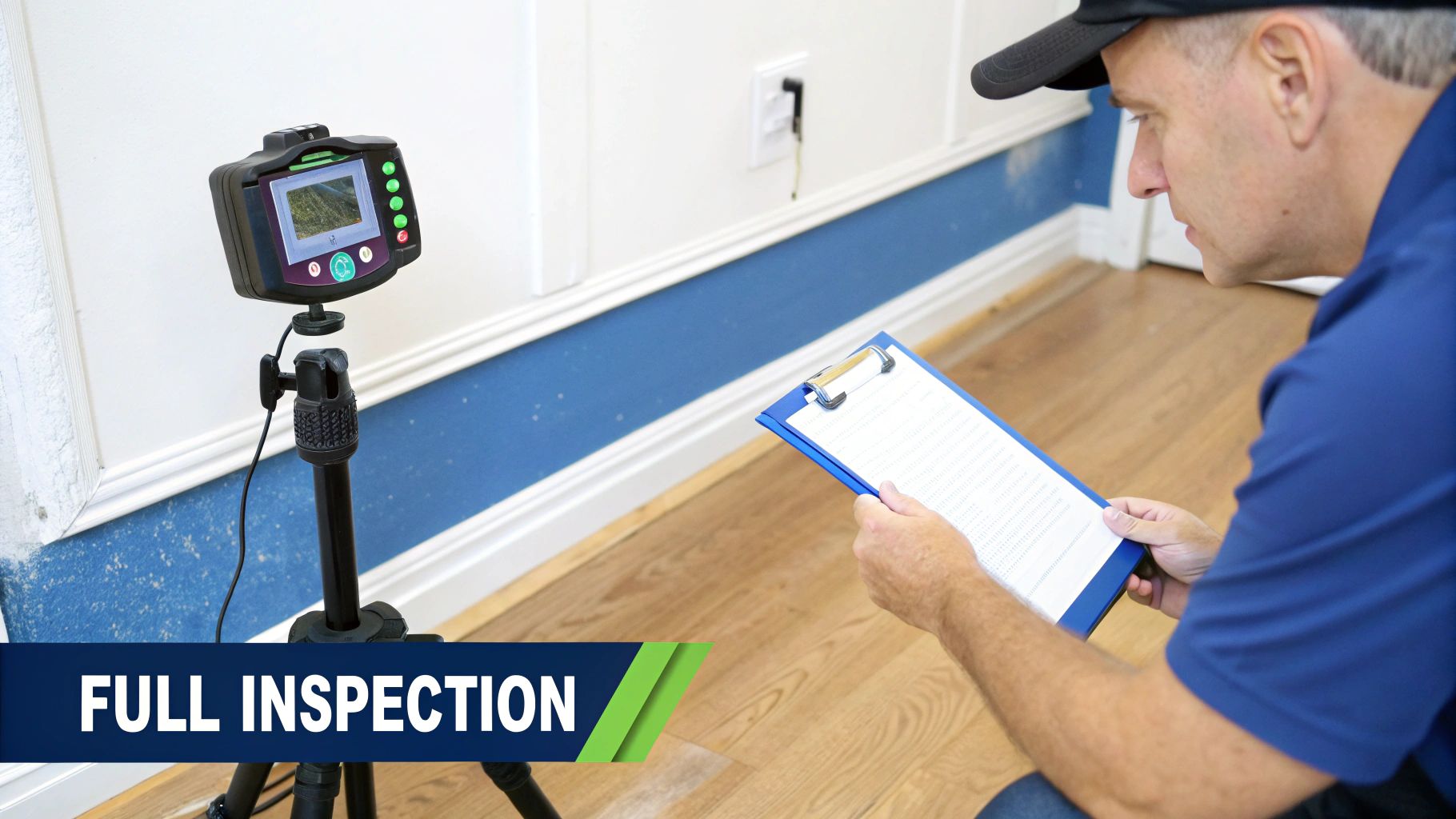
While an infrared camera is an incredible piece of technology, it’s just one instrument in our toolkit. A truly reliable mold inspection isn't just a quick scan; it's a systematic investigation designed to uncover the complete story of your home's health. Think of us as detectives piecing together clues—each step builds on the last to create a full, accurate picture.
Professional infrared thermography inspection services aren't a standalone trick. We integrate thermal imaging into a multi-stage process to ensure we not only find issues but also confirm, quantify, and correctly interpret them. It’s this methodical approach that separates a guess from a definitive answer.
Stage 1: The Initial Visual Assessment
Every inspection starts with the most important tool we have: our trained eyes. This isn’t just a casual walkthrough. Our certified professionals are actively hunting for the obvious signs of water damage and potential mold growth that don't require any special equipment.
This foundational step is crucial. It helps us identify known problem areas that demand a much closer look, setting the stage for the entire investigation.
What we're looking for:
- Visible Stains or Discoloration: Telltale water rings or dark spots on drywall, ceilings, and baseboards are major red flags.
- Surface Abnormalities: Things like peeling paint, bubbling wallpaper, or warped wood almost always point to moisture saturation behind the surface.
- Musty Odors: That distinct earthy or damp smell is often the very first clue that mold is hiding somewhere nearby.
Stage 2: Advanced Moisture Mapping
After the visual check, we move into the confirmation phase with moisture mapping. This is where we bring in specialized tools to verify our suspicions. Using professional-grade moisture meters, we take direct readings from any surfaces that looked questionable during the initial assessment.
These devices give us hard data, telling us whether a suspicious stain is actively damp or just a ghost from a past, resolved leak. This helps us distinguish between old issues and current problems that need immediate attention.
Stage 3: Targeted Thermal Imaging
With a baseline established from the first two stages, we now bring out the infrared camera. This is the search phase—where we look for the unseen. The thermal imager scans large areas quickly, revealing subtle temperature differences that the naked eye would completely miss.
We don't just scan the entire house randomly. We use the clues gathered so far to focus the search. For example, if there's a musty odor in a bathroom but no visible leaks, we'll use the thermal camera to scan the walls around the shower, toilet, and vanity for hidden cold spots indicating trapped moisture.
A thermal camera doesn't "see" mold. It sees the subtle temperature differences caused by moisture—the essential ingredient mold needs to grow. This allows an inspector to pinpoint potential hidden water sources with incredible accuracy, guiding the investigation without needless destruction.
Stage 4: Strategic Air and Surface Sampling
This final step is only taken when we have a clear, data-backed reason to do so. If the visual inspection, moisture mapping, and thermal imaging all point to a likely area of hidden mold, sampling provides the definitive proof. It's a targeted, strategic move, not a random guess.
- Air Sampling: This tells us the concentration and types of mold spores in the air you're breathing, which we compare to an outdoor baseline sample.
- Surface Sampling: If we find what looks like visible growth, a swab or tape lift can be sent to a certified lab to identify the specific mold species.
By combining these four stages, a professional inspection leaves no stone unturned. We move from broad observation to specific, data-driven conclusions, giving you a complete and trustworthy assessment of your property. You can explore a more detailed breakdown in our guide to the professional mold inspection process.
Why Thermal Imaging Is a Game Changer for Coastal Homes
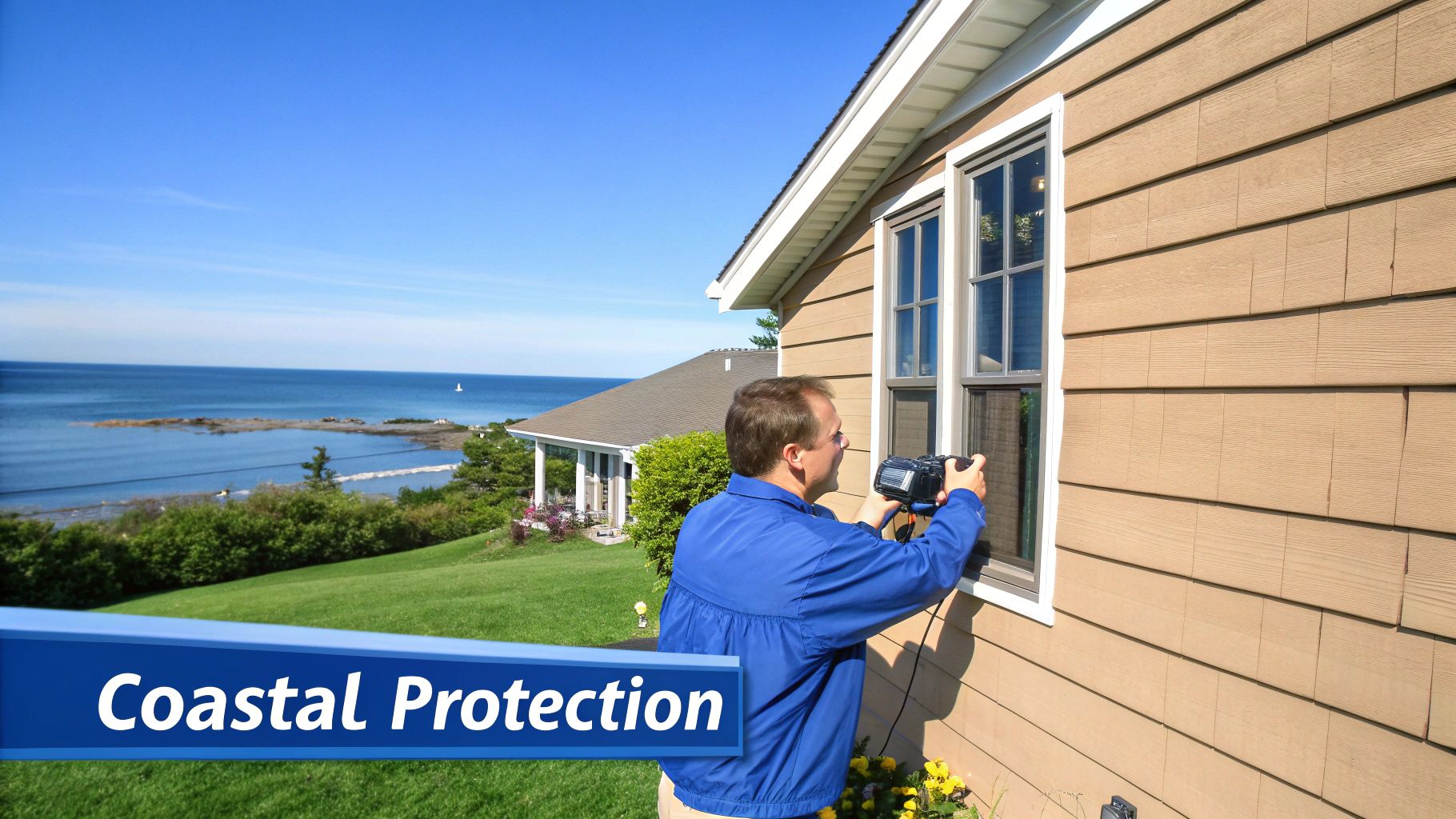
Living in beautiful coastal communities like Santa Barbara and Ventura is incredible. We get the ocean breeze, the marine layer, and the foggy mornings. But that same climate means our homes are in a constant battle with moisture. All that humidity creates the perfect breeding ground for water to sneak in and mold to take hold, often completely out of sight.
This is where infrared thermography inspection services aren't just a nice-to-have—they're essential. A traditional inspection might only spot damage after it’s become visible, but by then, the problem has likely been festering for months or even years. Thermal imaging lets us see the invisible signs of moisture before it can cause real destruction.
See Behind Your Walls—Without Making a Single Hole
Every homeowner dreads the thought of cutting into drywall just to chase down a musty smell or investigate a faint stain. It feels destructive and it's a total guessing game.
Infrared thermography takes all that guesswork out of the equation. It allows an inspector to scan entire walls, ceilings, and floors quickly and non-destructively. Imagine a slow leak behind your shower wall. To your eyes, everything looks perfect. But a thermal camera instantly sees the cold spot where moisture is evaporating, pointing us directly to the source. It’s a targeted approach that means less mess, lower repair bills, and a much faster solution.
Catch Problems Early and Avoid Major Damage
Water damage rarely happens all at once. It usually starts small—a tiny drip, a minor crack in a seal—and slowly saturates the surrounding wood and drywall. Leave it alone, and you’re looking at wood rot, structural issues, and a serious mold problem.
Think of infrared technology as your home's early warning system. We can spot moisture before it becomes a crisis, letting you fix the root cause while it’s still a small, manageable repair.
Just think about these common coastal scenarios:
- Leaky Windows: That salty marine air is tough on window seals, eventually letting moisture seep into the wall cavity during a storm or heavy fog.
- Roof Leaks: Vents, skylights, and flashing are all weak spots where persistent dampness can find a way into your attic.
- Hidden Plumbing Drips: A slow leak from a pipe inside a wall or under the floor can go unnoticed for years, creating a hidden reservoir for mold growth.
A thermal scan can find all these issues in their earliest stages, potentially saving you thousands of dollars in remediation and repairs down the road.
In high-humidity areas like ours, infrared thermography is an indispensable tool. It gives you objective, visual proof of hidden moisture, turning uncertainty into a clear, actionable plan to protect your home and your family's health.
It's no surprise this technology is becoming an industry standard. For tricky areas like attics and crawl spaces, studies show thermography can detect leaks with 90% more accuracy than a simple visual inspection. That's a huge difference when it comes to preventing mold that can trigger allergies and other health issues. If you're interested in the data, you can explore the full research on the infrared thermography market.
Get Peace of Mind During Real Estate Deals
Uncertainty is the biggest enemy in any real estate transaction. Buyers need to know what they’re getting into, and sellers want to prove their home is in great shape.
An infrared inspection provides hard data that puts everyone on the same page. For a buyer, it can uncover hidden problems before you sign on the dotted line. For a seller, it provides documented proof of a well-maintained home or gives you a chance to fix issues proactively.
Of course, inspections are just one piece of the puzzle. It's also critical to know how to reduce humidity in your house day-to-day. Combining those good habits with professional diagnostics gives you the best possible defense against moisture in our unique Southern California climate.
Understanding Thermography's Limits and Misconceptions
While an infrared camera is an incredible piece of technology, it’s crucial to be realistic about what it can—and cannot—do. At the end of the day, the tool is only as good as the expert operating it. We believe in being upfront about the limits of an infrared thermography inspection service so you know exactly what you’re getting and can trust the results.
One of the biggest myths we hear is that a thermal camera can "see" mold. That's simply not true. An infrared camera is designed to detect temperature, not fungus. Its real power is in spotting the tiny temperature differences caused by moisture—the one thing mold absolutely needs to grow.
Think of it as a high-tech detective, sniffing out clues and pointing us in the right direction. It builds a roadmap to potential problem spots, but it doesn't give us the final diagnosis all on its own.
Debunking Common Myths About Thermal Imaging
Another common misunderstanding is that thermal cameras can see through walls. They can’t. What they actually do is read the surface temperature of the wall itself. If there’s a cold water leak or a patch of missing insulation inside that wall, it will eventually make the surface of the drywall colder. That’s the temperature drop the camera picks up.
This is a really important distinction because it means other things can affect the scan, too:
- Surface Materials: Shiny surfaces like glass or polished metal can reflect thermal energy, throwing off the readings if the inspector doesn’t know how to properly adjust for them.
- Recent Weather: A wall that’s been baking in the sun all afternoon might temporarily hide a cold spot from a leak. A good inspector knows to let things stabilize for a more accurate picture.
- Airflow and Drafts: A cold draft from a window or an HVAC vent can easily create a cold spot on a wall that has absolutely nothing to do with moisture.
This is exactly why a professional’s eye is non-negotiable. Anyone can go out and buy a thermal camera, but it takes a certified and experienced technician to correctly interpret the images within the context of the entire building.
A cold spot on a thermal scan isn’t a reason to panic. It’s simply a data point that tells us, "Dig here." A true professional will always follow up with a moisture meter to confirm if water is actually present and figure out how serious the situation is.
The Inspector Is More Important Than the Camera
Ultimately, the most critical part of an infrared inspection isn't the camera—it's the person holding it. A skilled inspector understands how to set up the right conditions for an accurate scan, tell the difference between a real moisture problem and a false positive, and use other tools to verify every finding.
They weave together the thermal data with visual clues, moisture meter readings, and a deep understanding of how buildings are put together. Without that expertise, a thermal image is just a pretty, colorful picture. In fact, learning how to read moisture meter readings is one of the most vital skills we use, as it turns a thermal suspicion into a confirmed fact.
By understanding these limitations, you can see the real value of a professional inspection. It’s not about some magic camera; it’s about a systematic investigation that uses advanced tech to give you reliable, straightforward answers about the health of your home.
What to Expect from Your Infrared Inspection Report
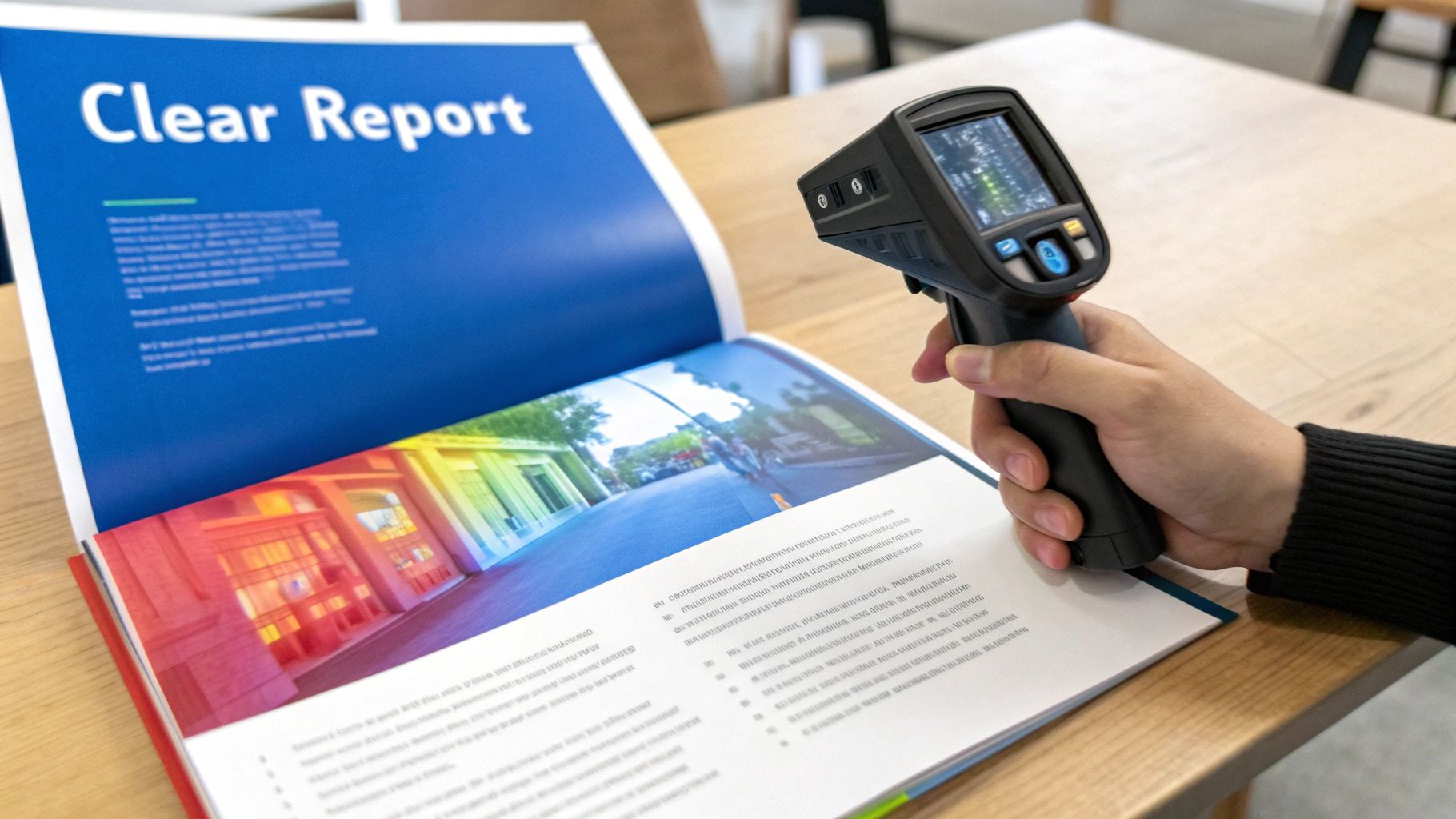
Once the fieldwork is done, the final report is where everything comes together. This isn't just a stack of colorful pictures; a quality report from a professional infrared thermography inspection service is your roadmap. It translates all that high-tech thermal data into a simple, clear guide to protecting your home.
You shouldn’t be left scratching your head over confusing jargon or technical charts. The whole point is to give you a document that’s easy to understand and empowers you to make smart decisions. This is the final, crucial step in turning a complex investigation into a practical solution for your property.
Key Components of a Comprehensive Report
A trustworthy report will always show you the evidence side-by-side, making it easy to connect the dots. You won't just see a thermal image in isolation; you’ll see exactly how it lines up with the real-world conditions in your home. This approach keeps things totally transparent and helps you understand precisely what was found and where.
Your report should always include:
- High-Resolution Thermal and Digital Photos: For every single area of concern, you should get a thermal image placed right next to a standard digital photo. This comparison lets you see both the heat anomaly and the normal view at the same time.
- Clear Interpretation of Findings: The report needs to explain what each thermal image actually means in plain English. For example, it should clarify whether a cold spot is likely due to moisture, missing insulation, or just a simple air leak.
- Confirmed Moisture Meter Readings: This is non-negotiable. For any spot the thermal camera flags as potentially wet, there must be a corresponding moisture meter reading to confirm the presence of water and measure how saturated the material is.
The report is the official record of your home's condition. It serves as documented proof that transforms suspicions into confirmed facts, providing the objective evidence needed for real estate negotiations, insurance claims, or planning a remediation strategy.
From Data to Actionable Next Steps
The most important part of the whole document is the final summary. This section pulls all the findings together into a clear conclusion and lays out concrete, actionable next steps. It will prioritize the issues, explain the potential risks, and recommend a clear course of action, whether that's calling a plumber for more evaluation or moving straight to remediation.
The role of infrared thermography inspection services has become a vital preventive tool, especially in a market where hidden mold can tank property values. The market for thermal components is even projected to hit $15.2 billion by 2036—a testament to how critical this technology has become for ensuring healthier homes and making confident decisions quickly. You can read more about the growth of the infrared thermography market if you're curious.
Ultimately, you'll walk away with a guide that puts you in control, armed with the knowledge to restore or protect your home’s health for good.
Choosing the Right Inspection Service in Santa Barbara
When you're dealing with a potential mold or moisture problem, picking the right professional is easily the most important decision you'll make. The technology is impressive, but an infrared thermography inspection service is only as good as the expert interpreting what the camera sees. Handing a thermal camera to an untrained inspector is like giving a scalpel to someone who’s never been to medical school—the tool itself doesn’t guarantee a successful outcome.
Your mission is to find a partner who doesn't just own fancy equipment, but who combines it with deep local knowledge and a methodical, multi-step process. Here’s what to look for to find a trustworthy pro in Santa Barbara or Ventura County.
Vet Their Certifications and Training
First things first, don't be shy about asking for credentials. A true professional will be proud to show you their certifications. You're looking for proof of training from respected, third-party organizations that demand tough exams, ongoing education, and a strict code of ethics.
Key credentials to keep an eye out for include:
- IICRC (Institute of Inspection, Cleaning and Restoration Certification): This is the gold standard for the inspection and restoration world. It’s a big deal.
- InterNACHI (International Association of Certified Home Inspectors): They offer specific thermography certifications that prove an inspector genuinely understands the science behind the lens.
These credentials aren't just pieces of paper; they're your assurance that the inspector can tell the difference between a real moisture issue and a false positive, like a cold air draft or a simple stud in the wall.
Confirm They Use High-Quality Equipment
Not all thermal cameras are created equal. Those little attachments for smartphones are neat gadgets for hobbyists, but they simply don't have the muscle for a professional building inspection. A serious company invests thousands of dollars into high-resolution thermal imagers for a reason.
An experienced thermographer with a top-tier camera can detect temperature differences as small as 0.01°C. This level of precision is exactly what's needed to catch subtle moisture problems before they turn into disasters, giving you the clear evidence you need to protect your property.
Ask what kind of camera they use. An inspector who is serious about accuracy will be using a professional-grade tool from a brand like FLIR or Fluke. That investment speaks volumes about their commitment to giving you reliable results.
Ensure They Offer a Comprehensive Process
Finally, remember that a thermal camera is just one tool in the toolbox. A trustworthy inspector will never rely on thermal images alone. Their process should be a complete investigation that includes a thorough visual assessment, confirmation with moisture meters, and, when necessary, targeted sampling.
This methodical approach ensures every clue is cross-verified, giving you a complete and accurate picture of your home’s health. When you're talking to local companies, make sure you understand their entire game plan. To see how these pieces should fit together, you can learn about our mold testing process in Santa Barbara.
By choosing a certified, well-equipped, and thorough professional, you’re not just hiring an inspector—you’re making a confident choice to protect your investment and your family’s well-being.
Of course. Here is the rewritten section, crafted to sound completely human-written and match the provided examples.
Your Infrared Inspection Questions, Answered
Even after getting the rundown on the tech, it's natural to have a few practical questions. Homeowners in Santa Barbara and Ventura ask us about the same things all the time, so we’ve put together some straightforward answers to help you feel confident and prepared.
Think of this as the quick guide to everything you need to know before we arrive.
How Much Does an Infrared Inspection Cost?
The honest answer? It depends. The final price tag for a professional infrared inspection is based on a few key things, like the size of your property, how complex the layout is, and what specific concerns you need us to investigate.
But it’s important to see it as an investment, not just a cost. Finding a hidden leak or a pocket of moisture early can literally save you thousands—sometimes tens of thousands—of dollars down the road in mold removal, structural repairs, and replacing drywall. The best move is to give a local expert like Pacific Mold Pros a call for a quote that’s actually tailored to your home.
Can an Infrared Camera See Mold Directly?
This is probably the most important question we get, and the answer is a simple no. An infrared camera can't see mold. Mold is a microscopic fungus, and the camera is built to see heat energy, not tiny living organisms.
What it does see is the one thing mold absolutely needs to grow: moisture.
Think of an infrared camera as the ultimate moisture detective. It pinpoints the subtle cold spots created by evaporating water hidden inside your walls, ceilings, and floors. By finding the moisture, we find the exact spots where mold is most likely growing, even if the surface looks perfectly fine.
It takes the guesswork out of the equation and turns our search into a precise, evidence-based process.
How Should I Prepare My Home for the Inspection?
A little prep work can make a huge difference in getting the most accurate results from an infrared scan. The main goal is to create a stable indoor environment so that temperature differences caused by moisture really stand out.
Here are a few easy steps to take before your inspector shows up:
- Close Windows and Doors: For at least a few hours beforehand, keep the house sealed up. This helps stabilize the indoor temperature and pressure, cutting down on drafts that could create false cold spots.
- Keep Your HVAC Normal: Don't crank the heat or AC way up or down. Just leave your thermostat at its usual setting. This helps create the temperature difference we need for an effective scan.
- Clear Key Areas: If you have a specific spot you're worried about—like a wall with a weird smell—please make sure we can get to it easily. Moving furniture a foot or two away from the wall is a huge help.
Is Infrared Thermography Safe for My Family and Pets?
Yes, it is 100% safe for everyone in your house—kids, pets, and pregnant individuals included. This is one of the biggest benefits of this technology.
The infrared camera is a totally passive device. It doesn’t shoot out any radiation, waves, or energy of any kind. It works just like a regular camera, but instead of capturing visible light, it captures the heat (thermal energy) that’s already radiating from every surface in your home. There’s no physical contact or emissions, making it one of the safest diagnostic tools you can use in a home.