When you're dealing with mold, the best air purifiers need two non-negotiable features: a True HEPA filter to capture those microscopic spores and a strong Clean Air Delivery Rate (CADR) that’s right for your room. You'll want a unit that can cycle the air in the room at least four times an hour (4 ACH) to really make a dent in airborne spore counts.
Why Generic Air Purifiers Fail Against Mold
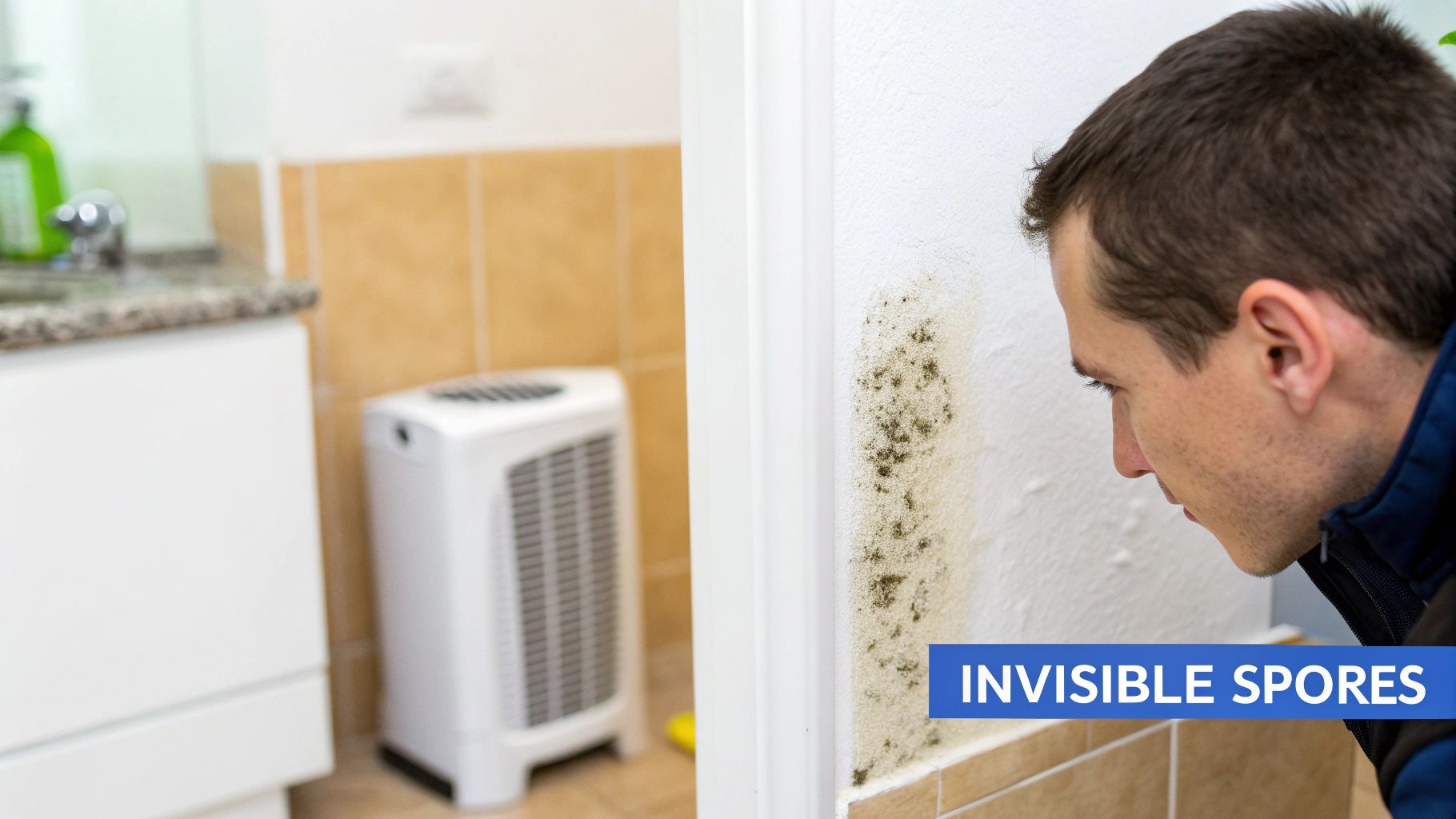
It’s one thing to see a dark patch of mold spreading on a wall, but the real threat to your health is often the one you can’t see. Long before mold becomes visible, it releases millions of microscopic spores into the air, triggering everything from allergies and asthma to more serious respiratory problems.
A lot of homeowners grab a standard air purifier off the shelf, thinking it will solve the problem. That’s an understandable, but often costly, mistake. Mold is a unique beast, and it demands a much more targeted approach than what your average air purifier can offer.
The Problem with Undersized Filters and Low Power
The biggest reason most standard air purifiers just don't cut it is that their filters can’t handle something as tiny and persistent as a mold spore. Spores typically range from 1 to 20 microns in size—incredibly small. They'll sail right through a basic "HEPA-type" or washable filter that might catch bigger dust bunnies. Those spores get shot right back out into the room you're trying to clean.
On top of that, many budget-friendly units just don't have the fan power to move enough air. They might clean a small bubble of air right around the machine, but they won't create the airflow needed to pull in contaminants from across the room. This leaves pockets of spore-filled air hanging out in corners, behind the couch, and near the very moisture sources where mold loves to grow.
An air purifier is just one piece of the puzzle. It helps manage airborne spores, but it can’t stop the source of the growth. Getting humidity under control is the single most important step in preventing mold from taking over.
Mold Requires More Than Just Particle Capture
Another thing to remember is that mold is a living organism. When its spores get trapped on a filter—a dark, potentially damp environment inside an air purifier—they can actually start to grow again if the conditions are right. A smart strategy for choosing the best air purifiers for mold spores means picking a unit that not only traps them but also makes sure they don't become a new colony inside the machine. This is where more advanced features, which we’ll get into later, become really important.
At the end of the day, an air purifier is a tool for managing a symptom (airborne spores), not the root cause. Mold growth is always tied to moisture. Getting a handle on your home's humidity levels is the foundation of any real solution. To get a better grasp on this, check out our guide on at what humidity does mold grow. It will give you the insight you need to choose the right purifier as part of a complete mold management plan.
What’s Inside? A Deep Dive Into Air Purifier Technology
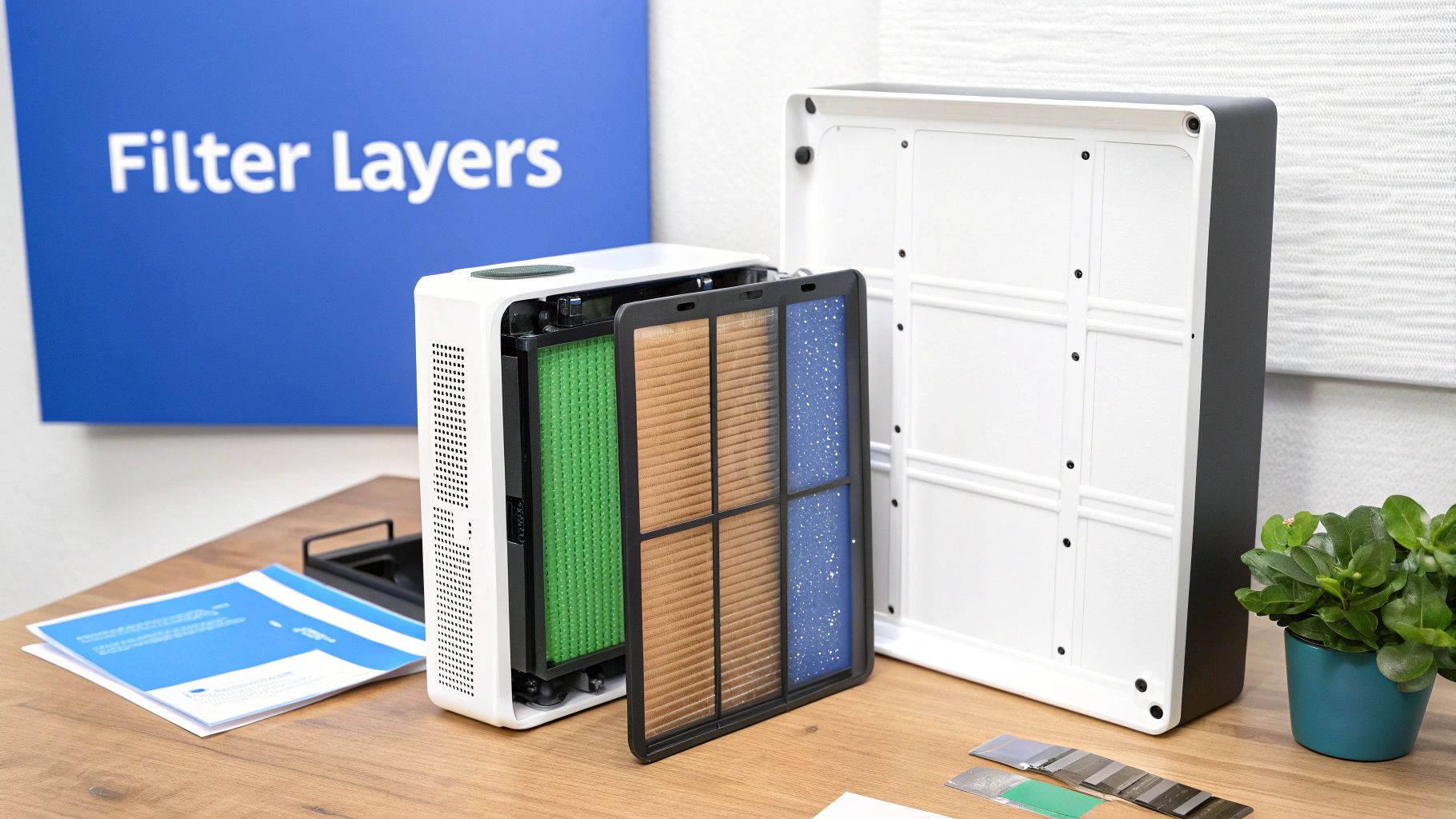
When it comes to getting rid of mold spores, the technology inside an air purifier is what really counts. Not all filters are designed the same, and knowing what’s under the hood helps you separate a machine that truly cleans your air from one that just pushes it around.
The internal workings of the best air purifiers for mold spores are designed to capture microscopic threats you can't even see. We'll break down the three most common technologies—True HEPA filtration, activated carbon, and UV-C light—to see how they work on their own and, more importantly, together.
This will help you figure out which features are mission-critical for your home, whether you're trying to get rid of a musty basement smell or need a serious defense against airborne allergens. An informed choice starts right here.
The Gold Standard: True HEPA Filtration
At the heart of any air purifier worth its salt is the primary filter. True HEPA (High-Efficiency Particulate Air) filters are the absolute non-negotiable for capturing mold spores. Why? Because they’re incredibly dense and work by physically trapping particles.
A True HEPA filter is a tangled web of tiny glass fibers that creates a physical barrier. As air is forced through this maze, particles get caught through interception, impaction, or diffusion. It’s a purely mechanical process, which is great because it doesn't create any harmful byproducts like ozone.
This is what makes them the gold standard. A genuine True HEPA filter will trap 99.97% of particles as small as 0.3 microns. Since most mold spores fall between 1 to 20 microns, they don't stand a chance. Some advanced systems even take it a step further. Blueair's HEPASilent™ technology, for example, uses both mechanical and electrostatic filtration to snag 99.97% of particles down to an even tinier 0.1 microns. Independent tests back this up, showing a minimum 99.9% reduction of common mold allergens in just 60 minutes.
For Musty Odors: Activated Carbon
While a HEPA filter is a rockstar at capturing solid particles like spores, it won't do a thing about the smells they create. That distinct, musty odor is caused by Microbial Volatile Organic Compounds (MVOCs)—gases that mold releases as it grows.
This is where an activated carbon filter becomes your best friend. Activated carbon is specially treated to create millions of tiny pores, which gives it a massive surface area to trap gas and odor molecules through a process called adsorption.
Think of it as a sponge for smells. As MVOCs and other fumes pass through, they get stuck in this porous structure, leaving cleaner, fresher-smelling air to pass through.
A layered approach is always best. A unit with only a HEPA filter will leave behind the musty smell, while a unit with only a carbon filter won't capture the spores themselves. The combination provides a complete solution.
For Neutralizing Germs: UV-C Light
The third layer of defense you’ll find in some of the best air purifiers is UV-C (Ultraviolet-C) light. This technology adds a germ-killing function, designed to neutralize the microorganisms that get trapped in the HEPA filter.
UV-C light works by scrambling the DNA of things like mold spores, bacteria, and viruses. By disrupting their genetic code, it stops them from reproducing, which effectively kills them.
But here’s the catch: its effectiveness really depends on two things—exposure time and intensity. Spores need to be exposed to a strong enough UV-C light for long enough to be neutralized. In a machine where air is moving quickly, this can be a real challenge, which is why its role is often seen as secondary to a top-tier HEPA filter.
Comparing Air Purification Technologies for Mold Control
So, how do these technologies stack up when your goal is to get rid of mold? Each one plays a distinct role, and the best purifiers use them in combination to tackle both the spores and their smelly byproducts. Here’s a quick breakdown.
| Technology | Primary Function | Effectiveness on Mold Spores | Best Use Case |
|---|---|---|---|
| True HEPA Filter | Physically traps airborne particles | Excellent. Captures over 99.97% of spores. | Essential for all situations involving mold. |
| Activated Carbon | Adsorbs gases, chemicals, and odors | Poor. Does not capture spores but eliminates musty smells. | Paired with HEPA to address mold-related odors. |
| UV-C Light | Neutralizes microorganisms | Moderate. Can kill trapped spores with enough exposure. | As a supplemental feature to prevent growth on the filter. |
Ultimately, an air purifier is just one piece of the puzzle. It’s a powerful tool in a larger strategy for improving indoor air quality in your home. By understanding these core technologies, you’re in a much better position to pick a unit that can handle both the physical spores and the unpleasant odors they leave behind.
Decoding CADR and ACH for Effective Mold Removal
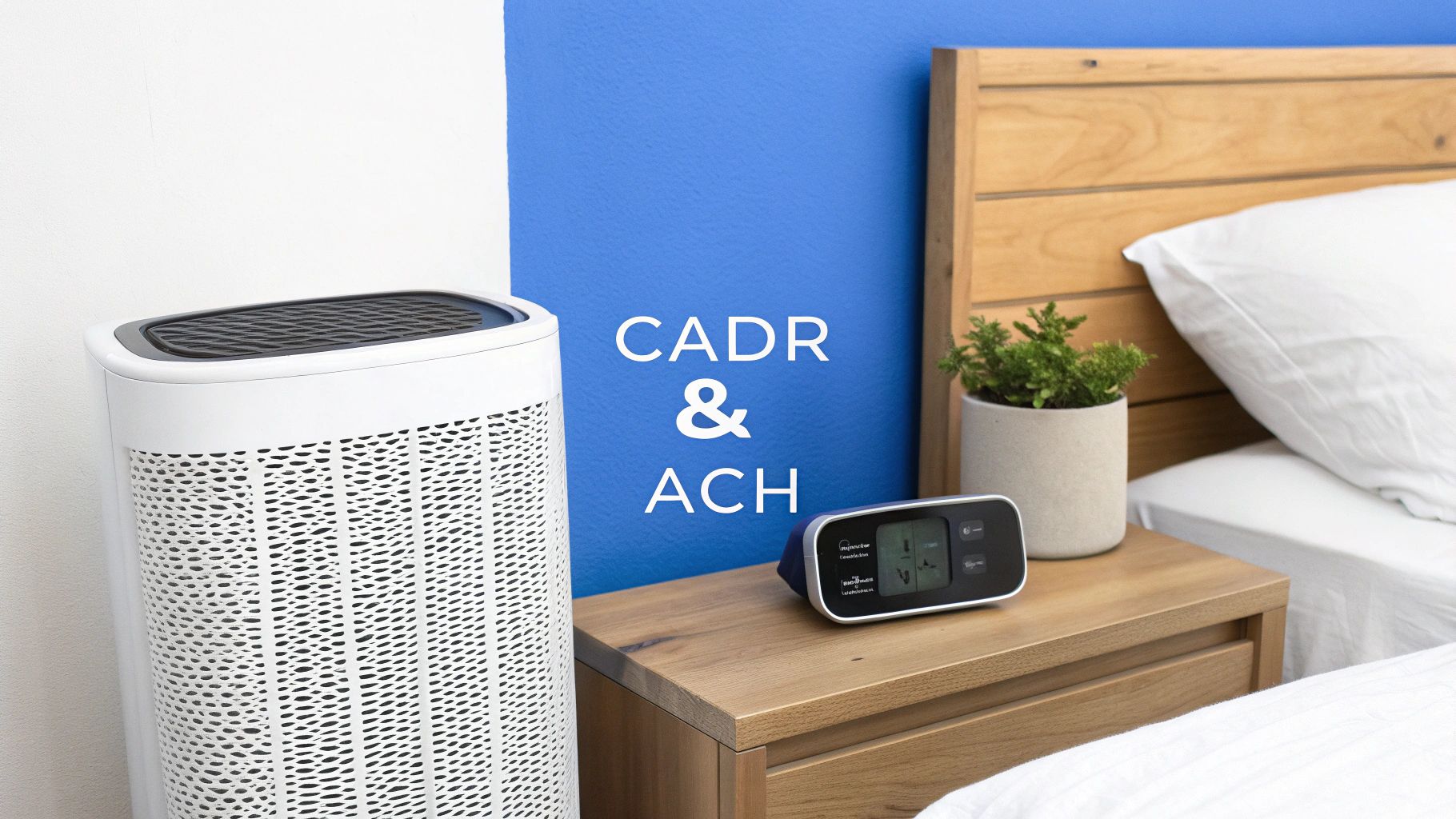
Stepping into the world of air purifiers means coming face-to-face with a wall of technical jargon. Two of the most important—and often misunderstood—metrics are CADR and ACH. Getting these right is the key to unlocking an air purifier’s true potential and making sure it has the muscle to tackle a persistent threat like mold.
Think of it like this: CADR is the raw horsepower, while ACH is the performance over time. Without knowing what they mean for your specific room, you’re essentially buying blind.
What Is CADR and How Does It Affect Mold Removal?
The Clean Air Delivery Rate (CADR) is a standardized metric that tells you the volume of filtered air an air purifier can deliver. Developed by the Association of Home Appliance Manufacturers (AHAM), it measures how quickly a unit can clean a room of specific pollutants like smoke, dust, and pollen, all in cubic feet per minute (CFM).
For mold spores, which are similar in size to pollen, the pollen CADR rating is the number you want to focus on. A higher CADR means the purifier can process more air, grabbing those spores before they have a chance to land and settle.
A handy guideline for matching CADR to your space is the "Two-Thirds Rule." This simple rule suggests that your air purifier's pollen CADR rating should be at least two-thirds of your room's square footage.
- For a 150-square-foot bedroom, you'll want a purifier with a CADR of at least 100 (150 x 2/3).
- For a larger 300-square-foot living room, you should look for a CADR of at least 200 (300 x 2/3).
Following this calculation ensures your unit has enough power to effectively circulate and clean all the air in the room. It’s a crucial first step in finding the best air purifiers for mold spores.
Why ACH Is the Most Critical Metric for Mold Control
While CADR measures raw power, Air Changes per Hour (ACH) tells you how frequently the purifier can cycle through all the air in a room. When you're dealing with a chronic issue like mold, which constantly releases new spores, this metric is arguably even more important. A low ACH means spores can build up faster than your purifier can remove them.
While an ACH of 2-3 might be fine for general air quality, it's not enough for a mold-prone environment. For mold, you need to aim for an ACH of at least 4-5. This ensures the air is completely scrubbed every 12 to 15 minutes, drastically reducing the concentration of spores in the air.
This is especially critical in damp, poorly ventilated areas where mold loves to grow—think basements, bathrooms, or crawl spaces. A high ACH in these zones keeps the air in constant motion, pulling spores out of the atmosphere almost as soon as they’re released. For these high-risk spaces, you really want to aim for 4-6 ACH. Combined with a solid CADR (over 200 for a 300 sq ft room), you've got a powerful combination for mold control.
Putting It All Together for Your Home
So, how do you balance CADR and ACH? First, measure your room's square footage. Use the Two-Thirds Rule to figure out your minimum CADR. Then, check the manufacturer's specs to see what ACH that unit provides for your specific room size.
If you find a purifier with a great CADR but it only delivers 2 ACH for your space, it’s not the right fit for tackling mold. You'll likely need a more powerful unit—or even multiple smaller ones—to get the air exchange rate you need. Making a smart choice based on these numbers is fundamental, but it's just one part of a bigger strategy. For a deeper look into your home's unique environment, consider professional indoor air quality inspections to identify hidden problem areas.
A Head-to-Head Comparison of Top Mold Air Purifiers
Choosing the right air purifier for mold isn’t just about comparing spec sheets. It's about matching the right machine to a real-world situation. A purifier that’s a rockstar in a dry, dusty living room might completely flop in a damp, musty basement.
To help you sort through the noise, we're putting some of the leading models to the test in the exact situations you're likely facing. We’ll go beyond simple feature lists to show you how each unit’s unique blend of power, filtration, and special features makes it a winner for a specific job. Whether you need something whisper-quiet for a bedroom or raw power for a serious moisture problem, this breakdown will point you in the right direction.
Best for Damp Basements and Problem Areas: Levoit Core 600S
Damp basements are basically ground zero for mold. They demand an air purifier with some serious muscle. In these tough spots, high humidity and a constant release of spores require a machine that can move a massive amount of air—fast and without quitting.
The Levoit Core 600S is the clear champ for these challenging spaces. Its biggest advantage is its raw power, boasting an impressive Clean Air Delivery Rate (CADR) of 398 CFM for dust. That kind of horsepower lets it cycle the air more than four times an hour in rooms up to 560 sq. ft., easily keeping up with the relentless spore production you find in most basements.
Its all-plastic body is another practical win here, as it’s simple to wipe down and won’t get damaged by moisture. Sure, it can get loud on its highest setting (over 62 dBA), but that’s rarely a deal-breaker in an unfinished basement where you just need the job done.
Quietest Operation for Bedrooms: Blueair Blue Pure 311i Max
Bedrooms are a different game entirely. You need aggressive mold spore removal for healthy sleep, but you can’t have a jet engine roaring in the corner. The perfect bedroom unit has to be a quiet workhorse.
This is exactly where the Blueair Blue Pure 311i Max shines. It was practically engineered for this scenario, delivering clean air without all the racket. On its medium settings, it’s almost silent—clocking in under 40 dBA—while still moving enough air for a standard-sized bedroom.
The secret sauce is Blueair’s HEPASilent™ technology. This system uses a combination of standard mechanical filtration and electrostatic charging. That charge makes airborne particles like mold spores cling to the filter fibers more effectively. This two-pronged attack allows the fan to run at a much lower speed without sacrificing performance, making it one of the quietest and most effective purifiers for places you sleep.
Key Differentiator: A lot of purifiers make you choose between high power and low noise. Blueair’s technology hits that perfect sweet spot. The electrostatic charge boosts filtration efficiency, which means the fan doesn't have to work as hard—a huge plus for light sleepers worried about airborne mold.
Best Value for Whole-Home Coverage: Winix 5500-2
If you're looking to clean the air in a large living room or an open-concept space without draining your wallet, the Winix 5500-2 offers a killer combination of performance and value. It's been a top performer for years, and for good reason—it delivers results that often match much pricier models.
In independent tests, the Winix 5500-2 captures over 99% of smoke particles in 30 minutes, which is a great indicator of its powerful fan and effective True HEPA filter. That's more than enough power to handle mold spores floating around in a high-traffic great room.
The main trade-off? Its design is more functional than fashionable, and it's missing the fancy smart features of newer competitors. But if your main goal is pure, no-frills air cleaning power for a big area at a great price, the Winix 5500-2 is still tough to beat.
Understanding Advanced Filtration Features
Beyond a standard HEPA filter, some of the best air purifiers for mold spores include extra tech like UV-C light or electrostatic systems to get an edge. For example, the GermGuardian AC4825 adds a UV-C bulb to its True HEPA filter to help neutralize captured spores. But here's the catch: for UV light to actually work, spores need to be exposed to it for a while, which is hard to achieve when air is zipping through the unit.
On the other hand, Blueair's HEPASilent™ technology electrostatically charges particles to make them "stickier," improving the capture rate and resulting in 45% more clean air with 67% less noise. While these features sound great, the EPA has warned that UVGI might not be effective against all mold types without prolonged exposure, making robust mechanical filtration the more reliable choice. It's also critical to avoid any purifier that produces ozone, which is a known lung irritant. For a deeper dive into these features, check out this comprehensive air purifier buying guide.
Head-to-Head Feature Breakdown
To make things even clearer, let's stack these contenders up against each other based on what matters most for mold removal. This table really shows how each unit's strengths line up with different needs.
| Feature | Levoit Core 600S | Blueair Blue Pure 311i Max | Winix 5500-2 |
|---|---|---|---|
| Best For | Damp Basements, Large Spaces | Bedrooms, Quiet Environments | Value, Large Living Areas |
| Key Strength | Maximum Airflow (High CADR) | Whisper-Quiet Operation | Proven Performance for Price |
| Noise Level (High) | Loud (~62 dBA) | Moderate (~50 dBA) | Loud (~55 dBA) |
| Filtration Tech | True HEPA, Activated Carbon | HEPASilent™ Technology | True HEPA, PlasmaWave |
| Smart Features | Yes (VeSync App) | Yes (Blueair App) | No |
At the end of the day, choosing the right air purifier is about knowing your main problem—whether it's a high-moisture area, the need for silence, or covering a large space on a budget. When you match a machine's specific strengths to your home's needs, you'll end up with a purifier that makes a real difference.
Strategic Placement and Maintenance for Maximum Impact
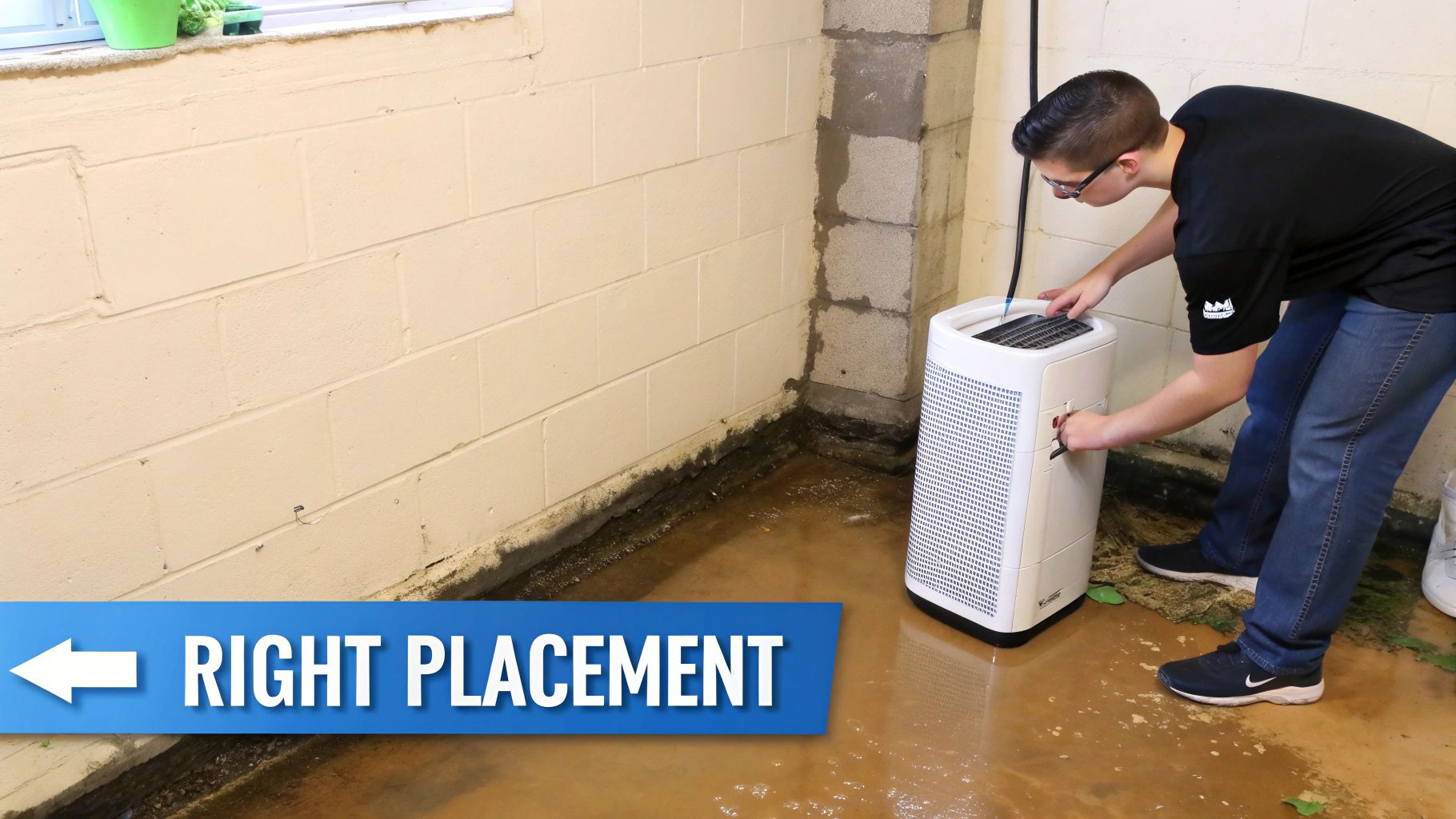
So, you’ve invested in one of the best air purifiers for mold spores. That's a huge step forward. But its real power isn’t just in the box—it’s in where you put it and how well you take care of it. Just plugging it into the nearest outlet won't cut it. To get the results you're after, you need a little strategy.
Think like a mold spore for a second. They originate in damp areas and then hitch a ride on natural air currents. Placing your purifier right at the source—near a musty basement corner, under a sink with a slow drip, or in a steamy, poorly-ventilated bathroom—lets you intercept those spores before they ever get a chance to spread.
Optimizing Airflow and Placement
Proper placement is all about airflow. You need to give your purifier an unobstructed path to draw in contaminated air and push out clean air. Anything that gets in the way of its intake and exhaust vents is just kneecapping its performance.
Keep these simple rules in mind for the best results:
- Give It Space: Always position your unit at least a foot away from walls, furniture, and even curtains. That clearance is non-negotiable for creating the circulation needed to clean the entire room.
- Target Problem Zones: Put the purifier right in the room where you know you have a moisture or mold problem. Basements, laundry rooms, and bathrooms are the usual suspects.
- Elevate If Possible: In rooms cluttered with low furniture, popping the unit on a small, sturdy table can sometimes give it a circulation boost.
Whatever you do, don't tuck your air purifier behind the sofa or shove it into a tight corner. It might look tidier, but you’re essentially crippling its ability to do its job, leaving huge pockets of your room completely untreated.
Your air purifier is designed to run continuously. Mold doesn't operate on a 9-to-5 schedule, and neither should your purifier. Running it 24/7 on a low or medium setting is the only way to consistently keep spore counts down.
Creating an Essential Maintenance Schedule
A neglected air purifier can go from friend to foe surprisingly fast. When the filter gets clogged with dust, dander, and trapped mold spores, it not only stops working but can become a breeding ground for the very thing you're trying to eliminate. A consistent maintenance routine isn't just a suggestion; it's essential.
Make this part of your regular home care:
- Pre-Filter Cleaning: Check the washable pre-filter every 2-4 weeks. A quick rinse to remove pet hair and larger dust bunnies helps the more expensive filters inside last longer and work better.
- HEPA Filter Replacement: This is the big one. Follow the manufacturer's guidelines and replace the main True HEPA filter every 6-12 months. A clogged HEPA filter forces the machine to work harder, driving up your energy bill while doing a worse job.
- Exterior Wiping: Give the unit's exterior and vents a quick wipe-down with a damp cloth every week or so to keep dust from building up and getting recirculated.
Making these small tasks a habit will ensure your air quality stays high for the long haul. For more ideas on keeping your home in top shape, our home spring maintenance checklist is packed with useful tips to keep your entire space healthy.
Knowing When an Air Purifier Is Not Enough
Investing in one of the best air purifiers for mold spores is a fantastic step toward cleaner indoor air. But it's important to know what they can—and can't—do. Think of an air purifier as a defensive tool, not a cure-all. It’s brilliant at capturing the airborne spores floating around your home, but it can’t actually kill a mold colony growing on your walls or hiding under the floorboards.
Essentially, an air purifier manages a symptom (spores in the air), but it doesn’t fix the underlying disease (the mold growth itself). If you don't address the moisture source that’s feeding the colony, it will just keep pumping out spores. Your purifier will be working overtime in a battle it can never truly win.
Signs You Need Professional Help
So, when is it time to call in the cavalry? Recognizing an air purifier's limits is the key. If you're seeing signs that the problem is bigger than just what's floating in the air, you need to escalate. These are clues that you have an active, growing colony that needs to be physically removed.
Keep an eye out for these red flags:
- A Persistent Musty Odor: If that damp, earthy smell just won't quit, even with your purifier running 24/7, it’s a dead giveaway you have an active mold source somewhere.
- Visible Growth: Found a patch of mold? If it covers an area larger than 10 square feet, it’s generally considered a significant problem that's best left to the pros.
- Ongoing Health Symptoms: If your family is still dealing with allergy-like sniffles, respiratory issues, or headaches despite running the purifier, the source is likely still thriving.
- Widespread Water Damage: If your home has had a major leak, a flood, or struggles with chronic high humidity, the chances of hidden mold are very high.
An air purifier acts as your home's respiratory defense system, constantly filtering out threats. But when the source of the problem is a deep-seated infestation, it’s like trying to bail out a boat with a major leak—you need to patch the hole first.
If any of this sounds familiar, it's time to bring in an expert. A professional can pinpoint the hidden moisture source, figure out how far the contamination has spread, and safely get rid of the mold. The next logical step is learning more about professional mold inspection services for a thorough evaluation.
Your air purifier is a crucial part of a long-term strategy for clean air, but it works best alongside professional remediation to keep your home healthy for good.
Got Questions About Air Purifiers and Mold? We've Got Answers.
When you're dealing with mold, it’s natural to have a lot of questions about how to best protect your home's air quality. Getting straight answers is the first step toward using an air purifier the right way and understanding what it can—and can't—do. Let's tackle some of the most common questions we hear from homeowners.
Can an Air Purifier Actually Get Rid of My Mold Problem?
This is the big one, and it's a critical distinction to make: an air purifier will not, on its own, eliminate a mold problem. While the best air purifiers for mold spores are fantastic at capturing what’s floating in the air, they can't do anything about the source—the actual mold colony growing on a wall, under a sink, or in your attic.
Think of it like this: your purifier is on defense, constantly catching spores. But if a leaky pipe keeps feeding a mold colony, that colony will keep producing new spores. An air purifier is an essential tool for managing the airborne symptoms, but it’s not the cure. You have to fix the moisture problem and physically remove the mold to solve the issue for good.
How Long Does It Take for an Air Purifier to Clear Spores From a Room?
The time it takes to really clean the air comes down to two things: your purifier’s power and your room’s size. The numbers you want to look for are CADR (Clean Air Delivery Rate) and ACH (Air Changes per Hour). For mold, you want a unit that can achieve 4-5 ACH, which means it’s powerful enough to filter the entire volume of air in the room every 12-15 minutes.
If you have the right-sized purifier running on high, you can expect a noticeable drop in airborne spores within the first 30 to 60 minutes. But keeping those levels low is an ongoing job.
Should I Just Leave My Air Purifier Running All the Time?
Yes, absolutely. Mold doesn’t release spores on a schedule—it happens whenever conditions are right. To keep airborne spores from building up again, your air purifier needs to be running 24/7.
The good news is that modern purifiers are built for this. Most are incredibly energy-efficient, especially on their lower settings. Our recommendation? Set it to a low or medium speed for quiet, constant filtration. If you’ve just vacuumed, dusted, or disturbed an area where you know there’s an issue, crank it up to high for an hour or so to clear the air quickly. Consistent filtration is the only way to stay ahead of the game.