When it comes to California rental agreements, mold isn't just an ugly nuisance—it's a serious legal issue. Under the state's implied warranty of habitability, every landlord has a fundamental, non-negotiable responsibility to provide a safe and livable home. A significant mold problem can put them in direct violation of that promise.
Understanding Mold And The Warranty Of Habitability
At the heart of every California lease—whether it's written down or not—is a guarantee called the implied warranty of habitability. Think of it as an unspoken promise from your landlord that the property is safe, sanitary, and fit to live in.
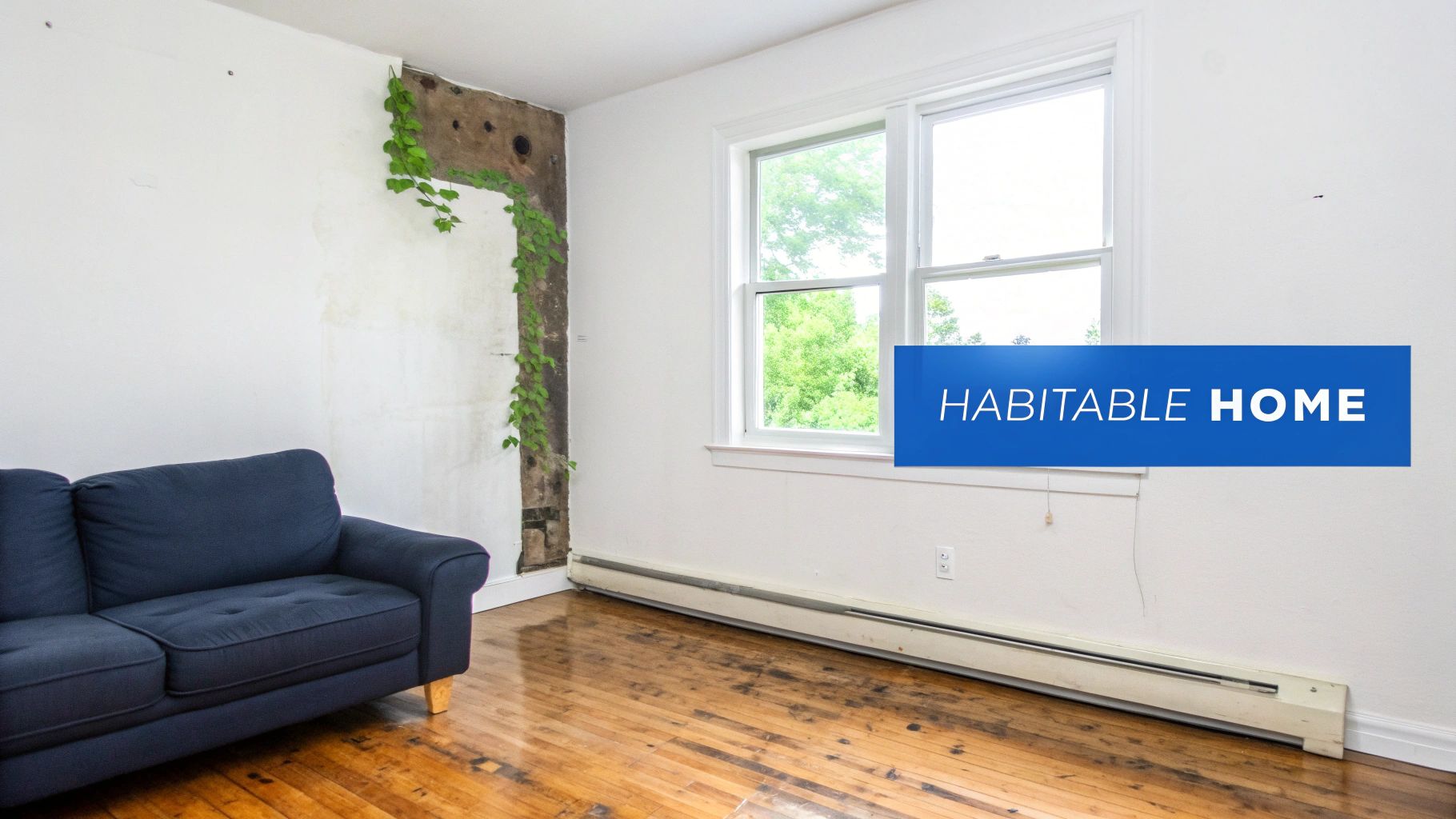
This warranty covers all the basics you’d expect: working plumbing, reliable heat, and secure doors and windows. But it also covers invisible threats that can affect your well-being, and that’s exactly where mold fits in. While a little mildew in the shower grout is one thing, widespread mold growing on walls, creeping up from the floorboards, or hiding behind drywall is a whole different beast.
Before we dive into the specifics of landlord and tenant duties, here's a quick cheat sheet to see who is responsible for what.
Quick Guide Landlord vs Tenant Mold Responsibilities
This table breaks down the core duties for preventing and handling mold in a California rental property.
| Responsibility Area | Landlord's Duty | Tenant's Duty |
|---|---|---|
| Moisture Control | Repairing leaks from roofs, pipes, and windows promptly. Ensuring proper drainage. | Reporting any leaks, water intrusion, or signs of dampness immediately. |
| Ventilation | Providing and maintaining functional ventilation, especially in bathrooms and kitchens. | Using fans during showers/cooking. Avoiding blocking vents. Airing out the unit. |
| Cleanliness | Providing a clean and sanitary unit at the start of the tenancy. | Keeping the property clean and dry. Not allowing moisture to build up. |
| Mold Remediation | Investigating and fixing mold caused by structural issues (leaks, etc.). | Notifying the landlord in writing of any suspected mold growth. |
| Tenant-Caused Mold | Not responsible for mold caused by tenant negligence (e.g., overflowing a tub). | Responsible for cleaning up minor surface mold caused by their own actions. |
This shared responsibility is key. While landlords hold the primary duty for the building's integrity, tenants play a vital role in day-to-day prevention and communication.
How Mold Breaches The Habitability Standard
When mold becomes a serious problem, it can legally render a property "uninhabitable." This doesn't mean the building is falling apart. It simply means the conditions inside pose a real threat to the health and safety of the people living there.
The presence of visible mold, especially when it's tied to an ongoing moisture issue like a leaky roof or a dripping pipe, is a direct challenge to the warranty of habitability. It's a clear signal that the landlord has failed to keep the property in a safe condition.
The law recognizes that mold exposure can lead to a whole host of problems. If you're concerned, it’s worth taking a moment to understand the potential health effects of household mold. This is why a landlord’s failure to fix a mold issue isn't just bad service; it’s a potential breach of their core legal duty, giving tenants specific rights and leverage.
In the eyes of California law, a landlord's responsibility isn't just to rent out a space, but to provide a safe space. Ignoring a mold problem is legally equivalent to ignoring a broken heater in winter or a faulty electrical system—it compromises the home's safety.
What Conditions Make A Property Uninhabitable
California Civil Code 1941.1 gets specific about what makes a rental uninhabitable. While the law doesn't explicitly mention "mold," it spells out several requirements that are directly related to the conditions that cause it:
- Effective Waterproofing: The code demands that roofs, exterior walls, windows, and doors are properly waterproofed and weather-protected. A persistent leak that fuels mold growth is a clear violation.
- Working Plumbing: All plumbing and gas facilities must be kept in good working order. That means no drips, no leaks, and no seeping water saturating your walls or floors.
- Clean and Sanitary Conditions: The property must be kept clean and free from garbage, rodents, and "vermin"—a legal term that has been interpreted to include harmful microbial growth like toxic mold.
This legal framework is the foundation of every California landlord tenant law mold dispute. It clearly establishes that landlords have a proactive duty to maintain their properties and fix the very issues that allow mold to take hold. When they fail, tenants have solid legal ground to stand on.
How SB 655 Changed The Game For Mold In California Rentals
Before 2016, the rules around mold in California rentals were frustratingly vague. Tenants often knew something was wrong—that visible mold was more than just an ugly spot on the wall—but getting a landlord to act was an uphill battle.
Landlords could argue that since "mold" wasn't explicitly named as a habitability issue in the law, they weren't required to fix it. This left tenants stuck in a legal gray area, trying to prove that the mold was a genuine health hazard.

Imagine having to hire experts and go to court just to prove the mold in your bathroom was making your kids sick. The burden of proof was incredibly high and expensive, leaving many renters with no real way to get help.
The Turning Point: Senate Bill 655
Everything shifted with Senate Bill 655. Signed into law on October 9, 2015, and taking effect on January 1, 2016, this legislation was a landmark moment for tenant rights. It officially added visible mold to the list of "substandard housing conditions" under California Health & Safety Code §17920.3. You can find more details about this crucial landlord-tenant legislation on sailproperties.com.
Suddenly, the ambiguity was gone. The law stated that visible mold growth endangering occupants' health is a direct violation of habitability standards. It was a total game-changer, shifting the responsibility squarely onto the landlord to take action.
Under SB 655, the very presence of significant visible mold is now considered a direct violation of the warranty of habitability. It's no longer a debatable point but a defined legal standard.
This gave tenants and code enforcement officers a powerful tool. It drew a clear line in the sand: if there's visible mold that poses a health risk, the landlord is legally required to deal with it.
Key Provisions Of The Law
SB 655 didn't just point a finger at mold; it created a clear framework. It defines mold as a substandard condition when it meets two key criteria:
- There is visible mold growth inside the rental unit.
- A health officer or code enforcement officer determines the mold is endangering the health of the occupants.
That second point is huge. It means you don't need a doctor's note or lab results to get the ball rolling. If a local official inspects the property and agrees the mold looks like a health risk, the landlord's obligation to remediate is triggered. It’s a much more practical and accessible standard than proving direct medical harm in court.
What This Means For Tenants And Landlords
The impact of this law is direct and practical. For tenants, it provides a clear, actionable path. You no longer have to debate whether mold is a "real" problem. If you see it and are concerned, you can report it, and know the law is on your side.
For landlords, the message is just as clear: ignoring a mold complaint is no longer an option. Doing so is a direct violation of state law and can lead to serious headaches, including:
- Official notices of violation from code enforcement.
- Tenant lawsuits for breaching the warranty of habitability.
- Financial liability for tenant health problems or relocation costs.
Essentially, SB 655 took the guesswork out of mold issues. It moved the conversation from personal arguments into the clear-cut domain of California landlord tenant law mold compliance, ensuring every complaint gets the serious attention it deserves.
Your Action Plan For Dealing With Mold
Finding mold in your rental can be alarming, but having a clear, step-by-step plan is your best defense. This isn't just about protecting your health; it's about protecting your legal rights as a tenant in California. The secret is to create a solid, undeniable record of the problem and every conversation you have about it.
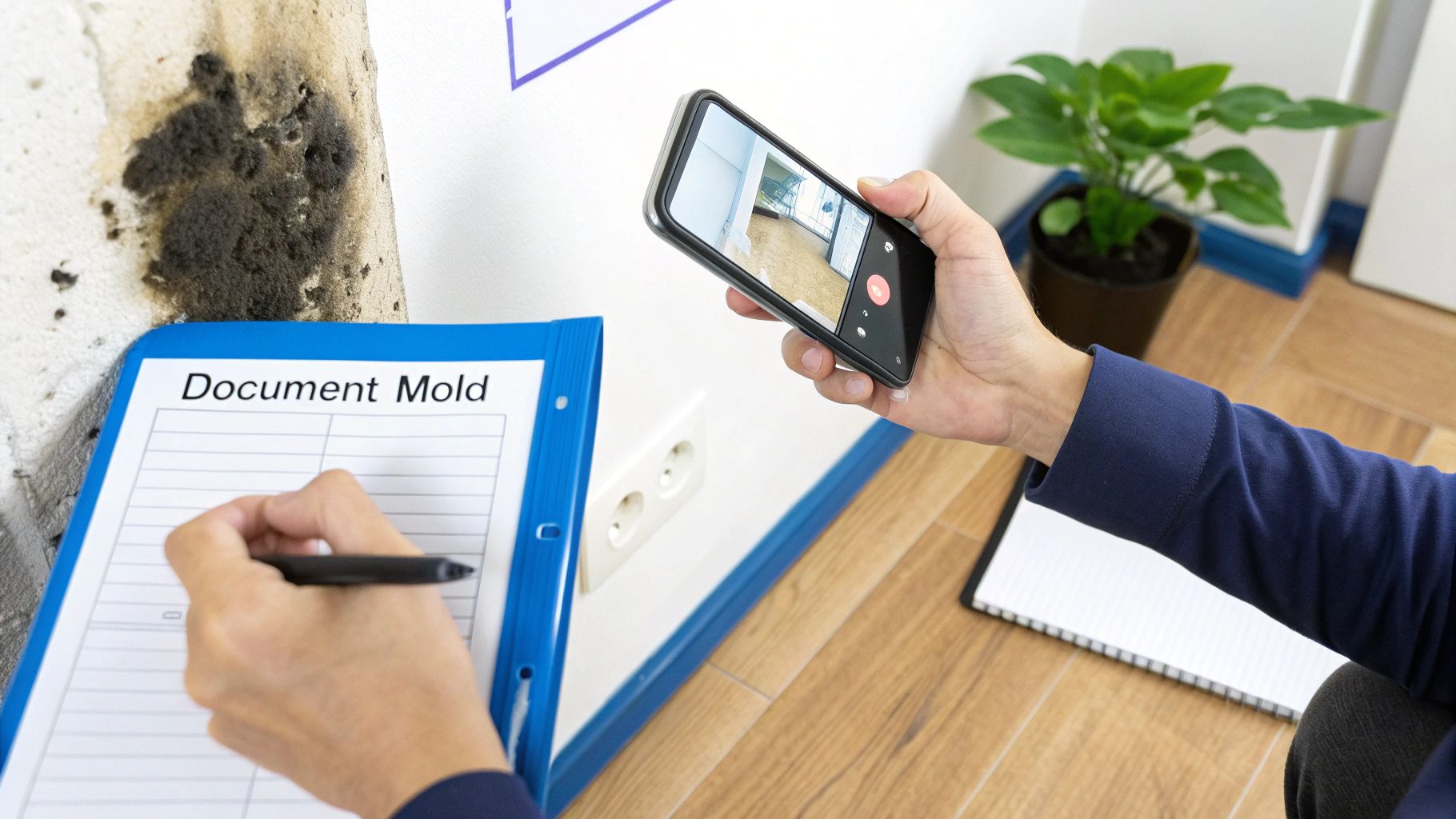
Think of this section as your practical roadmap. Following these steps ensures you've done your part as a tenant while holding your landlord accountable for theirs.
Step 1: Document Everything Immediately
Before you even think about calling your landlord, it's time to become a detective. Your mission is to build a detailed, time-stamped case file showing exactly what the mold looks like and when you found it. This evidence is your single most powerful tool.
Start by taking plenty of clear photos and videos. Get wide shots to show where the mold is in the room, then get close-ups to show its texture and color. If your phone has a feature to add date and time stamps to photos, turn it on.
Next, start a written log. You’ll want to note:
- Date of Discovery: The exact day you first saw the mold.
- Location: Be very specific. "Behind the toilet in the upstairs bathroom" is much better than "in the bathroom."
- Description: Write down what you see and smell. For example, "Black and fuzzy patches with a strong, musty odor."
- Related Issues: Is there a slow drip from a pipe nearby? Condensation on a window? Make a note of any potential water source.
This initial record creates a baseline, which is absolutely critical for tracking the problem and proving your case later if things escalate.
Step 2: Provide Formal Written Notice
Now that you have your evidence, you need to officially notify your landlord—and it has to be in writing. A quick text or a phone call might feel faster, but they don't create the official paper trail you need for legal protection.
The gold standard is a formal letter sent via certified mail with a return receipt requested. This simple step proves two crucial things: that you sent the notice and that your landlord actually received it. When it comes to California landlord-tenant law for mold, this is non-negotiable.
Keep your letter professional and stick to the facts. Be sure to include:
- Your Information: Your full name, address, and unit number.
- Date: The date you're writing the letter.
- Clear Statement: State plainly that you've found mold and are requesting its removal and the repair of whatever is causing the moisture.
- Details: Refer to the specific locations you documented and include copies of your photos.
- Call to Action: Request that they inspect the property and start the remediation process within a "reasonable" time.
Sending a formal, written notice is the legal trigger. It starts the clock on your landlord's responsibility to act and turns a casual complaint into a documented legal request.
Step 3: Understand Reasonable Timeframes
Once your landlord gets the notice, California law says they have a "reasonable time" to fix the issue. The law is intentionally vague here because "reasonable" depends on how bad the problem is.
As a general rule of thumb, 30 days is often considered a reasonable timeframe for most repairs. However, if you're dealing with extensive mold growth from a major water leak, you could expect a much faster response.
After sending your letter, follow up to confirm they have a plan and a timeline. And, as always, keep a log of every conversation—date, time, and what you discussed. If a serious leak is the culprit, it's also smart to read up on how to prevent mold after water damage to protect your health and belongings while you wait. If the landlord drags their feet or fails to act, that paper trail you started in step one becomes the foundation for any legal action you might need to take.
A Proactive Landlord's Guide To Mold Reports
When a tenant reports mold, it’s not just another maintenance ticket. It's a critical moment. How you respond protects your property, your tenant’s health, and your legal standing. Mishandling a mold complaint can quickly turn a simple fix into a costly dispute under California landlord tenant law mold regulations.
Treating every mold report seriously from the get-go is the best risk management you can practice. Whether it seems minor or not, a proactive approach shows you're a responsible property manager and starts a documented trail of your due diligence.
Initial Response: The First 48 Hours
What you do right after receiving a mold report is crucial. Procrastination is your worst enemy here—it can easily be interpreted as negligence. Your goal is to investigate quickly, communicate clearly, and get a plan in motion.
Here are the first steps to take:
- Acknowledge in Writing: Immediately send an email or text to the tenant confirming you received their complaint. This simple step shows you’re on top of it and creates a timestamped record.
- Schedule a Prompt Inspection: Arrange to see the property yourself within 24-48 hours. This lets you assess the situation firsthand and understand what you're dealing with.
- Document Everything: When you inspect, take your own detailed photos and notes—just like a tenant should. Document the visible growth and look for the obvious source of moisture.
This rapid response sets a professional tone from the start and begins building a defensible record that proves you took the report seriously.
Beyond Surface Cleaning: Address The Source
One of the biggest mistakes a landlord can make is just spraying some bleach on the visible mold and painting over it. That's a cosmetic fix, not a real solution. Mold is just a symptom; the real problem is moisture. Unless you fix what’s causing the dampness, the mold will always come back.
The goal isn't just to remove the mold you see. It's to eliminate the conditions that let it grow in the first place. Failing to fix the underlying moisture source is the number one reason a small mold issue blows up into a major legal liability.
Think of it this way: you can’t bail water out of a boat with a hole in it and expect to stay dry. You have to patch the hole. The same principle applies here. Your main objective has to be finding and repairing the source of the water—whether it's a leaky pipe, a bad window seal, or just poor ventilation.
When To Call A Certified Mold Inspector
While you can probably handle minor surface mildew yourself, some situations absolutely require a professional. If you run into any of the following, it’s time to call in a certified mold inspector:
- The visible mold covers an area larger than 10 square feet.
- You can smell a strong, musty odor but can't find the source.
- The mold showed up after significant water damage, like a flood or major leak.
- Your tenant is reporting serious respiratory issues or other health complaints.
A professional assessment gives you objective, scientific data about the scope of the problem. For landlords in Santa Barbara or Ventura County, understanding the details of a professional mold inspection process provides a clear roadmap for getting the remediation done right the first time. It's the best way to protect your tenant's health, your investment, and your reputation.
Why You Might Need A Professional Mold Inspection
Sometimes, what you see is just the tip of the iceberg. That small, dark spot on the bathroom ceiling might be hinting at a much larger, hidden colony lurking behind the drywall. When you're navigating a California landlord tenant law mold dispute, guesswork is the last thing you want to rely on—it can be a costly mistake for everyone involved.
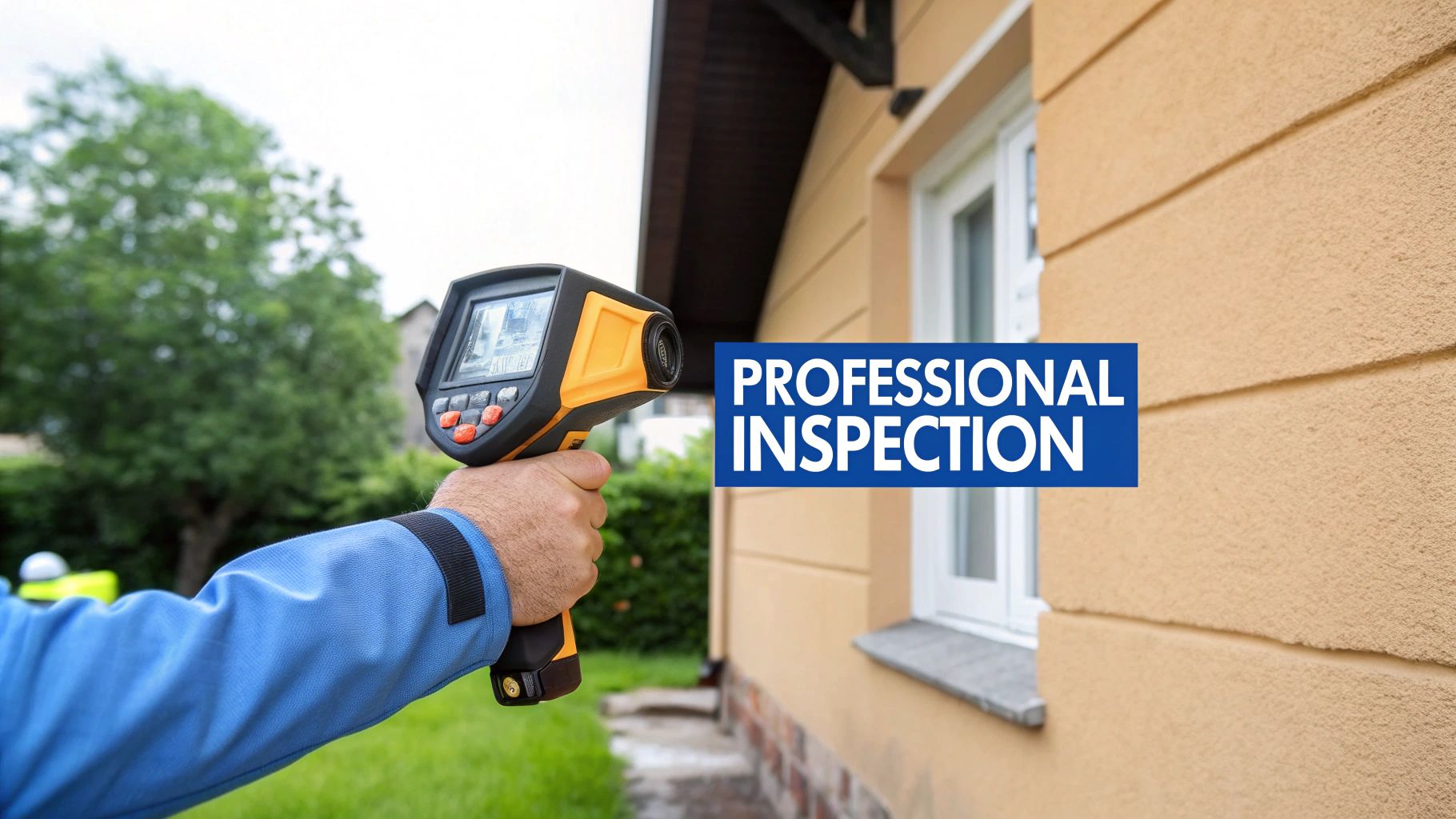
This is where a professional mold inspection becomes invaluable. It shifts the conversation from subjective opinions to objective, scientific data. An inspection can be the key to resolving the issue quickly, correctly, and without unnecessary conflict.
The Building Detective Finding Hidden Clues
Think of a certified mold inspector as a "building detective." They don't just glance at the obvious signs; they use specialized tools to uncover clues that are completely invisible to the naked eye. Their real job is to find the root cause of the mold, which is always an unwanted source of moisture.
If you don't find and fix that moisture source, any mold cleanup is just a temporary band-aid. It’s like painting over a stain from a leaky pipe without actually repairing the leak—you know that stain is coming back, and probably worse than before.
Certified inspectors use advanced gear to pinpoint these hidden problems:
- Moisture Meters: These devices can detect elevated moisture levels inside walls, under floors, and in ceilings, revealing damp spots that aren't yet visible.
- Thermal Imaging Cameras: These cameras reveal temperature differences on surfaces, which can instantly highlight areas of water intrusion or missing insulation where condensation loves to form.
- Hygrometers: This tool measures the humidity in the air, helping to identify if poor ventilation is contributing to the problem.
This kind of thorough investigation gives you the complete picture, ensuring the real problem gets addressed.
Objective Data For Landlords And Tenants
A professional inspection report is an impartial, third-party assessment. For tenants, this report is worth its weight in gold. It provides credible evidence that a habitability issue exists, moving the complaint beyond your word against the landlord’s. This data can be crucial if you need to escalate the issue or pursue legal remedies.
For landlords, this objective data is just as critical. It provides a clear roadmap for effective remediation, preventing the costly mistake of incomplete repairs that just lead to the mold returning. A professional report helps you solve the problem right the first time, protecting your property and demonstrating responsible action.
A professional mold inspection replaces uncertainty with facts. It provides both the tenant and the landlord with a clear, science-backed understanding of the problem's scope and origin, creating a solid foundation for a fair resolution.
When To Make The Call For An Inspection
Not every patch of mildew warrants a full-scale inspection. However, you should seriously consider hiring a professional in several key situations. Understanding what is a mold inspection can help you determine if your specific circumstances fit the bill.
Here are the most common scenarios where a professional assessment is a smart move:
- The Landlord Is Unresponsive: If you've provided written notice and your landlord is dismissive, unresponsive, or just performs a superficial cleanup, an inspection report provides the leverage needed to compel proper action.
- You Smell Mold But Can't See It: A persistent musty odor is a major red flag. It almost always means mold is growing somewhere hidden, like inside a wall cavity, in the HVAC system, or under carpeting.
- After Major Water Damage: Following a flood, burst pipe, or significant roof leak, a professional inspection is critical to ensure all affected materials have been thoroughly dried and no hidden mold has started to grow.
- Health Symptoms Are Present: If people in the home are experiencing unexplained respiratory issues, allergies, or other chronic symptoms that seem to get better when they leave, professional air quality testing is warranted to check for elevated mold spore counts.
In these situations, a professional inspection provides the clarity and proof needed to protect your health and enforce your rights under California law.
Legal Remedies When Your Landlord Fails To Act
So, you’ve done everything by the book. You documented the mold, sent a formal written notice, and gave your landlord a reasonable amount of time to fix it. And still… nothing. It’s a frustrating spot to be in, but don’t lose hope.
Under California law, your landlord's silence doesn't leave you powerless. In fact, it unlocks several powerful legal remedies designed to protect you and force the issue. Think of these as different tools in your toolbox. The one you choose will depend on how bad the mold is, what you want the outcome to be, and your comfort level with a potential conflict.
Using The Repair And Deduct Remedy
One of the most straightforward options is the "repair and deduct" remedy. It’s exactly what it sounds like: you hire a professional to fix the mold problem yourself, and then you subtract that cost from your next rent payment.
This tool is powerful, but it comes with some very specific rules you have to follow:
- Cost Limit: The total cost of the repair cannot be more than one month's rent.
- Usage Limit: You can only use this remedy twice in any 12-month period.
- Proper Notice: This only works if you’ve already given your landlord proper written notice and enough time to make the repairs themselves.
This approach is perfect for smaller, more contained mold issues where the repair costs are manageable. It lets you get the problem solved quickly instead of waiting around for a landlord who won’t act.
Rent Withholding: A Powerful But Risky Option
Another heavy hitter is rent withholding. This means you legally refuse to pay rent until your landlord makes the necessary repairs to make your home habitable again. This strategy puts immediate and immense pressure on the landlord because it hits them where it hurts—their income.
Before you go this route, you need to understand the risks. A landlord might try to evict you for non-payment of rent. To protect yourself, you absolutely should place the withheld rent money into a separate bank account, often called an escrow account. This proves you have the funds and are withholding them in good faith because of the unsafe living conditions, not because you can’t pay. Understanding all the nuances of tenant rights for mold in California is critical before taking this major step.
Breaking The Lease Under Constructive Eviction
What if the mold problem is so bad that your home is genuinely unsafe or unlivable? In that case, you may have the right to break your lease and move out. This is based on a legal concept called "constructive eviction."
Constructive eviction happens when a landlord’s failure to make repairs makes the rental unit unfit for a person to live in. This gives the tenant the right to leave the property without being responsible for any more rent.
Essentially, the law says that by failing to provide a habitable home, your landlord has effectively "evicted" you. This is a serious move and should only be considered in extreme situations. You must be able to prove that the conditions were truly intolerable, which is where your detailed documentation—photos, letters, and professional inspection reports—becomes your most important evidence.
Don’t underestimate the financial stakes for landlords who ignore mold complaints. One tenant in Riverside County, who developed chronic health problems from unresolved mold, was awarded a $275,000 settlement. You can learn more about the financial consequences for landlords on helbocklaw.com. Cases like this show that dealing with mold proactively isn't just the right thing to do—it's the smartest financial decision a property owner can make.
Common Questions About California Mold Law
When you're dealing with mold, a lot of "what if" questions can pop up. Let's tackle some of the most common ones that both tenants and landlords ask, so you have a clear picture of your rights and responsibilities.
Can My Landlord Evict Me For Reporting Mold?
Absolutely not. California law has strong anti-retaliation protections baked right in. Your landlord cannot legally serve you an eviction notice, jack up your rent, or refuse to renew your lease just because you asked for necessary mold repairs. It's flat-out illegal.
This protection also covers you if you report the problem to a local health or code enforcement agency. If your landlord takes any of those negative actions within 180 days of your complaint, the law automatically assumes it's retaliation. The burden of proof then falls on them to prove it wasn't, which is a tough spot for a landlord to be in.
Am I Responsible For Mold I Caused?
Sometimes, the answer is yes. It all comes down to where the moisture is coming from. A landlord is always on the hook for fixing the building itself—think leaking pipes, a bad roof, or busted window seals. But if a tenant's actions are the direct cause of the mold, the responsibility can flip.
For instance, if you constantly steam up the bathroom without ever using the fan or cracking a window, and surface mildew appears, that cleanup is likely on you. The same goes for overflowing a bathtub and not mopping up the water promptly. If your actions lead to the moisture, you could be liable for the mold that follows.
The most critical step is always figuring out the source of the moisture. Landlords are responsible for building failures, while tenants can be responsible for lifestyle-related moisture. This is exactly why a thorough, documented inspection is so important for everyone involved.
Does My Landlord Have To Pay For A Mold Test?
This is one of those areas where the law is a bit gray. California landlord tenant law on mold doesn't explicitly force a landlord to pay for a professional mold inspection or test. Their legal duty is to fix the conditions that allow mold to grow.
However, a professional report from a certified inspector is powerful, impartial evidence that a problem exists. Handing your landlord objective data from an expert often lights a fire under them to take action. It shows them you're serious and helps them understand the legal and financial risks of ignoring the problem.
What If Mold Is In A Common Area?
A landlord's responsibility doesn't stop at your front door. They are required to keep all parts of the property safe and sanitary, including common areas.
If you spot mold in a shared space like the laundry room, hallway, or community gym, their duty to fix it is the same as if it were inside your apartment. Report it to your landlord immediately—in writing—just like you would for an issue inside your own unit.