When you find mold creeping into your rental, you're not on your own. California law actually sides with you, the tenant. The state takes visible mold seriously, classifying it as a major housing defect. This gives you solid legal ground to stand on and requires your landlord to step up and fix it.
Bottom line: you have a right to a safe, mold-free home.
Your Fundamental Rights When You Find Mold
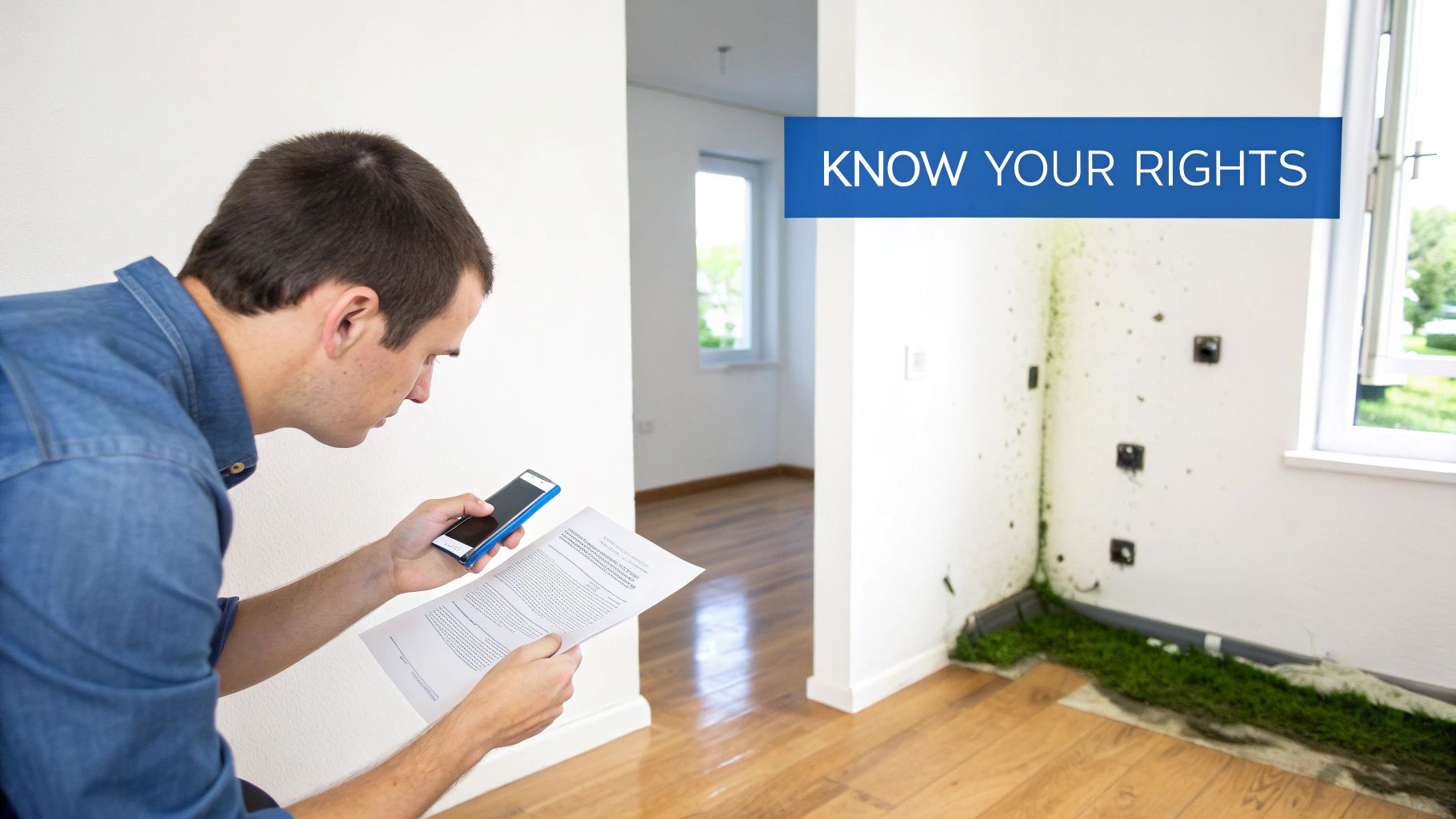
Finding mold can feel overwhelming, but as a renter in California, the law gives you a powerful toolkit to demand action and protect your health. At the heart of it all is a legal concept called the implied warranty of habitability.
Think of it as an invisible, automatic promise built into every single rental agreement in the state. This "warranty" legally binds your landlord to keep the property in a livable condition. A significant mold problem is a clear breach of that promise—no different than having a broken furnace in the dead of winter or a hole in the roof.
The Law That Gave Renters Real Power
For years, mold was a frustrating legal gray area. That all changed in 2016 when California updated its housing laws, finally giving renters some real leverage.
Now, under California Health and Safety Code §17920.3, visible mold is officially defined as a substandard housing condition once it's confirmed by a health or code enforcement officer. This was a game-changer. It took the ambiguity out of the equation and created a clear legal trigger for a landlord's responsibility.
This brings us to a quick rundown of what this all means for you.
Renter Rights And Landlord Duties At A Glance
Here’s a quick summary of the core concepts that protect you when dealing with a mold problem.
| Concept | What It Means For You | Landlord's Responsibility |
|---|---|---|
| Implied Warranty of Habitability | Your rental must be safe and livable. Significant mold makes it uninhabitable. | To maintain the property in a condition that's fit for humans to live in. |
| Right to Request Repairs | You can (and should) formally notify your landlord about the mold and expect action. | To make necessary repairs within a "reasonable" amount of time after being notified. |
| Right to a Safe Environment | If the mold is so bad it's a health hazard, you have legal ways to fix the situation or leave. | To ensure the property doesn't contain hazards that threaten your health and safety. |
These legal principles are the foundation for every step you'll take.
So, what are your core rights in plain English?
- The Right to a Habitable Home: Your apartment must be free from dangers that affect your health, and that absolutely includes harmful mold.
- The Right to Request Repairs: You can officially tell your landlord about the mold and expect them to fix it in a reasonable timeframe.
- The Right to Further Action: If the mold makes your home unsafe and your landlord won't act, you have legal options, which we’ll get into later.
Understanding these fundamental tenant rights in California is your first and most important step. They provide the legal backbone for everything you do next, from sending that first email to pursuing other remedies if your landlord drags their feet.
Understanding Your Landlord's Legal Responsibility For Mold
At the very core of California's tenant protections is a powerful concept called the implied warranty of habitability. This isn't just legal jargon; it's a fundamental promise baked into every single rental agreement, whether it's written down or not. It guarantees your landlord will provide and maintain a home that is safe, clean, and fit for people to live in.
Think of it as the basic safety and comfort standards for your home. Things like a working heater, secure doors, and reliable plumbing all fall under this promise. When significant mold growth appears, it completely shatters that promise, turning what should be a safe home into a hazardous one. More importantly, it puts your landlord in direct violation of their legal duties.
If you see visible mold that’s clearly the result of a leaky pipe, a damaged roof, or just persistent dampness that isn't your fault, it’s legally considered a failure to maintain a habitable home. This isn't a minor chore—it's a serious breach of your rental agreement.
The Duty To Disclose Known Mold Issues
For a landlord, responsibility for California mold laws for renters often starts before you even get the keys. They have a legal obligation to be upfront about known hazards. This isn’t just good manners; it's the law.
The Toxic Mold Protection Act of 2001 laid crucial groundwork for renter protections, requiring landlords to disclose any known mold issues to potential tenants in writing. Under Health & Safety Code Section 26147, if a landlord knows there's mold in the unit that exceeds permissible limits, they have to tell you.
This legal requirement for disclosure ensures you have the right to make an informed decision about your health and safety before moving in. It prevents landlords from hiding known mold problems from new tenants.
To back this up, California law also requires landlords to give every new tenant a state-approved booklet called "Information on Dampness and Mold for Renters" when they move in. This guide is designed to help you understand how to prevent mold and what your rights are if it shows up.
From Minor Issue To Substandard Condition
So, what elevates a patch of mold from a simple cleaning task to a legal violation? It all comes down to its impact on the home's habitability. A little mildew in the shower grout might not make the cut, but extensive mold growth spreading across walls, ceilings, or hiding in crawl spaces definitely does.
Thanks to a 2016 legal update, any visible mold growth that endangers the health and safety of the people living there is now officially classified as a "substandard housing condition." This simple phrase gives your formal complaint real legal weight and triggers your landlord’s obligation to take action.
When you report mold, you aren't just making a request; you are enforcing your legal right to a safe home. Understanding this core landlord responsibility for mold is one of the most important things every renter should know.
Your Step-By-Step Plan For Reporting Mold

Knowing your rights is one thing, but getting your landlord to act is another. When you find mold, how you respond in the first 48 hours can make all the difference. You need a clear, methodical plan.
Think of it like building a case from day one. Every photo you take and every letter you send becomes a piece of your story. A structured approach not only protects you but also gives you a solid foundation if things escalate.
Your first move? Document everything. Before you even pick up the phone to call your landlord, start keeping meticulous records. This simple habit is your most powerful tool.
Step 1: Start With Detailed Documentation
Your goal here is to create a record so thorough that it leaves no room for debate. A landlord can easily dismiss a frantic phone call, but a folder full of dated photos and notes? That’s much harder to ignore.
Here’s exactly what you need to capture:
- Take Clear Photos and Videos: Get wide shots to show the mold's location within the room, then move in for close-ups that show its texture and size. A great tip is to place a coin next to the mold in your close-up shots to give it a clear sense of scale.
- Keep a Written Log: Grab a notebook or start a digital document just for this. Write down the date you first spotted the mold and its exact location (e.g., "under the kitchen sink, behind the cleaning supplies," or "in the top left corner of the bedroom closet"). Don't forget to mention any musty smells.
- Track Your Health: Is anyone in the house feeling off? Note any new or worsening health symptoms. Be specific with dates, like "Started persistent coughing on March 15th" or "Headaches became a daily thing this week."
This log becomes your undeniable timeline, connecting the mold's appearance to its impact on your home and your health.
Step 2: Provide Formal Written Notice
A text or a quick call might feel easier, but they don't carry the legal weight of a formal, written notice. When it comes to California mold laws for renters, a paper trail is your best friend. This is the action that officially starts the clock on your landlord's legal duty to respond.
Your notice should be a straightforward, formal letter explaining the problem. To make sure it gets there—and you have proof—send it via certified mail with a return receipt. That little green card you get back in the mail is your golden ticket, proving your landlord was officially notified and when.
Why Certified Mail is Crucial: That return receipt is legally binding proof. It shows a court that you did your part and officially informed your landlord, which kicks off the legal timeline for them to make repairs—usually a "reasonable time" of 30 days.
Step 3: Understand The Timeline And Follow Up
Once that certified letter is delivered, the clock starts ticking. California law says landlords have a "reasonable time" to fix habitability issues, which is generally understood to be 30 days.
Put a reminder on your calendar. If a week goes by and you've heard nothing but silence, send a polite but firm follow-up email or another letter. Reference your original notice and the date it was delivered.
Consistent, professional communication shows you're serious and won't let the issue slide. Acting methodically is the key to getting results, and if you want to dig deeper, check out our guide on what to do if you find mold.
So, you’ve done everything right. You sent the certified letter, you’ve documented every phone call, and you’ve waited patiently for your landlord to do something. But the 30-day window has slammed shut, and all you’ve heard is silence.
It’s easy to feel defeated at this point, but this is not the end of the road. In fact, under California mold laws for renters, an unresponsive landlord just handed you the keys to take more powerful action.
These next steps are serious, and they absolutely come with legal risks. It's critical to understand how they work and, more importantly, when to use them. Think of them as powerful tools in your toolkit—incredibly effective when used correctly, but they can backfire if you're not careful. I always recommend getting some legal advice before you pull the trigger on any of these.

Option 1: The Repair and Deduct Remedy
One of the most direct approaches you can take is the "repair and deduct" remedy. It’s pretty much what it sounds like: you hire a professional to fix the mold problem yourself, and then you subtract that cost from your next rent payment. It's an empowering move, but it has some very strict guardrails.
Under California Civil Code §1942, the cost of the repair cannot be more than one month's rent. You’re also limited to using this remedy no more than twice in any 12-month period.
- Step 1: First, make absolutely sure you've given your landlord proper written notice and enough time to act.
- Step 2: Hire a qualified, licensed professional for the mold remediation. Don't cut corners here.
- Step 3: Pay for the work and get detailed receipts and invoices. Keep copies of everything.
- Step 4: Deduct the exact cost from your next rent check. Make sure you include a copy of the receipt with your payment so everything is transparent.
Option 2: Withholding Rent
Withholding rent is the nuclear option. It’s a high-stakes strategy that will get your landlord’s attention fast, but it’s also the riskiest path you can take. The logic is that you’re stopping rent payments because the landlord has breached the warranty of habitability by failing to fix the mold. If you go this route, you can almost guarantee your landlord will try to evict you for non-payment.
To protect yourself, you should never just stop paying and pocket the cash. The proper way to do this is to open a separate bank account—what’s often called an escrow account—and deposit your full rent payment there, on time, every single month. This proves to a judge that you had the money and were acting in good faith, ready to pay as soon as the home was made safe again.
Option 3: Breaking Your Lease
What if the mold problem is so bad that your home is genuinely unlivable? In that case, you may have the right to break your lease and move out. This is based on a legal concept called "constructive eviction." You're essentially arguing that by failing to fix the hazardous conditions, your landlord has effectively forced you out, or "evicted" you.
A constructive eviction claim argues that the landlord’s inaction created conditions so intolerable that any reasonable person would have to leave. This terminates your obligation to pay rent from the day you move out.
California renters have strong leverage here because of the implied warranty of habitability. When a landlord ignores a serious mold issue, they're on the hook. Before taking such a drastic step, though, you need an airtight record of your notices and the landlord's failure to respond. Ordering a professional mold inspection is one of the best ways to get the hard evidence you’ll need to back up your claim.
Why A Professional Mold Inspection Is Your Best Evidence
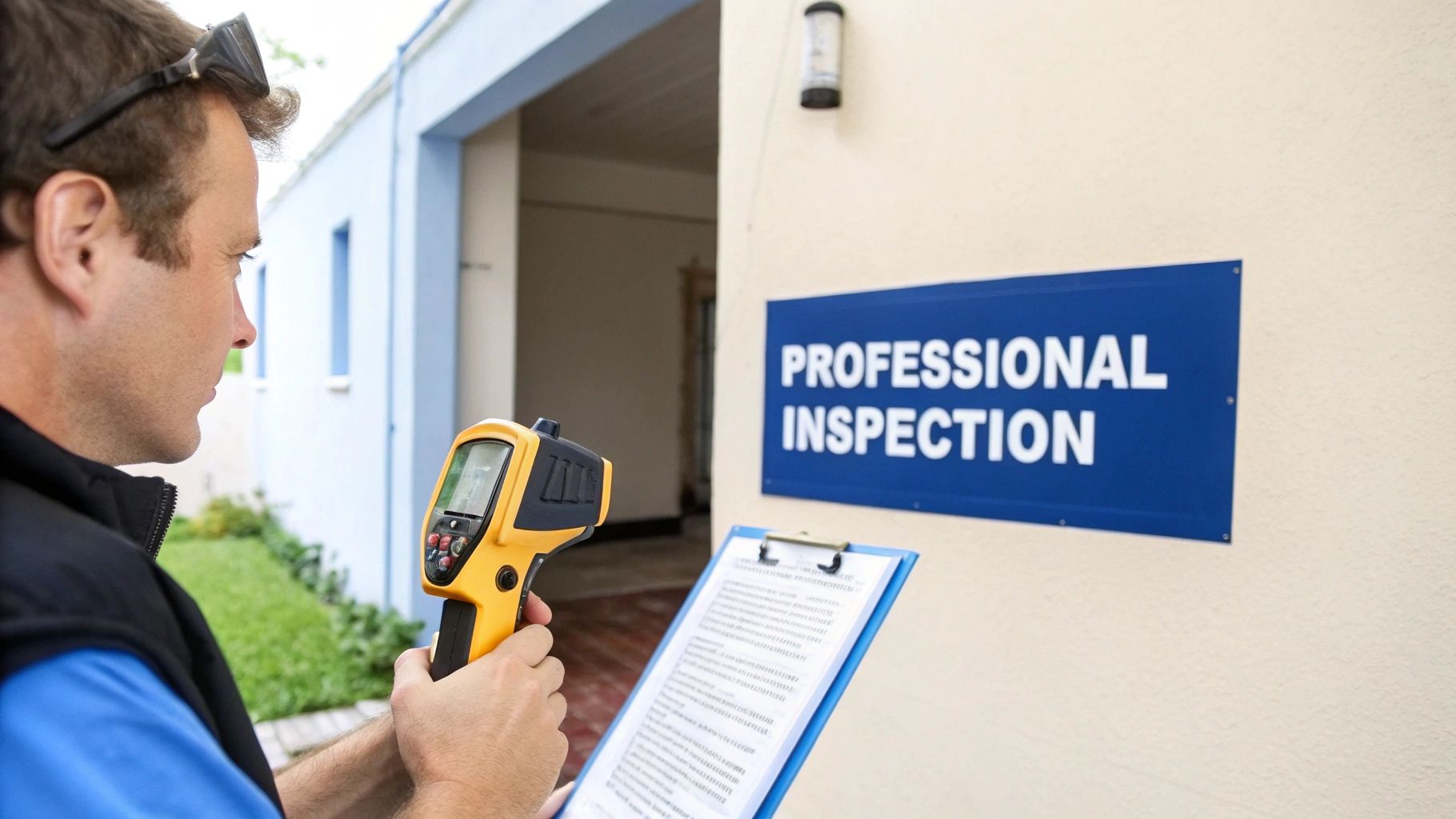
Your photos and detailed log are a fantastic start. Seriously, they're crucial. But when a landlord is digging in their heels, it can quickly become a "he said, she said" situation—and that's a tough battle to win on your own.
This is exactly where a professional mold inspection becomes your most powerful ally. It shifts the conversation from what you think you see to what science can definitively prove.
It's tempting for a landlord to just slap a coat of paint over a discolored spot on the wall and call it a day. We see it all the time. But that's a purely cosmetic fix that does absolutely nothing about the underlying moisture issue or the contamination festering inside the wall. An independent, third-party inspection cuts right through those lazy shortcuts.
A certified inspector doesn't just show up and look around. They bring specialized tools that can see what the naked eye can't, turning a simple complaint into a scientific investigation of your home's health.
Uncovering The Hidden Truth
A professional inspection report isn't just an opinion—it's objective, data-driven proof that’s incredibly hard for a landlord to dispute. This evidence goes light-years beyond what you can capture with a smartphone camera.
Inspectors use a whole toolkit of advanced techniques to build a complete picture of what's really going on:
- Moisture Meters: These gadgets can detect elevated moisture levels inside your walls, floors, and ceilings. This helps pinpoint the exact water source that’s feeding the mold.
- Thermal Imaging: Think of it like night vision for water damage. Infrared cameras show temperature differences in building materials, revealing hidden leaks or pockets of dampness that are otherwise completely invisible.
- Air and Surface Samples: If needed, an inspector can collect samples from the air and directly from contaminated surfaces. These get sent off to an accredited lab for a full analysis.
The Power Of A Lab Report
That lab report? It’s the ultimate piece of evidence. It's a factual, scientific document that identifies the specific types of mold in your home and, just as importantly, quantifies the concentration of spores in your air.
This detailed report transforms your complaint from a simple repair request into a documented health and safety issue. It provides the undeniable proof needed to compel a landlord to perform proper remediation, support your case in small claims court, or justify breaking your lease due to uninhabitable conditions.
This level of detail is exactly what you need to enforce your rights under California mold laws for renters. An inspection doesn't just find mold; it validates your concerns with hard evidence, giving you the leverage you need to protect your home and your health.
If you want to understand the entire process, you can learn more about what a professional mold inspection involves.
Got Questions About Mold In Your Rental? We’ve Got Answers.
Even when you know the basics, the world of California mold laws for renters can feel a little murky. Real-life situations rarely fit into neat little boxes. This is where the confusion usually starts.
Let’s tackle some of the most common questions we hear from tenants dealing with mold.
How Much Mold Is Actually a "Legal" Problem?
This is a great question because California law doesn't get hung up on spore counts or measuring patches in square inches. Instead, it uses a much more practical standard: "visible mold growth."
Under the Health and Safety Code §17920.3, any visible mold that could endanger the health of the people living there is considered a substandard housing condition. That means we're talking about more than the tiny bit of mildew you might find in a shower corner. If you see it spreading on walls or ceilings, or you can't escape that strong, musty smell, it's serious enough to require your landlord to act.
Getting a local code enforcement officer to come out and officially document the visible mold is a powerful move. It confirms your claim and officially puts the legal responsibility on your landlord to fix it.
Can My Landlord Evict Me for Complaining About Mold?
Absolutely not. In fact, California has strong laws to protect you from this very thing.
California Civil Code §1942.5 is your shield against landlord retaliation. It makes it flat-out illegal for a landlord to punish you for exercising your tenant rights, like requesting repairs for a habitability problem like mold. If your landlord tries to evict you, hike up your rent, or cut back on services within 180 days of you making a formal repair request, the law automatically assumes it's retaliation.
If you even think your landlord is retaliating, don't wait. Document everything. Keep copies of every email, text, and letter, noting the date of your repair request and the date of the landlord's questionable action. This paper trail is your best defense if you need to get legal help.
Could I Get Blamed for the Mold?
It's possible, but the burden of proof is on your landlord, and it’s a high bar to clear. Most of the time, serious mold problems stem from issues with the building itself—leaky pipes, a failing roof, or bad window seals. Your landlord is responsible for maintaining the structural integrity of the property.
As a tenant, your job is to keep the place reasonably clean and ventilated. That means using the bathroom fan when you shower, wiping up big spills, and not blocking air vents. A landlord might try to blame you if they can prove your direct actions were the sole cause, like if you knowingly let a bathtub overflow for hours and never cleaned it up.
But frankly, proving tenant negligence is tough, especially when there's an underlying leak or moisture issue. In the vast majority of cases, the responsibility to fix the source of the moisture—and the mold—lands right back on the landlord.
Does "Black Mold" Have Special Legal Status?
Legally, no. The term "toxic black mold" (its scientific name is Stachybotrys chartarum) gets a lot of media attention and understandably sounds terrifying. However, California law doesn't distinguish between different colors or types of mold.
The law is focused on one thing: any "visible mold growth" that makes your home an unhealthy place to live. Whether the mold is black, green, orange, or white doesn't change your landlord's fundamental duty to get rid of it. The presence of any significant mold is enough to trigger your rights under state habitability laws.
While a professional inspector might identify the specific type of mold to help assess health risks, your legal path to getting it fixed is exactly the same. The key is to document its existence and formally tell your landlord it's time to take care of it.