When you rent a home in California, you have a fundamental right to a safe and livable space. If you find mold, it’s not just an inconvenience—it's a potential health hazard that your landlord is legally required to address. The law is firmly on your side, thanks to something called the "implied warranty of habitability."
Recent updates to state law have made things even clearer, officially classifying visible mold as a substandard housing condition. This gives you solid legal ground to stand on.
Your Rights When You Find Mold in a California Rental

Discovering mold in your apartment can be deeply unsettling, but you aren't powerless. California law offers strong protections for renters, all built around a simple idea: everyone deserves a healthy place to live. The most important concept to get your head around is the "implied warranty of habitability."
Think of this warranty as a silent promise automatically included in every lease agreement in the state. It guarantees your rental meets basic health and safety standards.
When you find significant mold growth—especially if it’s tied to a leaky pipe, a damp wall, or poor ventilation—it’s a direct violation of that promise. It turns a simple maintenance issue into a legal one.
What Makes Mold a Legal Issue in California
For years, mold was a bit of a legal gray area. Everyone knew it was unhealthy, but it wasn't explicitly listed as a defect that made a home unlivable. That all changed with Senate Bill 655.
This game-changing update to the Health and Safety Code, which took effect in 2016, officially classified visible mold growth as a "substandard housing condition." To be official, it has to be deemed a health hazard by a code enforcement officer who finds that the mold endangers the health of the occupants.
This law is a huge win for tenants. It gives you the power to report mold directly to your local code enforcement, who can then order your landlord to fix the problem.
To get a clearer picture of your rights, here's a quick reference table.
Key Tenant Rights and Landlord Duties at a Glance
| Your Right as a Tenant | Landlord's Corresponding Duty | Governing Law/Code |
|---|---|---|
| To live in a safe, habitable home. | Maintain the property in a condition fit for human occupation. | CA Civil Code § 1941.1 |
| To have mold-causing issues repaired. | Fix underlying conditions like leaks that lead to mold growth. | CA Civil Code § 1941.1 |
| To be informed about mold risks. | Provide the "Information on Dampness and Mold" booklet. | CA Health & Safety Code § 26147 |
| To report unaddressed mold to authorities. | Comply with orders from code enforcement to remediate mold. | CA Health & Safety Code § 17920.3 |
This table boils it down, but the core idea is simple: your landlord must provide a healthy home, and you have legal avenues to make sure they do.
Your core protections as a tenant include:
- The Right to a Habitable Home: Your landlord is required to keep the property free from hazards that could affect your health, and that includes extensive mold.
- The Right to Repairs: It's your landlord’s legal duty to fix the source of the mold, whether it's a leaky roof, a cracked pipe, or a faulty window.
- The Right to Information: When you move in, landlords must give you a state-approved booklet called "Information on Dampness and Mold for Renters in California." This ensures you know the risks and what to look for.
Knowing how to detect mold early is your first line of defense. Understanding these fundamental rights is the first step toward taking control of the situation and making sure your home is the safe, healthy space it’s supposed to be.
Understanding the Warranty of Habitability
At the heart of California’s tenant rights around mold is a powerful concept you won't find spelled out in your lease: the implied warranty of habitability. This isn't just legalese—it's a fundamental promise that automatically applies to every residential rental in the state.
Think of it like this: when you buy a new car, you just expect it to have working brakes and an engine that starts. You don't need a clause in the contract for that. The warranty of habitability is the same idea for your home. It’s a guarantee that the place is safe, sanitary, and fit to live in from the day you get the keys.
When mold shows up, it’s often more than just a nuisance. It can be a clear signal that this fundamental promise has been broken.
Connecting the Dots from Defects to Mold
So, what makes a home "habitable"? California Civil Code 1941.1 lays it out. This law lists the bare-minimum conditions a landlord must provide. If they fail, the property can be legally considered uninhabitable, and many of these conditions are directly tied to preventing mold.
By law, your landlord has to provide:
- Effective Weatherproofing: This means roofs and walls that don't leak. They must be free of holes or cracks that let rain and moisture seep in. A leaky roof during a winter storm is a classic recipe for a massive mold problem.
- Functional Plumbing: All your pipes and fixtures need to be in good working order, without leaks. That slow drip under the sink or a hidden leak behind the shower wall is one of the most common causes of serious, hidden mold.
- Proper Heating: You need a working heater. This might not seem related to mold at first, but cold, damp air creates condensation, giving mold the perfect environment to take hold.
- Clean and Sanitary Premises: The landlord is responsible for making sure the building, grounds, and common areas are clean and free from trash and pests when you move in.
When a landlord lets these basics slide, they aren't just being lazy. They are actively creating the perfect breeding ground for mold and, in the process, are likely breaking the law.
How Mold Becomes a Breach of Warranty
A tiny bit of mildew on your shower grout probably isn’t going to be enough to break your lease. The law cares about conditions that seriously affect a tenant's health and safety. Significant mold growth, especially when you can trace it back to a leaky pipe or a damaged roof, is a different story—it's a clear breach of that warranty.
Picture this: you start smelling a musty odor in your bedroom and then notice a dark, ugly stain spreading across the ceiling. You figure out it's right below the upstairs neighbor's bathroom. This isn't just an eyesore; it's proof that a leak is compromising your home's structure and the air you breathe. It’s making your home unfit.
This scenario is a textbook violation of habitability. The mold is just the symptom; the real problem is the landlord's failure to maintain the plumbing, which is their legal duty. By letting the leak continue, your landlord has breached the implied warranty of habitability.
This is the critical link that gives your written notice to the landlord so much legal power. It’s the foundation for every step you take next if they fail to fix the problem.
Your Landlord's Duty to Disclose Mold Issues
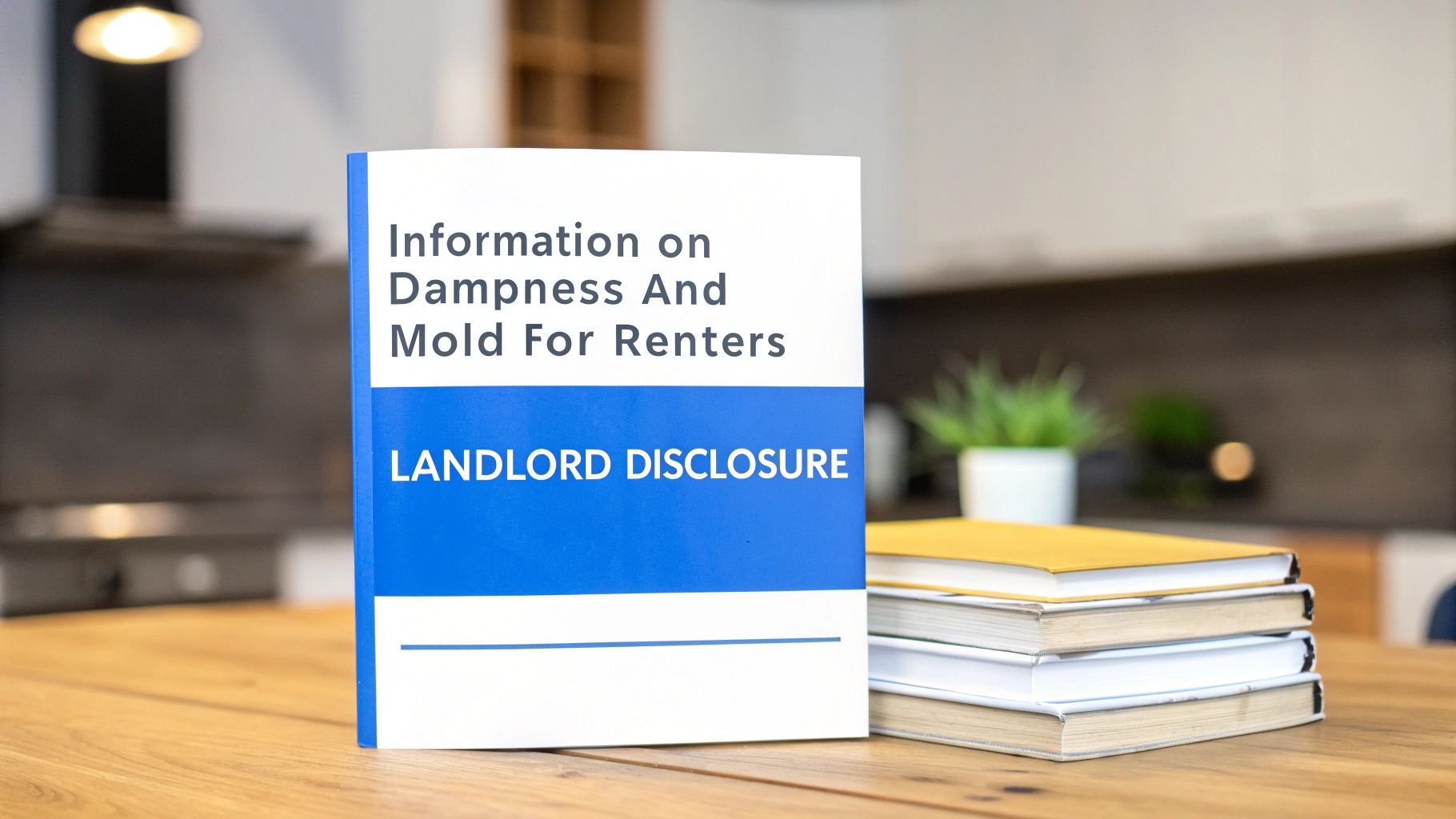
While the warranty of habitability protects you after you've moved in, California law also gives you critical protections before you even sign on the dotted line. Landlords can't just keep quiet about known mold problems; they have a legal duty to be transparent.
This isn't just a friendly suggestion—it's a requirement. It’s designed to stop tenants from unknowingly walking into a home with existing health hazards. Think of it like a home sale where the seller is legally obligated to point out any known defects. This gives you, the renter, the power to make a genuinely informed decision about where you're going to live.
The Toxic Mold Protection Act of 2001
A cornerstone of this transparency is the Toxic Mold Protection Act of 2001. This law squarely places the responsibility on landlords to educate their tenants about the risks of indoor dampness and mold. Its main tool is an official, state-approved booklet that your landlord is required to give you.
As of January 1, 2022, all California landlords must provide new tenants with the 'Information on Dampness and Mold for Renters' booklet at move-in. The goal is to get you up to speed on identifying problems, understanding health risks, and knowing your rights from day one, especially since the state doesn't have specific "permissible" mold exposure limits.
This guide is much more than a simple pamphlet. It’s an educational resource meant to help you:
- Connect the dots between moisture and mold.
- Spot the common signs of hidden water damage or mold growth.
- Learn basic steps for keeping mold at bay in your own space.
Getting this booklet equips you to be a proactive partner in keeping your home healthy right from the start.
Written Disclosure of Known Mold
Beyond the educational guide, California law gets even more direct about existing problems. Health & Safety Code §26147 requires landlords to give prospective tenants a written disclosure if they know about mold in the unit that exceeds health limits or poses a health threat.
What does this really mean? If a landlord is aware of a past mold problem big enough to be a health concern, they can't just slap a coat of paint over it and call it a day. They have a duty to tell you about it—in writing—before you agree to rent the place.
This disclosure has to be clear and upfront. It’s a vital protection that ensures you’re not walking into a hidden health hazard. Understanding the full picture of a landlord's responsibility for mold means knowing their obligation to be honest from the very beginning. This knowledge is your best defense against renting a property with a history of mold issues.
Your Step-By-Step Plan for Reporting Mold
Finding mold in your rental is stressful, but how you react can make all the difference. Following a clear, methodical plan is the best way to get your landlord's attention and, more importantly, build a solid legal foundation if they don't take action.
Think of yourself as building a case. Every photo, email, and note creates an undeniable record of the problem and your good-faith efforts to get it fixed. This guide will walk you through exactly how to document, report, and escalate a mold issue to protect both your health and your rights as a California tenant.
Step 1: Document Everything Meticulously
Before you even think about calling your landlord, grab your phone and start acting like a detective in your own home. Your phone is your single most important tool right now.
Take clear, well-lit photos and videos of every spot where you see mold. Get close-ups to show the color and texture, but also pull back for wider shots that show the mold's location and scale within the room. One of the best pro-tips is to make sure your phone's settings have a timestamp feature enabled for every photo and video you take.
At the same time, start a detailed written log. This doesn't have to be fancy—a simple notebook or a document on your computer works perfectly. Be sure to include:
- Dates: Write down the exact date you first noticed the mold.
- Locations: Be specific (e.g., "in the corner of the primary bedroom closet, near the floor").
- Descriptions: Note what it looks and smells like (e.g., "black fuzzy spots with a strong, musty odor").
- Health Symptoms: Keep a record of any new or worsening health issues like coughing, headaches, or skin irritation, and the date they started.
This documentation is your evidence. It turns your complaint into a well-supported, factual case that's hard to ignore.
Step 2: Notify Your Landlord in Writing
A quick text or a casual phone call isn't going to cut it. To officially start the clock on your landlord's legal responsibility, you absolutely must provide written notice. This creates the official paper trail that protects you.
Your notice should be polite but firm. The gold standard is to send it via certified mail with a return receipt requested. This gives you undeniable proof of when your landlord received the communication. Sending an email as a follow-up is a great idea, but it should never replace the certified letter.
Here's a simple template you can adapt:
[Your Name]
[Your Address]
[Date][Landlord's Name]
[Landlord's Address]Subject: Formal Notice of Mold and Uninhabitable Conditions
Dear [Landlord's Name],
This letter is to formally notify you of a significant mold problem I discovered at the above address on [Date of Discovery]. The mold is located in the following areas: [List all locations, e.g., bathroom ceiling, behind the kitchen sink].
As you know, California law requires you to maintain a habitable rental unit. The presence of this mold is a violation of the implied warranty of habitability. I am requesting that you promptly investigate the source of the moisture and hire a professional to remediate all mold within the legally required timeframe.
Please contact me within 48 hours to schedule an inspection.
Sincerely,
[Your Name and Signature]
Sending this letter is the critical first move. Once your landlord gets it, a legal timeline for action officially begins.
Step 3: Escalate if Your Landlord Doesn't Act
California law gives tenants powerful tools when a landlord ignores habitability issues. After receiving your written notice, landlords generally have 30 days to make repairs under Civil Code § 1942.
However, for a serious hazard like extensive or toxic mold, that timeline can be much shorter, especially if a government agency gets involved and demands faster action.
If your landlord ignores your notice or refuses to fix the problem within a reasonable time, it's time to contact your local authorities. This could be your city or county’s code enforcement agency or public health department. When you call, be ready to provide them with all the detailed documentation you gathered in Step 1. An official inspection can lead to a formal order forcing your landlord to fix the mold.
Step 4: Consider a Professional Mold Inspection
What if your landlord downplays the issue, claims it's just mildew, or argues it isn't their problem? This is when hiring your own professional mold inspector can be a game-changer.
A certified inspector provides objective, third-party evidence. They can identify the exact type of mold you're dealing with and uncover the full extent of the contamination, even if it's hiding inside walls or under floors. While you might have to pay for this out-of-pocket at first, the inspector's report is invaluable evidence. You can learn more by reading our guide on how to understand mold test results.
A professional report adds serious weight to your case and often gives a reluctant landlord the final push they need to take action.
To help you stay organized, here is a simple checklist to guide you through the process.
Tenant Action Checklist for Reporting Mold
This table breaks down the essential steps to take when you find mold, ensuring you create a solid record and follow the proper legal procedures.
| Step | Action to Take | Why It's Important |
|---|---|---|
| 1. Document | Take timestamped photos/videos. Start a detailed written log of locations, dates, smells, and health symptoms. | Creates undeniable proof of the problem's existence and timeline. This is your core evidence. |
| 2. Notify | Send a formal written notice to your landlord via certified mail with a return receipt requested. | Officially starts the legal clock for your landlord to respond and creates a legal paper trail. |
| 3. Follow-Up | Keep copies of all communication, including the certified mail receipt and any emails or letters exchanged. | A complete record is crucial if you need to escalate the issue or take legal action later. |
| 4. Escalate | If the landlord is unresponsive after a reasonable time (e.g., 30 days), contact your local code enforcement or health department. | Involving a government agency can result in official orders for the landlord to make repairs. |
| 5. Inspect | If the landlord disputes the issue, consider hiring a certified mold inspector for an unbiased report. | A professional report provides objective, scientific evidence that is difficult for a landlord to argue with. |
Following these steps methodically will put you in the strongest possible position to get the mold problem resolved and ensure your home is safe and healthy.
Legal Options if Your Landlord Refuses to Act

So, you've done everything right. You documented the mold, sent that certified letter, and waited. And waited. But your landlord is either ignoring you or flat-out refusing to deal with the problem. What now?
When polite requests get you nowhere, California mold laws for tenants give you some powerful next steps. This isn't about picking a fight; it's about enforcing your right to a safe, healthy home. But be warned: these options have strict rules and real risks. You need to know exactly what you’re getting into before you make a move.
Using the "Repair and Deduct" Remedy
One of the first tools in your toolbox is the "repair and deduct" remedy, outlined in California Civil Code § 1942. Put simply, this lets you hire a professional to fix the mold problem yourself and then subtract the cost from your next rent payment. It’s like you’re stepping in to do the job your landlord should have done.
But there are some serious guardrails. The cost of the repair cannot be more than one month's rent. You're also limited to using this option only twice in any 12-month period. Most importantly, you must have given your landlord a reasonable amount of time to fix it first after getting your written notice.
This approach is best for smaller, clear-cut mold issues, like a little colony growing from a leaky pipe under the sink. If you're dealing with a massive infestation, the cost will almost certainly blow past the one-month rent limit, making this option a non-starter. It’s also vital to know if you need a simple cleaning or a full-blown professional job; understanding the difference between mold removal vs. remediation is key here.
Withholding Rent the Right Way
A much more aggressive move is to withhold rent. This means you stop paying your landlord until they make the necessary repairs to bring your home back up to habitable standards. It's a powerful motivator, but it's also incredibly risky if you don't do it perfectly.
You can't just decide to stop paying rent one day. To shield yourself from eviction, you have to be ready to prove that the mold problem is so severe that it makes your rental legally uninhabitable. Most legal pros strongly advise tenants to put the withheld rent money into a separate bank account, often called an escrow account.
This move shows you're acting in good faith. You have the money, and you fully intend to pay it—but only once the landlord upholds their end of the bargain. It's your best defense if they try to haul you into court for non-payment.
Breaking Your Lease and Moving Out
When a mold situation is truly out of control and makes your home unlivable, you may have the right to break your lease and walk away. This is a legal concept called "constructive eviction." You're basically arguing that by failing to fix the mold, your landlord has effectively kicked you out.
This is a huge step and should only be considered in the most extreme cases. Your documentation has to be rock-solid, proving the property is a direct threat to your health and safety. The biggest risk? If a judge doesn't see it your way, you could be on the hook for all the remaining rent on your lease.
Suing Your Landlord in Small Claims Court
Finally, you always have the option to take your landlord to small claims court. This is a great route if the mold has cost you money out of pocket that you want to get back. You could sue for things like:
- The cost of that professional mold inspection you paid for.
- Medical bills from health problems the mold caused.
- Damage to your personal property, like ruined clothes, books, or furniture.
- A partial refund of your rent for the time the unit was uninhabitable.
Small claims court is designed for people to represent themselves, and in California, you can sue for up to $10,000. Just remember, the person with the best paperwork usually wins. Your photos, letters, reports, and receipts will be the star witnesses for your case.
Local Resources for Santa Barbara and Ventura County
Knowing your rights as a tenant is one thing, but knowing who to call in your own backyard when things go wrong is what really makes a difference. If you live in Santa Barbara or Ventura counties, you’re not alone. There’s a whole network of local agencies and organizations ready to help you enforce your right to a safe, mold-free home.
Think of these resources as your next step if your landlord isn't responding to your written notices. When you get them involved, it adds official weight to your complaint and can be the push a reluctant landlord needs to finally take action.
Key County and City Contacts
When it's time to escalate a mold issue, these government agencies are your first call. Bringing them a professional mold inspection report can seriously speed things up, giving them the clear, scientific proof they need to validate your claim. Our certified reports are recognized by these local bodies and can turn a simple complaint into an urgent issue.
- Santa Barbara County Public Health Department: This is the agency that handles health-related housing complaints, including serious mold growth. They have the authority to investigate and issue abatement orders if they confirm a health hazard.
- Ventura County Code Compliance: For habitability problems in Ventura County, this is your go-to. They enforce building codes, and since visible mold is officially a "substandard housing condition," they can inspect your home and cite your landlord for violations.
- City-Specific Housing Authorities: Don't forget that cities like Santa Barbara, Oxnard, and Ventura often have their own code enforcement teams or housing authorities that can provide even more direct help, depending on where you live.
An independent, third-party report is a game-changer. When you hand a code enforcement officer an official document detailing mold types, spore counts, and moisture sources, your complaint is no longer just your word against your landlord's. It becomes a documented, evidence-backed case demanding immediate action.
Legal Aid and Tenant Advocacy Groups
Beyond the official city and county agencies, several non-profits offer free or low-cost legal support for tenants. These groups are invaluable for getting advice on your specific situation, helping you draft effective notices, or even guiding you through the small claims court process if it comes to that.
They are experts in local landlord-tenant law and can give you the confidence to exercise your rights without making a misstep. Getting this kind of professional guidance is often the single most effective step you can take. To make those conversations as productive as possible, it helps to know what a professional inspection involves. You can learn more about the process with our detailed guide to mold testing in Santa Barbara.
Got Questions About Mold and Your Rights? We've Got Answers.
When you're dealing with something as stressful as mold in your rental, you need clear, straightforward answers. Navigating the ins and outs of California mold laws for tenants can feel confusing, but understanding your rights is the first step toward getting the problem fixed. Let's tackle some of the most common questions renters in your shoes ask every day.
We'll cover what happens if your landlord digs in their heels, who's on the hook for cleanup costs, and whether you really need to bring in a professional inspector. Getting a handle on these details will give you the confidence to stand your ground and protect your home.
Can My Landlord Evict Me for Reporting a Mold Problem?
Let's be crystal clear: absolutely not. California law is firmly on your side here. Under Civil Code 1942.5, it is flat-out illegal for a landlord to retaliate against you by serving an eviction notice, jacking up your rent, or cutting back on services for a full 180 days after you’ve exercised a legal right.
Requesting mold repairs or calling a health inspector are exactly the kinds of protected actions this law was designed for. If your landlord even hints at retaliation, start documenting everything—every text, email, and conversation—and get some legal advice. You likely have a very strong case.
Am I Responsible for Mold I Caused?
This is a tricky one, but the short answer is yes, sometimes. The "implied warranty of habitability" is a two-way street; it doesn't cover damage that's your own fault. For instance, if you regularly let water spill and pool on the bathroom floor, never run the ventilation fan during steamy showers, or ignore a leak you created, the landlord could argue you're liable for the cleanup.
This is precisely why you should report any leak or water issue to your landlord in writing the second you notice it. That written record is your proof that you acted responsibly and put the ball in their court.
What Is the Difference Between Mold and Mildew?
You'll often hear these terms used interchangeably. Technically, mildew is a type of mold, usually the flat, powdery stuff you see on shower grout. Other molds might look fuzzy or black and can dig deep into materials like drywall or wood.
But from a legal standpoint, California law doesn't get bogged down in the specifics. Senate Bill 655 identifies "visible mold growth" as a substandard housing condition if it's more than a tiny bit of surface discoloration and presents a health risk. The focus isn't on the scientific name but on whether its presence makes your home unsafe.
The Bottom Line: The law cares about the impact of the growth, not what you call it. If you have visible growth that's more than a minor patch, your landlord has a duty to deal with it.
Does My Landlord Have to Pay for a Professional Mold Inspection?
The law doesn't explicitly force your landlord to hire a third-party inspector just because you ask for one. Their legal obligation is to investigate the issue you reported and fix both the mold and the moisture source causing it.
However, if your landlord is dragging their feet or claims there's no problem, a report from a certified inspector becomes your single most powerful tool. This unbiased, professional documentation often lights a fire under a hesitant landlord. It's also invaluable if you end up in small claims court, where many tenants have successfully argued that the inspection was a necessary expense and recovered the cost.