At first glance, a vapor barrier and a full crawl space encapsulation might seem pretty similar. They're both about managing moisture, right? Yes, but how they do it and how well they do it are worlds apart, especially here on the coast.
A simple vapor barrier is just a sheet of plastic laid across the crawl space floor. Its one and only job is to slow down the moisture coming up from the damp soil. On the other hand, crawl space encapsulation is a complete, sealed system. We’re talking about covering everything—the floor, the walls, and sealing up the vents—and usually adding a dehumidifier to actively control the humidity.
For homes in Santa Barbara or Ventura, this difference isn't just a minor detail. It's critical. The persistent coastal humidity we live with means a simple floor covering just doesn't cut it. Encapsulation is what provides real protection against the mold, rot, and poor air quality that come with our climate.
Making The Smart Choice: Encapsulation vs Vapor Barrier
Picking between crawl space encapsulation and a basic vapor barrier is one of the most important decisions you can make for the health of your home, especially in a coastal community. Think of a vapor barrier as a foundational first step, but encapsulation is the complete, definitive solution.
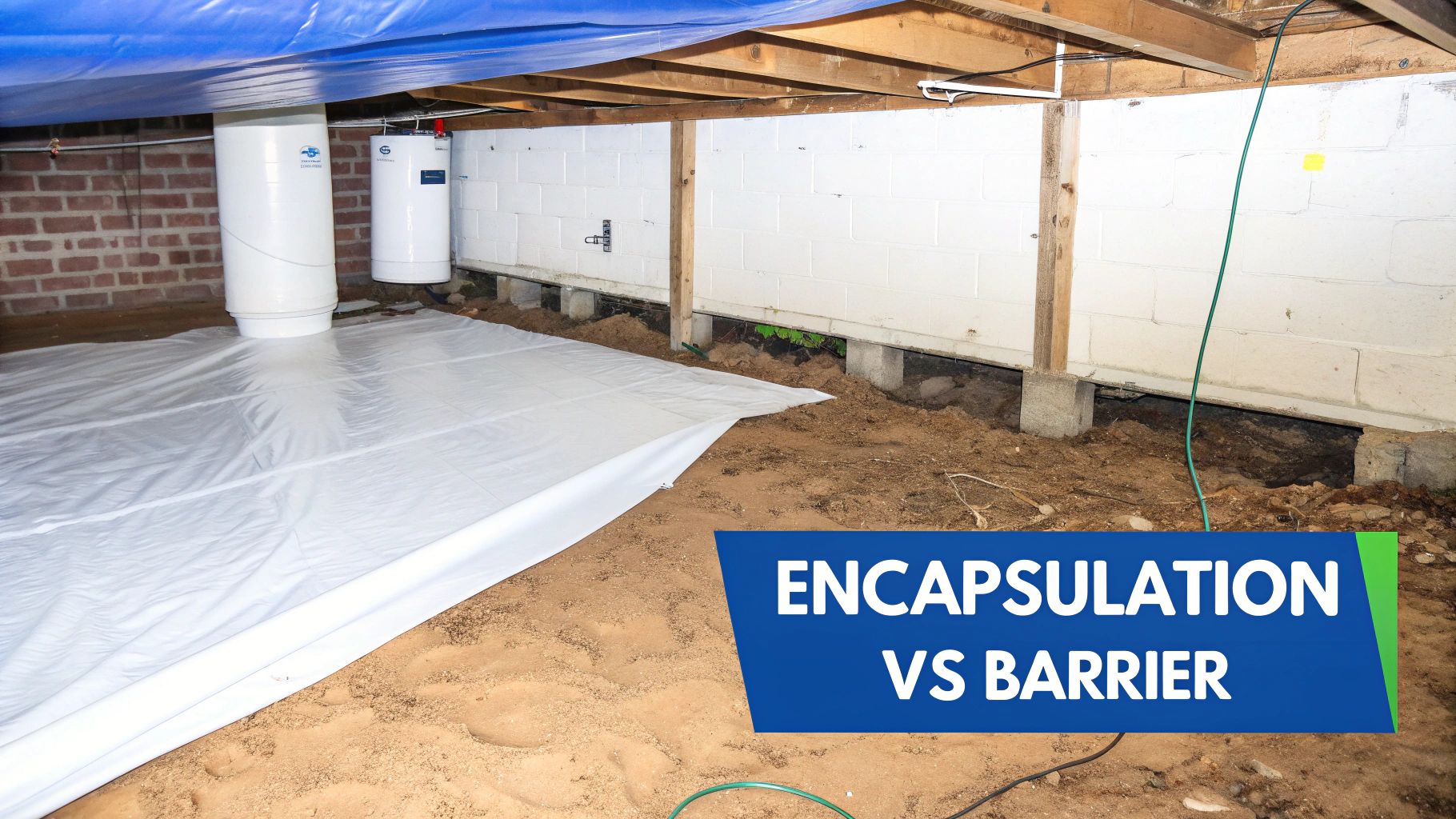
To really get it, you have to understand the fundamental differences. A vapor barrier is focused on one thing: moisture evaporating from the soil. That leaves the walls and vents totally vulnerable to damp air coming in from outside. Encapsulation takes a completely different approach by treating the entire crawl space as a single unit, creating an isolated and controlled environment that's sealed off from the elements.
Quick Comparison: Vapor Barrier vs. Encapsulation
To make it simple, let's break down the key differences side-by-side. This table gives you a clear snapshot of what each option offers.
| Feature | Vapor Barrier | Crawl Space Encapsulation |
|---|---|---|
| Coverage Area | Only covers the ground/floor of the crawl space. | Covers floors, walls, support pillars, and seals vents. |
| Primary Purpose | To reduce moisture evaporation from the soil into the air. | To completely isolate the crawl space from outside air and ground moisture. |
| Air Sealing | Does not seal air leaks from vents, gaps, or the foundation. | Involves sealing all vents and air leaks for a controlled environment. |
| Humidity Control | Passive; does not actively control ambient air humidity. | Active; often includes a dehumidifier to maintain a set humidity level. |
| Material Thickness | Typically 6-10 mil polyethylene sheeting. | Heavy-duty, reinforced liner, often 12-20 mil thick. |
| Pest Control | Minimal impact on pests entering through walls or vents. | Creates a significant barrier against insects and rodents. |
| Cost | Lower initial investment. | Higher initial investment with long-term savings. |
| Best For | Newer homes on high ground with no signs of moisture issues. | Homes with existing dampness, musty odors, or in humid coastal climates. |
As you can see, crawl space encapsulation is simply a much more complete and robust solution for managing moisture. While a standard vapor barrier only lays on the floor, an encapsulation system wraps the entire crawl space. The materials are also a night-and-day difference; encapsulation uses tough, reinforced liners that are often 12-20 mil thick, which is substantially more durable than the typical 6 or 10 mil plastic used for a basic vapor barrier. You can find more insights about these material differences on dfxrepair.com.
The core difference in the crawl space encapsulation vs vapor barrier debate is simple: one is a passive shield, and the other is an active system. A vapor barrier slows down a single source of moisture, while encapsulation creates a completely managed environment beneath your home, protecting it from all angles. This is particularly vital in coastal areas like Ventura, where humid air is a constant threat.
Understanding Your Crawl Space Protection Options
When you're trying to decide between a crawl space encapsulation vs. a vapor barrier, you need to look past the simple definitions. It’s about understanding what each one actually accomplishes for your home. These two approaches aren't just slightly different—they represent two completely different philosophies for managing the moisture under your house.
One is a passive attempt at a fix, and the other is an active, engineered system.
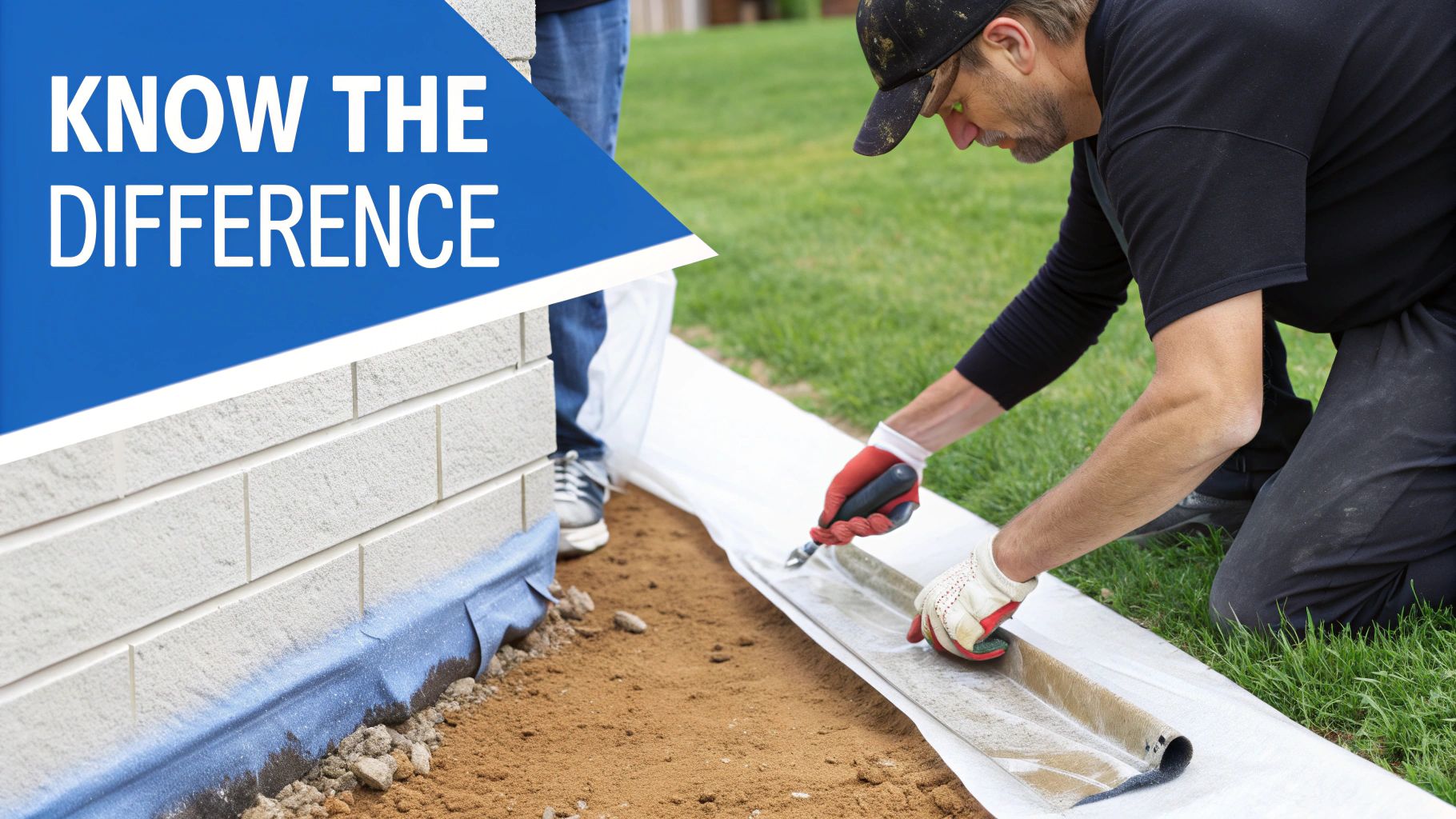
Think of a standard vapor barrier as a basic, passive defense. It’s just a sheet of polyethylene, usually around 6 to 10 mils thick, rolled out over the dirt floor of your crawl space. Its only job is to slow down the moisture evaporating from the soil into the air. While that’s certainly better than leaving the earth floor exposed, it’s far from a complete solution.
This approach leaves your crawl space wide open to a lot of other problems. The foundation walls are still exposed, the vents are left open, and the seams in the plastic are rarely sealed properly. This means humid coastal air, pests, and allergens can still waltz right in, which undermines much of the benefit.
The Limits of a Vapor Barrier
A vapor barrier is really a one-dimensional fix for what is almost always a multi-faceted problem. It only deals with moisture coming from one source—the ground—while completely ignoring other critical ways moisture and contaminants get in.
Here’s where a vapor barrier falls short:
- Exposed Walls and Vents: Concrete walls are porous and act like a sponge, soaking up moisture from the soil around them. And those open vents? We now know they often let more humid air in than they let out, especially during Santa Barbara's damp spring and summer months.
- Incomplete Seal: Without being professionally taped at the seams and mechanically sealed to the foundation walls and support pillars, moisture just creeps in around the edges of the plastic sheeting.
- No Humidity Control: A simple plastic sheet on the ground does absolutely nothing to control the humidity already in the air. This airborne moisture can still condense on cooler surfaces like your pipes and floor joists, creating the perfect conditions for mold and wood rot.
Think of a vapor barrier like holding an umbrella in a hurricane. It might keep some rain off your head, but it won’t do a thing against the driving wind and water hitting you from all sides. Encapsulation, on the other hand, is like being inside a secure, dry building.
Encapsulation: A Complete Engineered System
Crawl space encapsulation is a different beast entirely. It’s an active, engineered system designed to completely seal off the crawl space from the outside world. It transforms that damp, dirty space from a liability into a clean, dry, and healthy part of your home. This is a much more involved process that treats the entire area as a single, controlled environment.
The process starts by installing a heavy-duty, reinforced liner—often 12 to 20 mils thick—that covers not just the floor but also runs all the way up the foundation walls. Every seam is overlapped and sealed with specialized tape, and the liner is mechanically fastened to the walls to create a truly airtight barrier. Critically, all vents and air leaks to the outside are permanently sealed off.
This comprehensive approach is the only way to achieve total crawl space moisture control and eliminate the conditions that allow mold to take hold.
But it doesn't stop there. A true encapsulation system is almost always paired with a dedicated crawl space dehumidifier. This is the final, crucial piece of the puzzle. The dehumidifier actively manages the relative humidity within the newly sealed space, keeping it below the 50% threshold where mold can grow. By creating this controlled environment, encapsulation doesn't just block moisture; it actively removes it. It fundamentally changes the ecosystem beneath your feet for the better.
How Each Solution Performs in Our Coastal Climate
For homeowners in Santa Barbara and Ventura, the debate over crawl space encapsulation vs. a vapor barrier isn't just academic. Our beautiful coastal environment—with its marine layer, winter rains, and year-round humidity—creates a unique set of challenges that can turn an unprotected crawl space into a breeding ground for problems that affect your entire home.
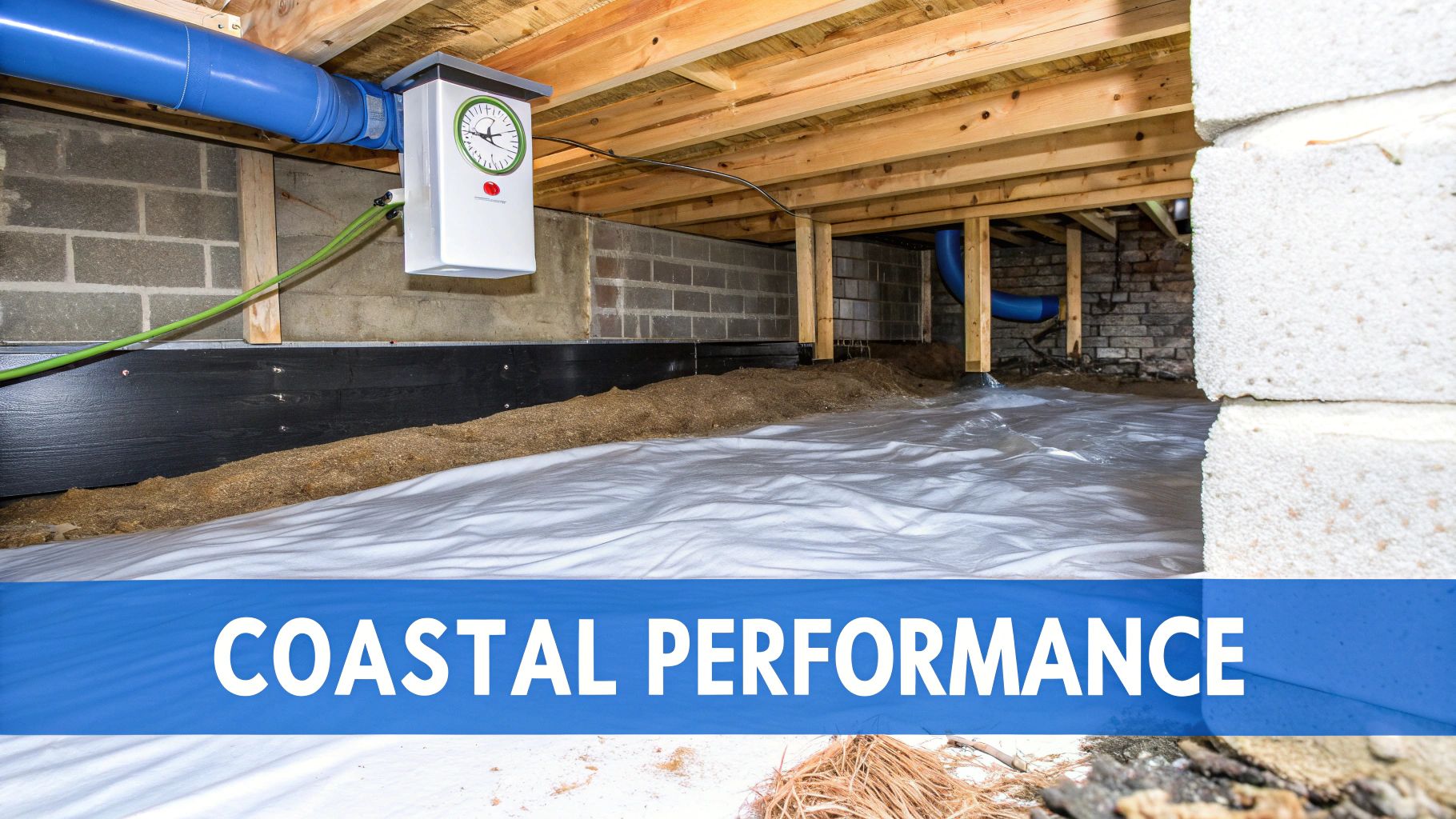
A standard vapor barrier offers a very basic first line of defense. By laying plastic sheeting over the soil, it slows down moisture evaporating directly from the ground into the crawl space. That’s it. That’s where its job ends. It does absolutely nothing to stop humid, salt-heavy air from pouring in through foundation vents or seeping through porous concrete walls.
That single limitation is a huge vulnerability in our climate. During foggy mornings or after a rainstorm, the relative humidity outside can easily top 70-80%. A simple plastic sheet on the ground is completely powerless against this airborne moisture, which then condenses on cooler surfaces like your floor joists and ductwork. It’s the perfect recipe for wood rot and decay.
The Vapor Barrier’s Performance Gaps
A vapor barrier’s performance here on the coast is defined by what it can’t do. It’s a passive solution fighting an active, constant environmental pressure.
- No Defense Against Airborne Humidity: It fails to block the number one source of moisture in our region—the humid air itself. In fact, open vents actively invite this problem inside.
- Condensation Risk: It doesn’t control the dew point inside the crawl space. This means condensation can still form on pipes, insulation, and framing, leading to moisture damage.
- Limited Mold Prevention: While it helps with ground moisture, it doesn’t eliminate the airborne humidity that mold needs to thrive on every other surface in the crawl space.
In the unique climate of Santa Barbara and Ventura, a vapor barrier is like trying to dry a room with a single sponge while leaving the windows open during a rainstorm. It addresses only one small part of a much larger, more persistent problem.
Encapsulation’s Comprehensive Climate Control
This is exactly where crawl space encapsulation proves its worth. It isn’t just a barrier; it's a complete environmental control system designed to shut down every pathway moisture can take—an absolute must for our coastal homes.
By sealing all the vents and wrapping the floors and walls with a thick, impermeable liner, encapsulation completely isolates the crawl space from the outside climate. Then, we add a high-efficiency dehumidifier to actively manage the air inside, keeping the humidity at a consistently low level (usually between 30-50%). This holistic approach directly neutralizes the specific threats our environment poses.
The fundamental difference is how each one manages water. Encapsulation systems are engineered to handle both gaseous water vapor and potential liquid water from leaks or intrusion. Traditional vapor barriers, on the other hand, are only designed to slow down moisture coming up from the soil.
A Proactive Defense Against Mold and Rot
The performance difference is most obvious when it comes to preventing mold. Mold spores are everywhere, all the time. But they need two things to grow: a food source (like the wood framing of your home) and moisture. A vapor barrier might reduce one source of that moisture, but it leaves plenty of airborne humidity for mold to flourish.
Encapsulation actively robs mold of the moisture it needs to survive. By creating a dry, conditioned space, it transforms the crawl space from a mold incubator into an environment where fungus simply can't grow. For your family’s health and the structural integrity of your property, that distinction is critical. As our guide on how to prevent mold growth explains, controlling moisture is the single most effective strategy.
Ultimately, when you're weighing crawl space encapsulation vs. a vapor barrier for a coastal home, performance is everything. Encapsulation offers a robust, multi-layered defense that is perfectly suited to the challenges of our climate. A vapor barrier, in contrast, provides a limited, single-point solution that leaves your home vulnerable.
Breaking Down the Cost: Short-Term Price vs. Long-Term Value
When you’re weighing crawl space encapsulation against a vapor barrier, it’s easy to get fixated on the initial price tag. And yes, a basic vapor barrier is cheaper upfront. But that’s only the beginning of the financial story. The real picture emerges over time, factoring in energy savings, preventing expensive repairs, and protecting your home’s value.
Thinking of a vapor barrier as a simple, one-time fix is a common mistake. While it costs less to install, it’s a pretty limited defense against moisture—especially in a coastal climate like ours here in Santa Barbara. If it doesn’t fully control the humidity, you could be facing some serious hidden costs down the road.
On the other hand, crawl space encapsulation is a true investment in your home’s health and efficiency. The higher initial cost covers a complete system, and it’s one that delivers a tangible return. That return shows up in your monthly bills and even in your home's resale value.
What Goes into the Initial Investment?
So, what makes the prices so different? A vapor barrier installation is straightforward. It’s mostly just the cost of a roll of polyethylene sheeting and the labor to lay it out on the crawl space floor. It’s a single-step job.
Encapsulation is a whole different ballgame. It's a multi-stage process that requires more advanced materials and skilled labor. The cost reflects a much more involved project:
- Heavy-Duty Liner: We’re not talking about thin plastic. A thick, reinforced liner (12-20 mil) costs significantly more than the standard 6-mil plastic used for a basic vapor barrier.
- Total Sealing: Labor costs are higher because the job is meticulous. It involves sealing every seam, fastening the liner to the foundation walls, and permanently sealing off vents and air leaks.
- Dehumidifier: A high-quality, energy-efficient crawl space dehumidifier is a non-negotiable part of the system, which adds to the initial price.
While you'll pay more for encapsulation at the start, you're buying a permanent solution, not just a temporary patch. That’s the key difference when you start thinking about long-term value.
How Encapsulation Pays You Back in Energy Savings
One of the biggest financial perks of encapsulation is the impact on your energy bills. A damp, vented crawl space is constantly working against your HVAC system. In the winter, that cold, moist air seeps up, making your floors cold and forcing your furnace to run overtime. In the summer, the humid air creates a bigger workload for your air conditioner.
Encapsulation creates a dry, conditioned buffer zone under your home. This drastically cuts down on the energy your house needs to stay comfortable. In fact, many homeowners are surprised by how much their utility bills drop. A properly encapsulated crawl space can lower heating and cooling costs by 15-30% every year. Those savings add up and directly chip away at the initial investment. You can find more details about these energy savings on tristatewaterproofing.net.
An investment in full encapsulation isn't just an expense; it's a direct upgrade to your home's energy performance. The monthly savings on your utility bills provide a consistent financial return, making it an investment that pays you back over time.
Dodging Future Costs and Boosting Property Value
The hidden costs of a flimsy moisture barrier can be staggering. A simple vapor barrier that lets humidity build up can lead to mold growth, wood rot, and pest infestations. Suddenly, you're looking at bills for professional mold remediation or structural repairs to your floor joists that can run into thousands of dollars—far more than what you saved by choosing the cheaper option.
Beyond that, a professionally encapsulated crawl space is a huge asset if you ever decide to sell. It gives potential buyers peace of mind, showing them the home is well-maintained, healthy, and energy-efficient. This can genuinely increase your home's market value and make it stand out to savvy buyers who know what to look for. In our work with moisture intrusion solutions, we see firsthand how a dry, sealed crawl space adds real, tangible value.
Ultimately, the financial choice between encapsulation and a vapor barrier comes down to short-term cost versus long-term value. A vapor barrier saves you a little money today, but a full encapsulation protects your investment and saves you a whole lot more tomorrow.
So, What's Right for Your Santa Barbara Home?
Figuring out whether to go with crawl space encapsulation or a vapor barrier really boils down to your home’s unique situation and what you're trying to achieve long-term. Both handle moisture to some degree, but they’re built for very different scenarios—especially in the coastal climate we have here in Santa Barbara and Ventura. To make the right call, you have to be honest about your property’s age, where it's located, and its current condition.
A basic vapor barrier can be a decent starting point, but only in a very narrow set of circumstances. Think of a newer home, built on high ground with fantastic drainage, and absolutely no history of moisture problems or musty smells. In that case, a professionally installed, high-quality vapor barrier might just do the trick. It provides a minimal defense against ground moisture, which could be enough if everything else is already in your favor.
Honestly, though, that ideal scenario is pretty rare around here.
When Encapsulation is the Only Responsible Choice
For the vast majority of homes in Santa Barbara and Montecito, crawl space encapsulation isn't just a "better" option—it's the responsible one. That persistent marine layer and our seasonal rains create an environment where a simple sheet of plastic on the ground is just completely outmatched.
If your home fits any of these descriptions, encapsulation becomes the obvious choice:
- Older Properties: Homes with older foundations tend to be more porous and susceptible to moisture seeping in. A complete seal is really the only way to combat that.
- Homes Near the Coast: Being close to the ocean means constant exposure to humid, salt-heavy air that a vapor barrier does absolutely nothing to stop.
- Visible Dampness or Musty Odors: If you're seeing condensation, have damp insulation, or smell that unmistakable "old basement" odor, you already have an active humidity problem. These are often clear signs of mold in the crawl space that need a real, systemic solution—not just a plastic sheet.
For a Santa Barbara homeowner, choosing encapsulation is an acknowledgment of our coastal reality. It’s a proactive investment in protecting your home’s structure and your family’s health from the constant threat of airborne moisture and the mold that follows.
A Quick Guide Based on Common Scenarios
Let's walk through a few common situations to make this decision crystal clear. Each one highlights different priorities, from health concerns to financial goals, so you can see where your own needs fit in.
Scenario 1: The Allergy Sufferer's Home
If anyone in your house deals with allergies, asthma, or other respiratory issues, the decision is a no-brainer. Encapsulation is the only solution that actively cleans up your indoor air quality by completely sealing off the crawl space. It stops mold spores, dust mites, and other gunk from getting pulled up into your living areas through the "stack effect," creating a much healthier home.
Scenario 2: The Energy-Conscious Homeowner
Are you always looking for ways to lower your utility bills and make your home more efficient? Encapsulation offers a serious return on investment here. By creating a conditioned, dry space under your home, it eases the load on your HVAC system. We’ve seen it lower heating and cooling costs by 15% or more. A vapor barrier offers zero energy benefits.
Scenario 3: The "Forever Home" Investment
If you see yourself living in your home for the long haul, encapsulation is a direct investment in its longevity. It’s all about protecting the structural integrity of your floor joists and foundation from the wood rot and decay that moisture inevitably causes. Think of it as preventative medicine for your house—one that helps you avoid incredibly expensive structural repairs down the road.
Your Next Steps Toward a Healthy Crawl Space
Okay, you've read about the pros and cons. You understand the difference between laying down a basic vapor barrier and going all-in on full encapsulation. But reading online can only get you so far—the real decision starts by understanding what's actually happening in your own crawl space.
Guessing can be a costly mistake. You don't want to install a simple vapor barrier when your coastal home is practically begging for a fully sealed system to combat that persistent dampness from the marine layer. The first real step is a professional assessment.
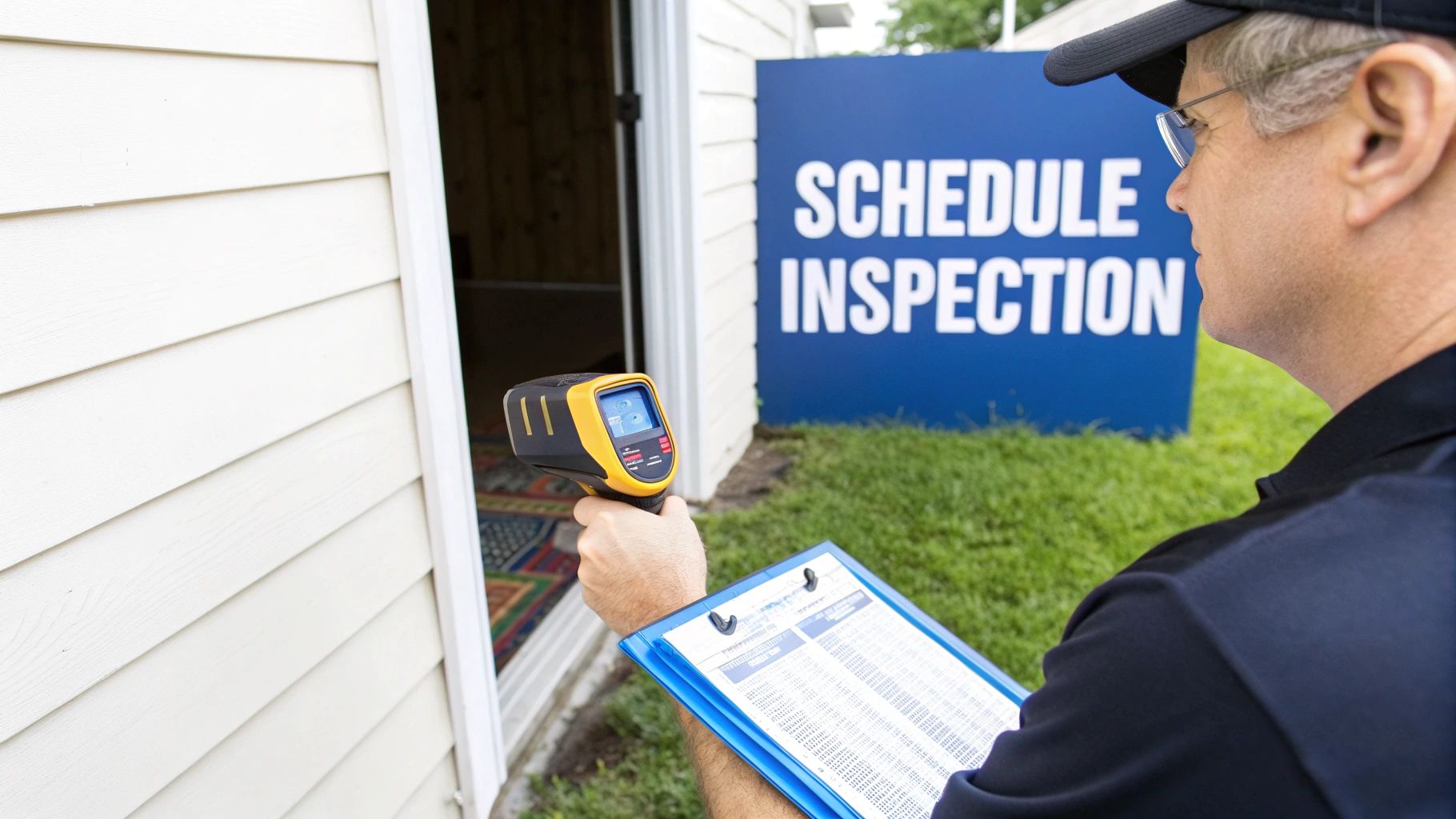
This is where Pacific Mold Pros comes in. Our goal isn't to sell you one solution over the other. It's to give you a clear, data-driven report that pinpoints the source of moisture or mold and recommends the most effective path forward for your specific situation. We provide clarity.
Our Diagnostic Inspection Process
We go way beyond a quick peek with a flashlight. Our certified inspectors use advanced diagnostic tools to get the full story of your crawl space, making sure you see exactly what’s happening beneath your floors.
Our comprehensive assessment includes:
- Moisture Mapping: We use specialized meters to measure the moisture content in the wood framing and concrete, highlighting problem areas that are completely invisible to the naked eye.
- Thermal Imaging: Infrared cameras are our secret weapon for spotting hidden water intrusion and temperature differences that signal poor insulation or air leaks.
- Professional Air and Surface Sampling: If we suspect mold, we take samples for certified lab analysis. Knowing what you're dealing with is a crucial part of a complete mold testing service in Santa Barbara, CA.
- Detailed Reporting: You'll get an easy-to-understand report with our findings, photos, and clear, actionable recommendations designed for your home.
A professional inspection takes the guesswork out of the equation. It provides a scientific baseline, ensuring that the solution you choose—whether it’s a vapor barrier or full encapsulation—is precisely what your property needs to stay healthy and protected.
Scheduling an inspection is the most reliable way to protect your property’s value and your family’s health. It gives you the hard data you need to invest wisely and move forward with confidence.
Ready to take control of your home's health? The Pacific Mold Pros team is here to help homeowners throughout Santa Barbara and Ventura Counties. Contact us today at (805) 232-3475 to schedule your detailed crawl space assessment and get the clear answers you deserve.
Common Questions We Hear from Homeowners
When you’re weighing crawl space encapsulation against a vapor barrier, a few key questions always come up. Here are the straight-up answers we give our clients in Santa Barbara and Ventura every day.
Can I Just Install This Myself?
It's tempting to think you can save a few bucks and DIY a vapor barrier, and in theory, you can. The problem is, it's a lot trickier than just laying down some plastic. Achieving a perfect seal is everything. Even small gaps, un-taped seams, or places where the plastic isn’t perfectly secured to the foundation walls will let moisture sneak right past, making the whole effort pointless.
Encapsulation, on the other hand, is absolutely a job for the pros. This isn't a weekend project. It involves specialized, heavy-duty materials, expert-level cutting and fitting around pipes and piers, and a meticulous process of sealing every single seam, vent, and opening. A botched encapsulation job is worse than no encapsulation at all—it can actually trap moisture against your home’s structure, creating a bigger disaster than what you started with.
Will Encapsulation Really Make My Home's Air Cleaner?
Yes, and it’s one of the most significant benefits. It all comes down to something called the "stack effect." Think of your house as a chimney—air naturally gets pulled up from the lowest point (your crawl space) and circulates into your living areas above. If that crawl space is a damp, musty, moldy mess, you're breathing in that contaminated air all day long.
Encapsulation puts a stop to this. By completely sealing the crawl space and controlling the humidity, you cut off that upward flow of dirty air at the source. The result is dramatically cleaner, healthier air throughout your home. For families with allergies or asthma, this can be a game-changer.
How Long Will Each Option Last?
There’s a massive difference in longevity here, which really reflects the quality of materials and the level of installation. You get what you pay for.
-
Vapor Barrier: A typical 6-10 mil plastic sheet you'd find at a hardware store might give you 5-10 years if you're lucky. Over time, it gets brittle, tears easily, and gets damaged by anyone who has to go into the crawl space for maintenance. It’s a temporary fix, not a long-term solution.
-
Crawl Space Encapsulation: A professional encapsulation system uses a thick, reinforced liner (think 12-20 mil). It’s designed to be a permanent part of your home. With proper installation and minimal maintenance, a good encapsulation system can last 20 years or more—often for the entire life of the house. It's a one-and-done investment in your home's health and value.