That musty smell in your basement isn't just an annoyance—it's your home's way of sending up a flare. It’s a dead giveaway that you have excess moisture, and where there's moisture, trouble is often brewing. Because they’re below ground, basements are naturally damp, creating the perfect environment for mold, mildew, and other allergens that can seriously tank your home's air quality.
Why a Damp Basement Is a Bigger Problem Than You Think
Ever wonder why basements feel like a magnet for dampness? It's simple physics. Basements are almost always cooler than the rest of your home. When warmer, humid air from upstairs or outside makes its way down, it hits that cooler environment and can't hold onto its moisture anymore.
The result is condensation. Water vapor collects on cool surfaces like concrete walls, pipes, and floors, creating a state of persistent dampness.
This isn't just about a clammy feeling or a musty odor. You're essentially rolling out the welcome mat for some nasty organisms to thrive. Understanding the risks is the first step toward reclaiming your basement and making it a healthy living space.
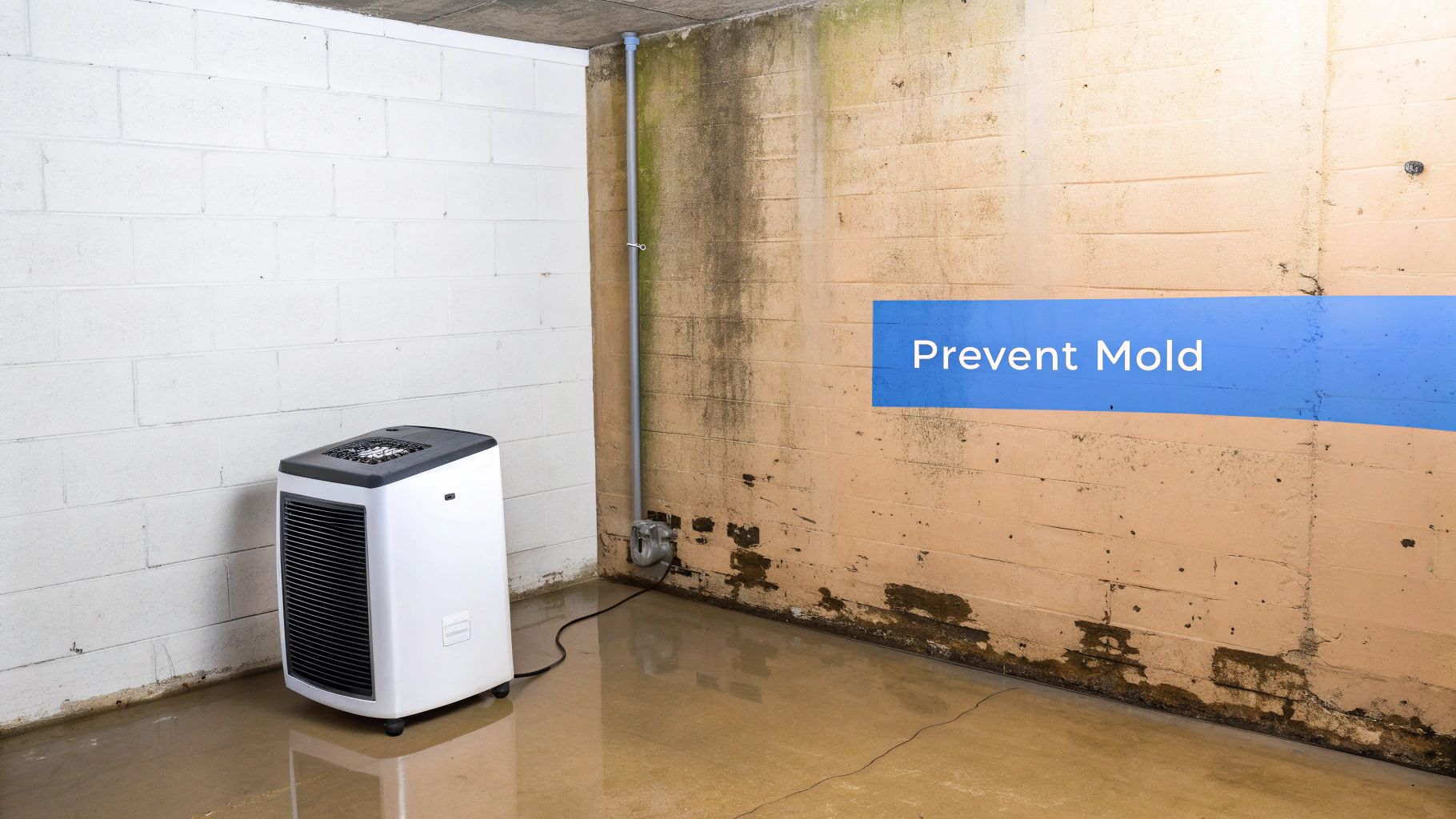
The Dangers of High Humidity
The number you need to watch is relative humidity (RH). This metric tells you how much moisture is in the air compared to the maximum amount it could hold at that temperature. Once your basement's RH consistently creeps above 60%, you’ve officially entered the danger zone.
High humidity is an open invitation for problems. Mold spores, which are always floating around in the air, suddenly have the fuel they need to multiply like crazy. Dust mite populations explode, and bacteria find perfect conditions to grow—all of which can trigger allergies and nasty respiratory issues.
But the consequences of unchecked moisture go way beyond health concerns. High humidity can also lead to:
- Structural Damage: All that moisture can seep into wood joists, beams, and flooring. Over time, this leads to rot and decay that can weaken the very foundation of your home.
- Property Damage: Anything you store in the basement—furniture, books, family photos, electronics—can be ruined by mold, mildew, and corrosion.
- Pest Infestations: Damp, dark spaces are a five-star resort for pests like cockroaches, silverfish, and termites, which can cause even more damage.
A dehumidifier isn't just another appliance; it's your first line of defense in protecting your property and your family. By taking active control of the relative humidity, you can transform your basement from a liability into a safe, usable part of your home. You can learn more about the specific health effects of household mold in our detailed guide. Getting your dehumidifier settings right is the most effective first step you can take.
Finding the Ideal Humidity Level for Your Basement
Let’s cut right to it. The magic number you're looking for when it comes to your basement's relative humidity (RH) is somewhere between 30% and 50%. This isn't just a number we pulled out of thin air; it’s the sweet spot backed by building science to keep your basement healthy and dry.
Think of this range as your basement’s comfort zone. If you let the humidity creep above 50%, you’re practically rolling out the welcome mat for mold, mildew, and dust mites. On the flip side, dropping below 30% can make the air uncomfortably dry, which can lead to everything from dry skin to cracked wooden furniture. Nailing this range is the single most important thing you can do to protect your home.
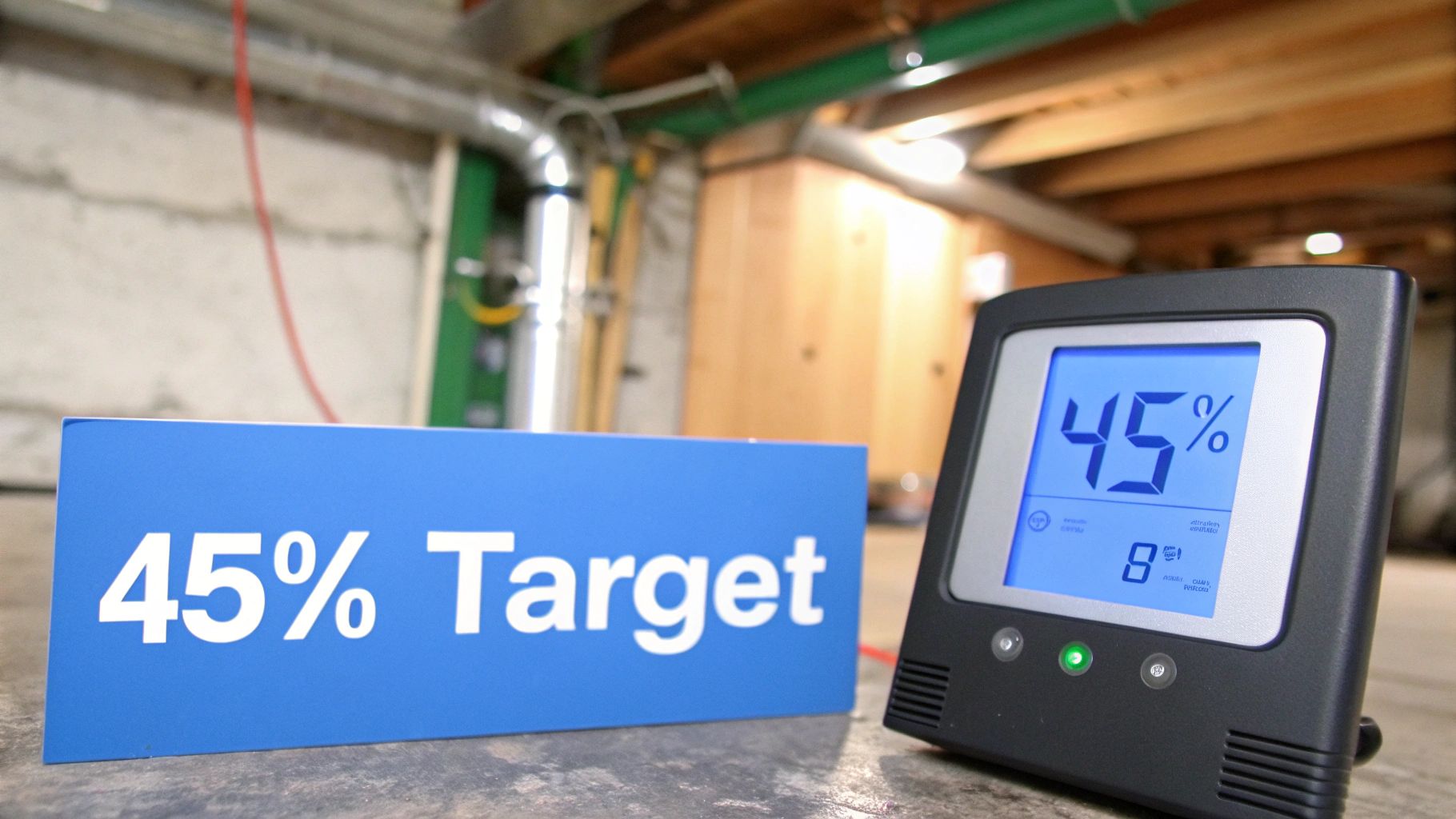
Why 45 Percent Is the Gold Standard
While anywhere from 30% to 50% is good, my years of experience have shown that setting your dehumidifier to 45% is the perfect target for most basements. Basements are naturally cooler, and that cooler air simply can't hold as much moisture. Setting the dial to 45% gives you an effective buffer against dampness without forcing the unit to run constantly or making the air feel too parched.
This specific setting is powerful enough to stop mold spores in their tracks but efficient enough to keep your energy bills from skyrocketing. This is especially critical in humid coastal areas like Santa Barbara and Ventura Counties. Studies have shown that up to 70% of homes with sustained humidity levels over 60% will eventually deal with mold. Even the Environmental Protection Agency (EPA) points to the 30% to 50% range as ideal, and that 40-50% zone is particularly effective for those cooler basements where mold loves to hide.
Quick Answer: For a healthy basement, set your dehumidifier's target relative humidity to 45%. This one simple setting is your best defense against mold, musty odors, and damage to your home’s structure and your stored belongings.
Understanding Different Humidity Levels
To give you a clearer picture of why this matters so much, let's look at what's actually happening at different humidity levels. The wrong setting can make your dehumidifier either totally ineffective or, worse, counterproductive.
Here’s a breakdown of what various Relative Humidity (RH) levels really mean for your basement. Think of this as your cheat sheet for a healthy home.
| RH Level | Effect on Basement Environment | Recommended Action |
|---|---|---|
| Above 60% | Danger Zone. Mold and mildew growth is practically guaranteed. Musty smells are strong, and you'll see condensation on walls and pipes. | Lower the setting immediately. If it's been this high for a while, it’s time to consider a professional mold inspection. |
| 50% – 60% | At-Risk Zone. Mold growth becomes a real possibility, especially in corners with poor airflow. The air just feels damp and clammy. | Adjust your dehumidifier down into the ideal range. I'd aim for 45% to get it under control. |
| 30% – 50% | Ideal Zone. The air feels fresh and dry. This environment makes it tough for mold, mildew, and dust mites to survive. | Perfect. Keep it here. Just check on it periodically to make sure the unit is maintaining a consistent level. |
| Below 30% | Too Dry. This can cause static electricity, dry skin, and irritated sinuses. You might even notice wood starting to crack. | Your dehumidifier is working too hard. Raise the target humidity back up to around 40-45%. |
Getting this right isn't just about tweaking an appliance—it's about actively managing your home's health. You can learn more about at what humidity mold grows in our comprehensive article. By targeting 45% RH, you’re taking a powerful, proactive stance against moisture damage before it can even start.
Choosing Your Dehumidifier Mode: Continuous vs. Auto
Okay, you've dialed in your target humidity. Now for the next big decision: which mode should you use? Most dehumidifiers today give you two main options: Continuous and Auto. Getting the difference between them is the key to managing your basement's climate without wasting a ton of electricity.
Think of Continuous mode (sometimes called "Turbo" or "Max") as your heavy hitter. It's a short-term power tool that tells the dehumidifier to run its compressor and fan constantly, completely ignoring whatever humidity target you’ve set. This mode is your go-to for tackling serious, immediate moisture problems.
When to Use Continuous Mode
Continuous mode is definitely not for everyday use, but it's a lifesaver in a few specific situations. You'll want to flip it on whenever you need to yank a massive amount of moisture out of the air, and fast.
A perfect example is when you first plug in a new unit in a really damp basement. Let it rip on Continuous for 24-48 hours just to get that initial, overwhelming humidity level down to a manageable state.
Other times it comes in handy:
- After a water leak or minor flood: Once you've cleared out the standing water, this mode is a beast for drying out the air, walls, and floors.
- During a week of non-stop rain: When the ground around your foundation gets saturated, basement humidity can spike. Continuous mode helps you fight back.
- Drying new construction materials: If you’ve just poured concrete or have fresh drywall mud, running the dehumidifier on high will seriously speed up the curing process.
Why Auto Mode Is Your Everyday Hero
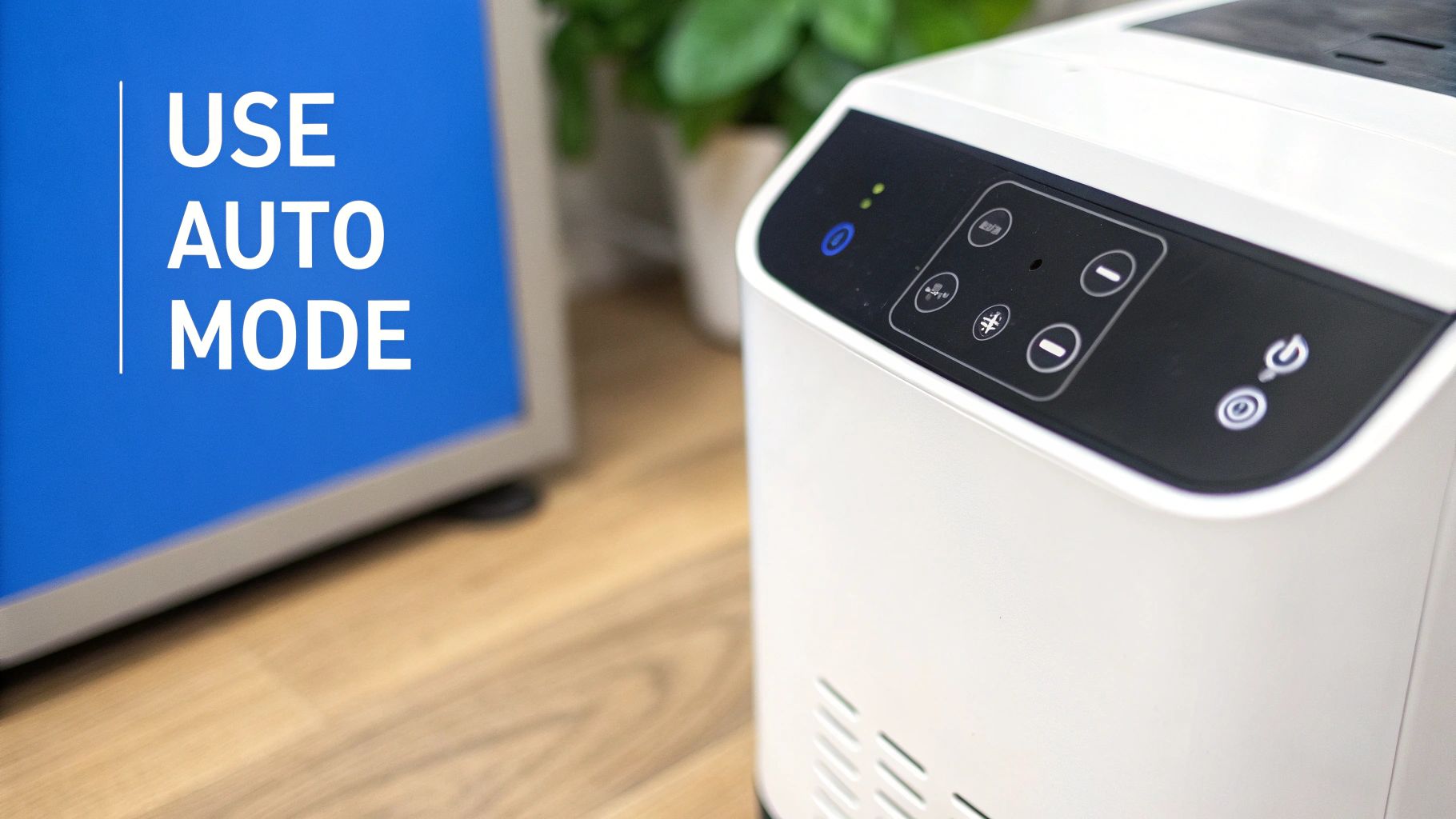
For the long haul—the day-in, day-out grind of keeping your basement dry—Auto mode is your best friend. In this setting, the machine uses its built-in sensor, called a humidistat, to keep an eye on the room's relative humidity.
It will run as hard as it needs to until it hits your target (that sweet spot of 45%), and then the compressor will automatically shut off. The fan might still run for a bit to circulate air, but the real energy-guzzling part takes a break.
The unit then just cycles on and off as needed to hold that perfect humidity level. This "set it and forget it" approach keeps your basement protected without you having to constantly mess with the settings or dreading your next electricity bill.
After you've used Continuous mode to knock down a big moisture problem, always switch back to Auto mode and set your target humidity to 45%. This is hands-down the most efficient and effective strategy for year-round basement health.
By knowing when to use each mode, you’re ready for any moisture situation, whether it’s a small emergency or just routine upkeep. It’s a simple tweak that puts you in complete control of your home’s air quality. And if you're looking for more ways to keep your home dry, check out our guide on how to reduce humidity in your house. Using your dehumidifier correctly is a fantastic first step.
Smarter Placement and Drainage for Better Results
Dialing in the perfect dehumidifier settings for your basement is a great start, but those settings don't mean much if the unit is stuck in the wrong spot. Where you place your appliance is just as crucial as the numbers on its display.
So many people make the mistake of tucking their dehumidifier away in a corner or shoving it right up against a wall. It seems logical—out of sight, out of mind. But doing that basically suffocates the machine.
A dehumidifier needs to breathe. It works by pulling in damp air, wringing the moisture out, and then pushing drier air back into the room. If its intake and exhaust vents are blocked, it can't create the airflow needed to treat the whole basement. It just ends up recycling the same little pocket of air, working way too hard for disappointing results.
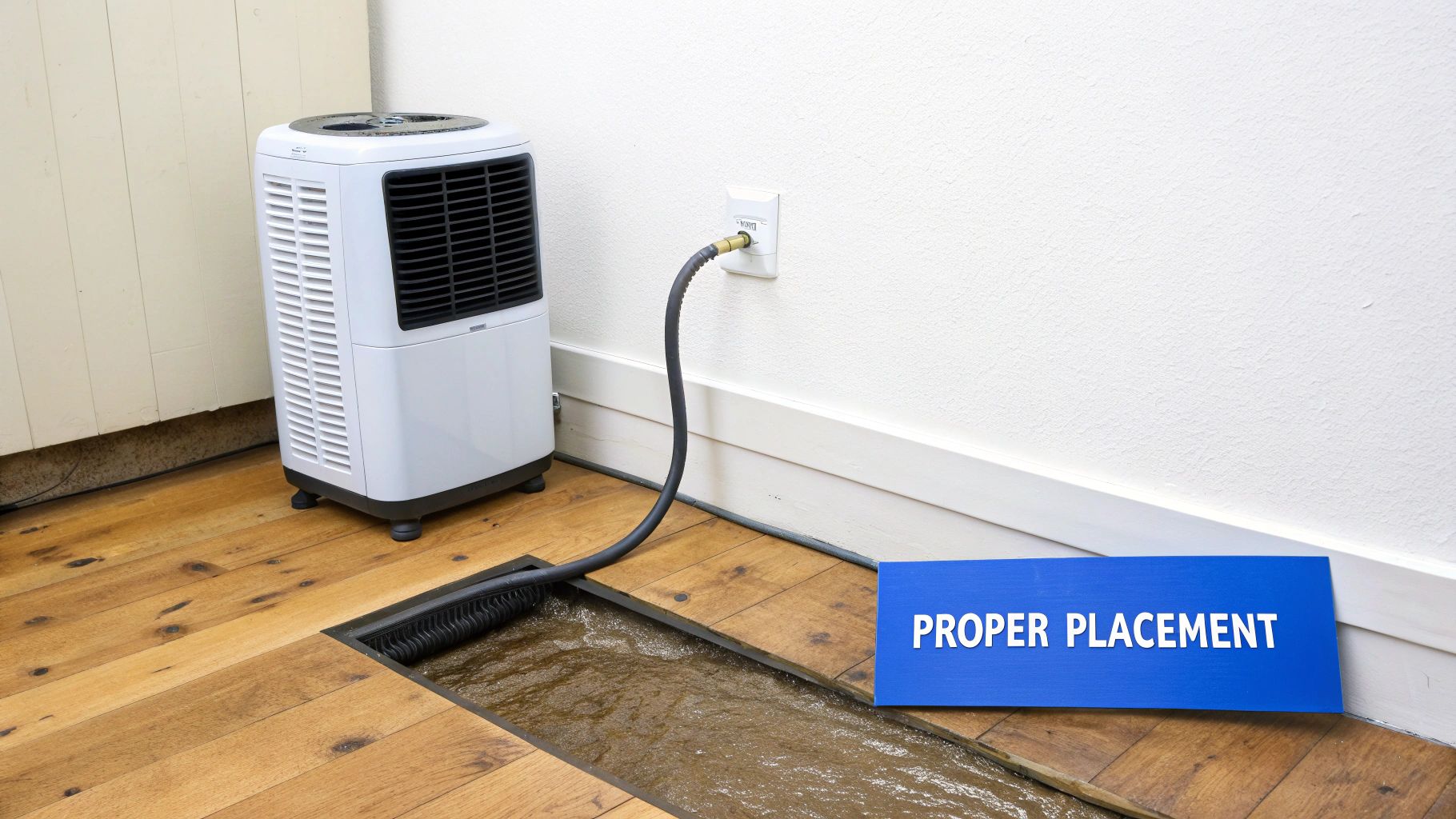
Finding the Right Location
To get the most out of your machine, you have to give it some personal space. A central location is always ideal, but if that’s just not practical in your basement, just stick to one simple rule.
Pro Tip: Always leave at least 12 inches of clearance on all sides of your dehumidifier. This gives it the unobstructed access it needs to pull in humid air and plenty of room to circulate the dry air it pushes back out.
Think about a fan trying to cool down a room—if you point it directly at a wall from two inches away, it’s not going to do much good. The exact same logic applies here. Proper placement lets the unit create a consistent, room-wide circulation pattern that tackles moisture everywhere, not just in one corner.
Creating a Hands-Off Drainage System
Once you’ve found the perfect spot, the next challenge is figuring out what to do with all the water it collects. If your daily routine includes trekking down to the basement to empty a heavy, sloshing water bucket, you're doing it the hard way.
This manual approach is not only a hassle but also risky. If you forget or go out of town, the bucket fills up, the unit shuts off, and your basement is left completely unprotected.
The real solution is a continuous drainage setup. This creates a true "set it and forget it" system, and most modern dehumidifiers come with a dedicated outlet port just for this.
You have two main options for automating the drainage:
Gravity-Fed Hose: This is the easiest method by far. Just attach a standard garden hose to the unit’s drainage port and run the other end to a nearby floor drain. As the name suggests, it uses gravity, so you’ll need to make sure the dehumidifier is elevated slightly above the drain so the water flows downhill properly.
Condensate Pump: What if you don’t have a floor drain, or the only available drain is higher than the unit? This is where a condensate pump becomes a game-changer. It's a small, external pump that you connect to your dehumidifier's drain hose. When water from the dehumidifier fills the pump's little reservoir, it automatically kicks on and pushes the water out through a small tube. This lets you drain it into a utility sink, out a window, or to a much more distant drain.
Setting up continuous drainage is the final piece of the puzzle. It ensures your dehumidifier can run without interruption, giving you constant protection against the kind of moisture intrusion that leads to much bigger problems. If you think your basement has ongoing water issues that go beyond just humidity, take a look at our guide on effective moisture intrusion solutions to help you find and fix the root cause.
When Your Dehumidifier Just Isn't Cutting It
Sometimes, even after you’ve nailed the perfect dehumidifier settings for your basement, something still feels… off. You’ve set the humidity target, you've got it draining continuously, but that stubborn, musty smell just won't quit.
This is a huge red flag.
A good dehumidifier is a workhorse for pulling moisture out of the air, but it can't perform miracles. It isn't designed to fix an underlying water problem. If water is actively seeping into your basement, your dehumidifier is fighting a battle it can never win. It’s just treating a symptom while the real problem gets worse behind the scenes.
Telltale Signs of a Deeper Problem
When your dehumidifier can’t seem to keep up, it’s time to put on your detective hat. There are a few classic signs that point to a much bigger issue than just damp air. These are the clues that tell you water is getting in from somewhere else.
- Peeling or Bubbling Paint: This happens when water vapor travels through concrete or masonry walls, literally pushing the paint right off the surface.
- A Chalky White Powder on Walls: See a crusty, white substance on your concrete? That's efflorescence. It’s the salt deposits left behind when water seeps through the foundation and then evaporates.
- A Musty Smell That Won’t Quit: If that damp, earthy odor persists even when your dehumidifier is holding the humidity steady at 45%, it's a strong hint that mold is already growing somewhere you can't see, like inside a wall cavity.
- Visible Water Stains: Dark spots or streaks on walls, floors, or right where the wall meets the floor are undeniable proof that water is getting in.
These signs mean your problem isn't just humidity—it's water intrusion. The source could be anything from cracks in the foundation to poor exterior drainage that lets rainwater pool against your house.
Why You Need a Professional Look
A dehumidifier might mask these issues for a while, but it will never solve them. Ignoring the source of the water is a surefire recipe for serious structural damage and widespread mold. This is the point where calling in a professional isn't just a good idea—it's essential for protecting your home and your health.
A dehumidifier is a tool for climate control, not a substitute for a waterproof foundation. If you see signs of water intrusion, addressing the source is the only long-term solution.
A professional assessment can uncover these hidden issues before they turn into a nightmare. Here in coastal areas like Santa Barbara, foggy conditions can create a damp climate similar to parts of the UK and Germany. Proactive inspections are key. This strategy is also catching on in Europe, where the dehumidifier market is expected to hit USD 1.50 billion by 2025. Studies there have shown that addressing moisture at its source can prevent 20-30% of mold claims. For more on global trends, check out this market research report.
If you’ve spotted any of these red flags, don't wait for things to get worse. It’s time to learn what to do if you find mold and get a professional evaluation to find the true source of the problem. Fixing a small foundation crack or improving your yard's grading now could save you from a massive and costly remediation project later.
Got Questions About Your Basement Dehumidifier?
Even after you've dialed in the perfect settings for your basement dehumidifier, a few questions might still linger. Getting to know your unit's little quirks is the final piece of the puzzle for mastering your home’s climate. Let’s tackle some of the most common questions we hear from homeowners.
How Do I Know if My Dehumidifier’s Humidity Reading Is Accurate?
That's a great question, and you're right to be skeptical. The humidistat built into your dehumidifier is decent, but it's not always perfectly calibrated. It’s only measuring the air right next to the machine, which can easily be different from the air in the far corner of the room.
For a true picture of your basement's humidity, grab an inexpensive digital hygrometer. Place it in the middle of the room, away from the dehumidifier, to get an honest baseline reading.
If you see a significant difference—say, more than 5-10%—don't worry. Just adjust your dehumidifier's target setting up or down to compensate. If your goal is 45% but your separate hygrometer reads 52%, try setting the dehumidifier to 38% and see if that brings the room into balance.
Why Won’t My Dehumidifier Ever Shut Off?
If your dehumidifier is running constantly, especially on Auto mode, it's telling you it’s struggling to reach its target humidity. It's working overtime, but something is holding it back. This usually boils down to a few common culprits:
- It’s Undersized for the Space: A small dehumidifier in a big, damp basement is like trying to empty a swimming pool with a bucket. It simply can’t keep up with the amount of moisture in the air.
- The Target Is Set Too Low: Aiming for a bone-dry 30% in a naturally damp basement can be an impossible goal, forcing the machine to run 24/7. Stick with that 45% sweet spot for the best results.
- You've Got Air Leaks: A constant stream of humid outside air from open windows, unsealed cracks, or a leaky basement door creates an endless job for your dehumidifier.
- There’s an Active Water Problem: Like we talked about earlier, if water is actively seeping through your foundation, your dehumidifier is fighting a battle it can't win.
If your dehumidifier runs nonstop, first double-check that your target is a realistic 45%. If it still won't cycle off, start hunting for air leaks or signs of water intrusion before you assume the unit itself is the problem.
What Fan Speed Should I Use?
Most dehumidifiers give you at least two fan speeds, and the best choice really depends on what you’re trying to accomplish.
For everyday maintenance, the low fan speed is your best friend. It’s quieter, uses less energy, and can actually be more effective at pulling moisture from the air because it draws air over the cold coils more slowly. Once you've got your humidity under control, this is the setting to use.
The high fan speed is for when you need to bring in the big guns. Use it when you're first drying out a very damp space or after a heavy rainstorm causes a spike in humidity. It circulates air more aggressively, which is great for ensuring the unit is treating the air from the entire basement, not just its immediate vicinity.
For most daily use on Auto mode, the low setting strikes the perfect balance between performance and efficiency.