It's a common question we hear from homeowners in Santa Barbara and Ventura: "If I dry out the mold, will it die?" It's a logical thought, but unfortunately, the answer is no.
Mold does not die without moisture. Instead, it goes into survival mode, entering a dormant, seed-like state. Simply drying out a moldy area only presses pause on the problem—it doesn't solve it.
Understanding Dormant Mold
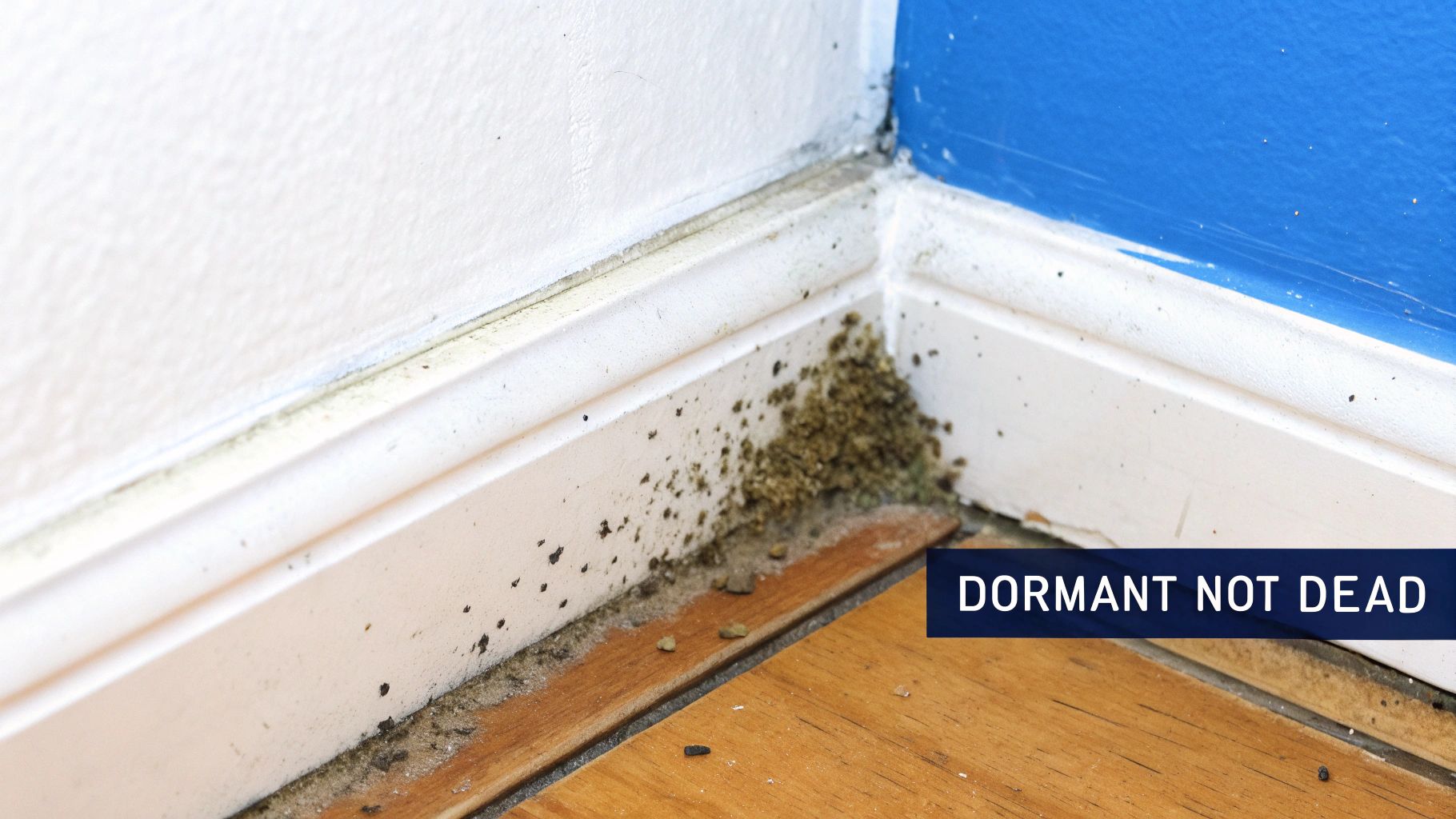
Think of dormant mold spores like seeds in the desert. They aren't actively growing and might not seem like a threat, but they are incredibly resilient survivors. These microscopic particles can hang around for years in dry conditions, just waiting for the one thing they need to spring back to life: water.
When you remove moisture, the visible, fuzzy mold colony will stop growing and may even dry up and crumble. But before it does, it releases countless hardy spores that settle on surfaces all over your home. These spores are the real long-term threat.
Active Growth vs. Dormant Spores
Making the distinction between active and dormant mold is critical. Active mold is an immediate problem, busily damaging materials and pumping allergens into your air. Dormant spores, on the other hand, are a ticking time bomb—a hidden danger ready to explode the moment a leak, spill, or high humidity returns. Understanding at what humidity does mold grow is key to preventing this from happening.
The core takeaway is simple: Drying out mold is not the same as removing it. The underlying spores remain, ready to reactivate. This is exactly why professional remediation focuses on physical removal, not just drying.
Scientific studies back this up. For instance, research on Cladosporium, a very common indoor mold, shows that when relative humidity drops below 60%, the mold's growth stops and it shows signs of cellular stress. But while these dry conditions halt the active colony, the spores are built to endure until moisture returns.
To help you get a clearer picture of what you might be dealing with, let's break down the key differences between a live colony and dormant spores.
Active Mold vs. Dormant Spores At a Glance
Here’s a quick comparison to help you identify the state of mold in your home.
| Characteristic | Active Mold Growth | Dormant Mold Spores |
|---|---|---|
| Appearance | Often fuzzy, slimy, or velvety. Can be black, green, white, or other colors. | Looks like a dry, powdery, or dusty substance, sometimes mistaken for dirt or soot. |
| Smell | Typically produces a distinct musty, earthy odor. | Usually odorless, since there are no active metabolic processes happening. |
| Location | Found in damp, humid areas with an active water source. | Can be found on any surface, even in dry areas, after settling from the air. |
| Risk Level | High immediate risk of property damage and health effects. | High potential risk for future growth and can still act as an allergen. |
Ultimately, whether the mold is actively growing or lying in wait, the spores present a risk. Both scenarios require attention to protect your property and your family's health.
How Mold Spores Play the Long Game
To really get why mold doesn't just die without moisture, you have to understand its secret weapon: the spore. Think of a mold spore less like a living plant and more like a microscopic seed, perfectly engineered by nature for one job—to wait. They are the ultimate survivalists of the microbial world, built to endure conditions that would wipe out an active mold colony in a heartbeat.
This incredible resilience is exactly why just drying out a damp wall isn’t a permanent solution. Sure, the visible fuzzy mold might wither away, but long before that, it released millions of these tiny spores into your home. These nearly weightless particles can float around indefinitely, eventually settling on surfaces like drywall, carpets, and deep inside your HVAC system.
The Science of Survival
A mold spore’s durability all comes down to its unique biological design. It’s basically a reproductive cell wrapped in a tough, protective outer shell. This shell acts like a suit of armor, shielding the spore's precious genetic material from a whole host of environmental threats.
This state of suspended animation is called dormancy. It’s not that different from how a bear hibernates through the winter. The spore slows its metabolism down to almost zero, needing practically no energy or food to survive. It isn't growing, and it isn't reproducing. It's just waiting.
A dormant mold spore is a highly resilient, self-contained survival pod. Its tough exterior and minimal life functions allow it to withstand years of dryness, temperature fluctuations, and lack of a food source, poised for reactivation.
This ability to play the long game is what makes mold so frustratingly persistent. A single spore can sit on a dusty bookshelf or behind a perfectly dry baseboard for years and remain completely viable. It poses little immediate threat in this dormant state, but it represents a huge future risk.
Built to Endure Harsh Conditions
The survival skills of mold spores are truly remarkable. They are designed to withstand challenges that would easily destroy an active, growing mold colony. That’s why dealing with the spores themselves is so critical for long-term indoor air quality.
Several factors make them so tough:
- Dryness: As we've covered, taking away moisture sends spores into dormancy, but it doesn’t kill them. They can survive in extremely dry conditions for a very long time.
- Temperature Extremes: Spores can handle freezing temperatures and significant heat far better than active mold, allowing them to easily persist through hot summers and cold winters.
- UV Light: While direct, prolonged UV exposure can damage spores, their protective shells offer a surprising amount of resistance, especially when they’ve settled in dark corners or wall cavities.
- Physical Durability: Their microscopic size and tough coating mean they can be kicked up by foot traffic or a vacuum cleaner without being destroyed, which only helps them spread throughout a home.
Because they are so light and resilient, managing their presence is key. For those particularly concerned about airborne particles, understanding how to choose from the best air purifiers for mold spores can be an important part of a larger home health strategy.
The Wake-Up Call for Spores
The switch from a dormant spore back to an active, growing mold colony happens shockingly fast. All it takes is the reintroduction of the one thing it's been waiting for: moisture. When a dormant spore lands on a surface that gets damp, it's like an alarm clock goes off.
The spore's outer shell softens, its metabolism roars back to life, and it begins to germinate. It sends out tiny, root-like structures called hyphae to anchor itself and start feeding. This whole process can kick off in as little as 24 to 48 hours after water becomes available.
Suddenly, that "dead" mold problem you thought you solved by just drying things out is back with a vengeance. The cycle begins all over again.
The Tipping Point for Mold Activation
Think of dormant mold spores as tiny seeds scattered everywhere, just waiting for the right conditions to sprout. They’re harmless when they’re sleeping, but when they wake up? That’s another story. The alarm clock that wakes them up is almost always moisture.
The big question we hear from homeowners in Santa Barbara and Ventura is, "How much moisture is actually too much?" It’s not about a single drop of water. It's about creating a consistently damp environment where mold can not only survive but thrive.

The key term to get familiar with is relative humidity (RH). Imagine the air in your home is like a sponge. RH tells you how "full" that sponge is with water vapor compared to how much it could possibly hold at its current temperature. When that sponge gets too full, it has to squeeze the excess moisture out somewhere—usually onto cooler surfaces like your windows, walls, or pipes.
That’s the signal dormant spores have been waiting for.
The 60 Percent Rule
In the world of mold, the tipping point from dormant to active growth usually happens when relative humidity consistently stays above 60%. Now, this isn't an instant switch. A quick spike in humidity from a steamy shower isn't likely to cause a major mold bloom on its own.
The real trouble starts with prolonged exposure. When a surface stays damp for just 24 to 48 hours, those sleeping spores have all the time they need to germinate and start a brand-new colony. This is precisely why a small, undiscovered leak can escalate into a massive mold headache so quickly.
Sustained humidity is the true catalyst. While a temporary bit of moisture might not be a problem, keeping your indoor RH above 60% for long stretches creates the perfect breeding ground that dormant spores have been waiting for.
It's not just the humidity level, but how long it stays there. Research from health officials in North Carolina really drives this home, showing that when RH stays above 70% for extended periods, mold growth becomes almost inevitable. For homeowners, this is a critical distinction. Lingering above 60% is a risk, but sitting above 70% is practically an invitation for mold to move in.
Common Household Culprits of High Humidity
This tipping point isn't always caused by a dramatic flood or a burst pipe. More often than not, it’s the quiet, everyday sources of moisture that slowly push your home's humidity into the danger zone. Knowing what to look for is your first line of defense.
Here are a few of the usual suspects we find in homes:
- Poor Bathroom Ventilation: A hot shower can easily push a bathroom's RH above 90%. If your exhaust fan is weak or you forget to run it, that moisture settles on walls and grout, creating a perfect little mold incubator.
- Slow Leaks: That tiny, nagging drip under the kitchen sink might not seem like a big deal, but it keeps the wood cabinet and drywall consistently damp—a hidden mold factory in the making.
- Condensation: Especially in coastal areas like Santa Barbara, the difference between your cool indoor air and the warm, humid air outside can cause "sweating" on windows, pipes, and poorly insulated walls.
- Unvented Appliances: Things like clothes dryers or even cooking that vent steam directly into a room can dramatically increase the overall moisture load in your home’s air.
Keeping an eye on these areas is key. If you suspect there’s a moisture problem you can’t see, knowing how to read moisture meter readings can give you the hard data on what’s happening behind your walls.
Ultimately, preventing mold from activating is all about controlling your indoor environment. By keeping your relative humidity below 60%, fixing leaks right away, and making sure your home has good ventilation, you deny mold spores the one thing they need to become an active threat. It turns your home from a potential petri dish into a place where mold simply can’t get a foothold.
The Hidden Dangers of Dormant Spores
It's one of the most common mistakes a homeowner can make: assuming that once mold dries out, the problem is solved. But just because you don't see active, fuzzy growth doesn't mean your home—or your family—is in the clear. Dormant mold spores are a quiet but serious threat, and thinking they're harmless is a gamble.
The danger is rooted in their biology. Spores are microscopic, incredibly light, and built for survival. They can hang around on surfaces and in the air for years, just waiting for the slightest disturbance to send them traveling again. Often, it's everyday household activities that stir them up and reintroduce them into the air you breathe.
How Dormant Spores Wreck Your Air Quality
You might not realize it, but simple actions can have a huge impact when dormant spores are lurking. Firing up the vacuum, dusting a bookshelf, or even just the air kicking on from your HVAC system can launch millions of these invisible particles into circulation.
Once they're airborne, they act just like any other microscopic allergen, like dust or pollen. They're easily inhaled and can trigger a whole host of health issues, especially for anyone with sensitivities.
Dormant spores aren't just inert dust. They are biological allergens that can cause irritation and allergic reactions even when they aren't actively growing. Their presence is a direct threat to your home's indoor air quality.
This can be incredibly frustrating. You might find yourself dealing with persistent symptoms without ever spotting a patch of visible mold, leaving you confused about what's causing your discomfort. It's so important to understand the full range of health risks of mold exposure, because both active and dormant forms contribute to the problem.
Common reactions to airborne mold spores include:
- Respiratory Issues: Sneezing, coughing, a runny or stuffy nose, and throat irritation are classic signs.
- Allergic Reactions: For those with mold allergies, exposure can mean more severe reactions, like wheezing, shortness of breath, and even asthma attacks.
- Eye Irritation: Itchy, watery, and red eyes are another frequent complaint when spores are in the air.
A Ticking Clock for Your Home
Beyond the immediate health concerns, a collection of dormant spores is a warning sign. It’s physical proof that a moisture problem happened in the past, and it basically acts as a ticking clock, waiting for that problem to come back.
Think of it like having a pile of dry kindling stacked in the corner. The kindling itself isn't a fire, but the second a spark hits it—in this case, moisture—you've got all the ingredients for a full-blown blaze.
This creates a cycle of recurring mold issues that can be incredibly tough to break without professional help. A small roof leak during a Santa Barbara winter storm or a particularly humid summer day in Ventura could be all it takes to wake up spores that have been lying in wait for years.
The Structural Threat of Reactivation
When these spores get the moisture they need, they don't just reappear. They start to consume whatever organic material they're sitting on. This is where the long-term structural risks really come into play.
Many common building materials are a perfect meal for newly awakened mold:
- Drywall: That paper facing is a favorite food source.
- Wood: Structural beams, subflooring, and framing can be slowly weakened.
- Insulation: Porous insulation gets contaminated easily, losing its effectiveness and helping spread spores through wall cavities.
- Carpet: The fibers and padding are notorious for trapping both spores and moisture, creating a perfect hidden breeding ground.
Each time this cycle of dormancy and reactivation happens, the damage digs a little deeper, potentially compromising your home's integrity from the inside out. That’s why just drying the area isn't enough. You have to address the spores themselves to truly solve the problem and protect your property.
Your Action Plan for Effective Mold Removal
So, we've established that mold doesn't just die when it dries out. Now what? It's time to take control. A truly effective mold removal strategy isn't just about scrubbing what you can see; it's a three-part process that tackles the entire mold lifecycle—from the water that feeds it to the invisible spores left behind.
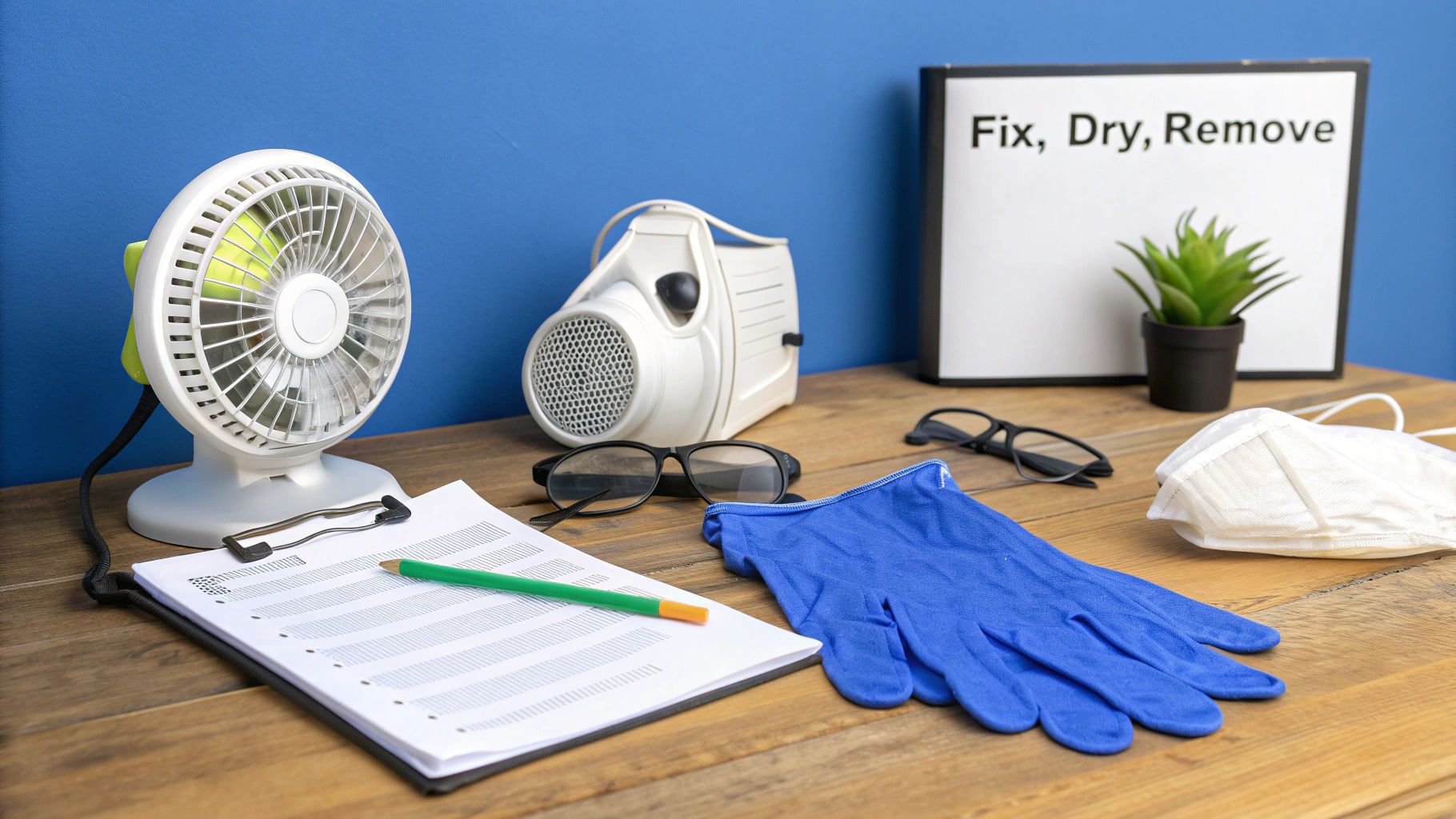
Simply wiping away the visible growth and calling it a day is a recipe for a recurring nightmare. You have to be methodical. The goal is to create an environment where mold simply can't make a comeback.
This process boils down to three critical stages.
Stage 1: Find and Fix the Water Source
This is the absolute, non-negotiable first step. If you don’t stop the moisture, the mold will always return, no matter how much you clean.
Your mission here is to play detective. Trace the mold back to its source of water. Start with the obvious culprits: a dripping pipe under the sink, a leaky roof flashing, or heavy condensation building up on your windows. Then, dig deeper. Look for less obvious sources like poor ventilation in a steamy bathroom or a slow, hidden leak inside a wall.
Once you find it, fix it. And fix it completely. This might mean calling a plumber, installing a new exhaust fan, or even regrading the soil outside your home to keep water from seeping into the foundation.
Stage 2: Dry the Affected Area Thoroughly
With the leak plugged, your next priority is to get everything bone dry. This step is crucial because any lingering dampness is an open invitation for those dormant spores we talked about to wake up and start a new colony.
For smaller jobs, you can often get by with fans to increase airflow and a good dehumidifier. You're aiming to get the relative humidity in the space consistently below 50%. That’s the magic number for creating an environment that’s hostile to mold.
A common mistake we see is only drying the surface. Moisture loves to soak deep into porous materials like drywall and wood. You need to ensure the area is dry all the way through, not just to the touch.
For bigger disasters, like a major leak or flood, you'll likely need professional-grade drying equipment to pull moisture out of structural materials and prevent serious long-term damage.
Stage 3: Safely Clean and Remove the Mold
Finally, it’s time to tackle the mold itself—both the active, growing colonies and the dormant spores. How you do this is critical for avoiding cross-contamination and protecting your own health.
On non-porous surfaces like glass or tile, a good scrub with a detergent solution can do the trick. But for porous materials like drywall, carpet, or insulation, removal is almost always the only safe bet. Once mold sinks its "roots" into these materials, it's nearly impossible to clean it all out.
A Critical Warning About Bleach
So many people reach for bleach, thinking it will kill mold. Unfortunately, it's often ineffective and can even make things worse. Bleach might kill surface mold, but its high water content can soak into porous materials, feeding the deeper parts of the colony you can't see. For better, safer methods, you can learn how to remove mold from walls the right way.
DIY vs. Professional Mold Remediation: When to Call for Help
Knowing your limits is key. A tiny patch of surface mold on your shower tile is often a manageable DIY project. But some situations absolutely demand a professional’s touch.
Deciding whether to tackle a mold problem yourself or call for backup is a huge decision. Here’s a quick guide to help you make the right call.
| Situation | Recommended Action | Reasoning |
|---|---|---|
| Mold area is small (under 10 sq. ft.) on a non-porous surface. | DIY | Can be effectively cleaned with proper safety gear (gloves, mask) and containment. |
| Mold area is larger than 10 sq. ft. | Call a Professional | Large infestations require professional containment to prevent spores from spreading throughout the home. |
| Mold is inside your HVAC system or ductwork. | Call a Professional | Attempting to clean HVAC systems yourself can blast spores into every single room in your house. |
| You smell a strong, musty odor but see no mold. | Call a Professional | This is a classic sign of hidden mold, likely inside walls or under flooring, which requires specialized detection tools. |
| A household member is immunocompromised or has severe allergies. | Call a Professional | The health risks are just too high. Professionals use advanced techniques to ensure complete spore removal and protect your family. |
While a DIY approach might seem like it saves money upfront, a job done incorrectly can lead to recurring growth, more property damage, and ongoing health issues. When in doubt, consulting a certified professional like Pacific Mold Pros in Santa Barbara or Ventura gives you certainty that the problem will be solved for good.
When Should You Call a Professional for a Mold Assessment?
Sometimes, what you can’t see is far more dangerous than what you can. While a tiny spot of surface mold can often be a simple DIY fix, many situations call for an expert eye to understand the true scope of the problem.
Guesswork just isn’t a strategy when your family’s health and your home's integrity are on the line. A professional mold assessment replaces that uncertainty with hard facts, giving you a clear roadmap for what to do next.
Knowing when to bring in a certified inspector is half the battle. Certain scenarios are major red flags that the problem is more widespread or hidden than it appears.
Clear Signs You Need an Expert
If you find yourself in any of the following situations, picking up the phone is the smartest—and safest—move you can make. These are the times when the risks of an incomplete or improper assessment are just too high.
You Smell Musty Odors But See No Mold: This is the classic sign of hidden mold. A persistent earthy or musty smell is a strong indicator that a colony is growing somewhere out of sight—inside a wall, under the floorboards, or deep within your HVAC system. Professionals use tools like moisture meters and thermal imaging cameras to pinpoint these hidden sources without tearing your walls apart.
After a Major Water Event: After a flood, a burst pipe, or a significant roof leak, you should always assume mold is a possibility. Water seeps into structural materials much deeper than you might think, and mold can start growing in as little as 24-48 hours. A professional assessment can determine the extent of the moisture damage and identify at-risk areas before a full-blown infestation takes hold.
During a Real Estate Transaction: Whether you're buying or selling a home in Santa Barbara or Ventura, a mold inspection provides critical peace of mind. For buyers, it uncovers potential hidden issues that could lead to expensive repairs and health problems down the road. For sellers, it demonstrates transparency and can prevent last-minute surprises from derailing the sale.
When a Household Member is Immunocompromised: For anyone with asthma, severe allergies, or a compromised immune system, even low levels of mold spores can pose a significant health risk. In these cases, professional testing is essential to ensure the indoor air is truly safe. Air sampling can measure the concentration and types of spores, giving you the data needed to protect vulnerable family members.
A professional mold assessment isn’t just about finding mold; it’s about understanding the "why" and "how." It identifies the moisture source, maps the extent of the problem, and determines the specific types of mold present, giving you a complete picture of your home's health.
Ultimately, a professional assessment gives you certainty. Instead of wondering if you "got it all," you'll get a detailed report from a company like Pacific Mold Pros that outlines exactly what's happening and the precise steps needed for effective remediation.
Common Questions About Mold and Moisture
Even after learning that mold doesn't really die, just goes dormant, a lot of questions usually pop up. Here are some of the most common ones we hear from homeowners in Santa Barbara and Ventura, with clear answers to help you figure out your next steps.
Common Questions About Mold
We get asked about mold all the time. To make things easier, we've put together a quick-reference table with answers to the questions that come up most often.
| Question | Answer |
|---|---|
| Can mold spores travel through the air? | Yes, absolutely. Mold spores are microscopic and incredibly light. The slightest disturbance—like sweeping, dusting, or even just your HVAC system kicking on—can send them floating throughout your entire home. This is how a small problem in one room can quickly spread. |
| Will a dehumidifier kill mold? | No, a dehumidifier will not kill mold. Think of it as a prevention tool. By keeping your home's humidity below 50-60%, you're making it impossible for dormant spores to "wake up" and start growing. But it won’t get rid of the spores that are already there; they still need to be physically removed. |
| Is it safe to live with dormant mold? | No, it's not considered safe. While dormant spores aren't actively eating away at your drywall, they are still potent allergens. They can seriously degrade your indoor air quality and trigger allergies, asthma, and other respiratory problems, especially in kids or sensitive adults. |
| What's the best way to get rid of mold for good? | Professional removal is always the best course of action. Simply cleaning the visible spots isn't enough because the spores are microscopic and airborne. A professional remediation ensures the source is fixed, the mold is contained and removed safely, and the air is cleaned to protect your family's health. |
Hopefully, this table gives you a better sense of how to handle mold. The key takeaway is that mold spores are resilient, and managing moisture is only half the battle.
A Deeper Look at Dormant Mold
It's tempting to think that once you've dried out a damp area, the problem is solved. But dormant mold is like a ticking time bomb.
It's a clear sign that a moisture problem has happened before, and without addressing the root cause, it will almost certainly happen again. Every time humidity spikes or a small leak occurs, you're risking a full-blown mold outbreak.
This is why proper, professional removal is so important. When you work with a certified inspector like Pacific Mold Pros, we don't just look at the visible signs. We investigate the underlying moisture issues to ensure that once the mold is gone, it stays gone. It's the only way to truly protect your property and your family’s health from future problems.