When you punch "indoor air quality testing near me" into a search bar, you're doing more than just looking for a service. You're acting on a feeling—that persistent cough, the musty smell that won't go away, or allergy symptoms that seem to hit the moment you walk in the door. It’s the first step toward finding answers to a problem you can feel but can't see.
Why Local Indoor Air Quality Testing Matters
Here in Santa Barbara and Ventura, we love our beautiful coastal weather. But the air inside our homes can tell a very different story. Modern homes are built to be incredibly energy-efficient, sealed up tight to keep the cool air in and the hot air out. That’s great for your utility bills, but it also means that whatever is inside your home… stays inside your home.
Without proper ventilation, indoor pollutants get trapped and accumulate. This creates a unique "cocktail" of airborne particles that is specific to your living space. This invisible mixture can include:
- Biological Pollutants: Things like dust mites, pet dander, and mold spores that thrive in hidden damp spots.
- Chemical Vapors: Known as Volatile Organic Compounds (VOCs), these gases are released from new furniture, paint, carpets, and even your favorite cleaning products.
- Particulates: Just plain old microscopic dust and debris that are small enough to get deep into your lungs.
The Connection Between Outdoor and Indoor Air
The air outside doesn't just stay outside. Especially during events like wildfires, what's happening outdoors has a direct impact on your indoor environment. Public health data shows that nearly 131 million Americans live in counties with failing grades for outdoor air quality. When the air outside is bad, it inevitably finds its way indoors, mixing with the existing contaminants and making things even worse.
A professional assessment is the only real way to know exactly what you’re dealing with. It takes you from worrying about a potential issue to holding clear, actionable data in your hands.
"Understanding your indoor environment is not a luxury; it's a fundamental part of maintaining your family's health. Testing provides the roadmap to a cleaner, safer home."
This guide is here to give you the knowledge you need to take confident, informed steps. Whether you’re just starting your research or you're ready to explore our service areas in Santa Barbara and Ventura Counties, understanding why local testing is so critical is the first step toward creating a healthier place to live.
What Kinds of Air Quality Tests Are There?
Choosing an indoor air quality test can feel like you're trying to order from a complicated menu with ingredients you don't recognize. Let's make it simple. Think of an IAQ inspector as a doctor for your home; they run specific diagnostics based on the symptoms your property is showing, whether that’s a nagging musty smell, some weird discoloration on the wall, or family members with persistent allergy issues.
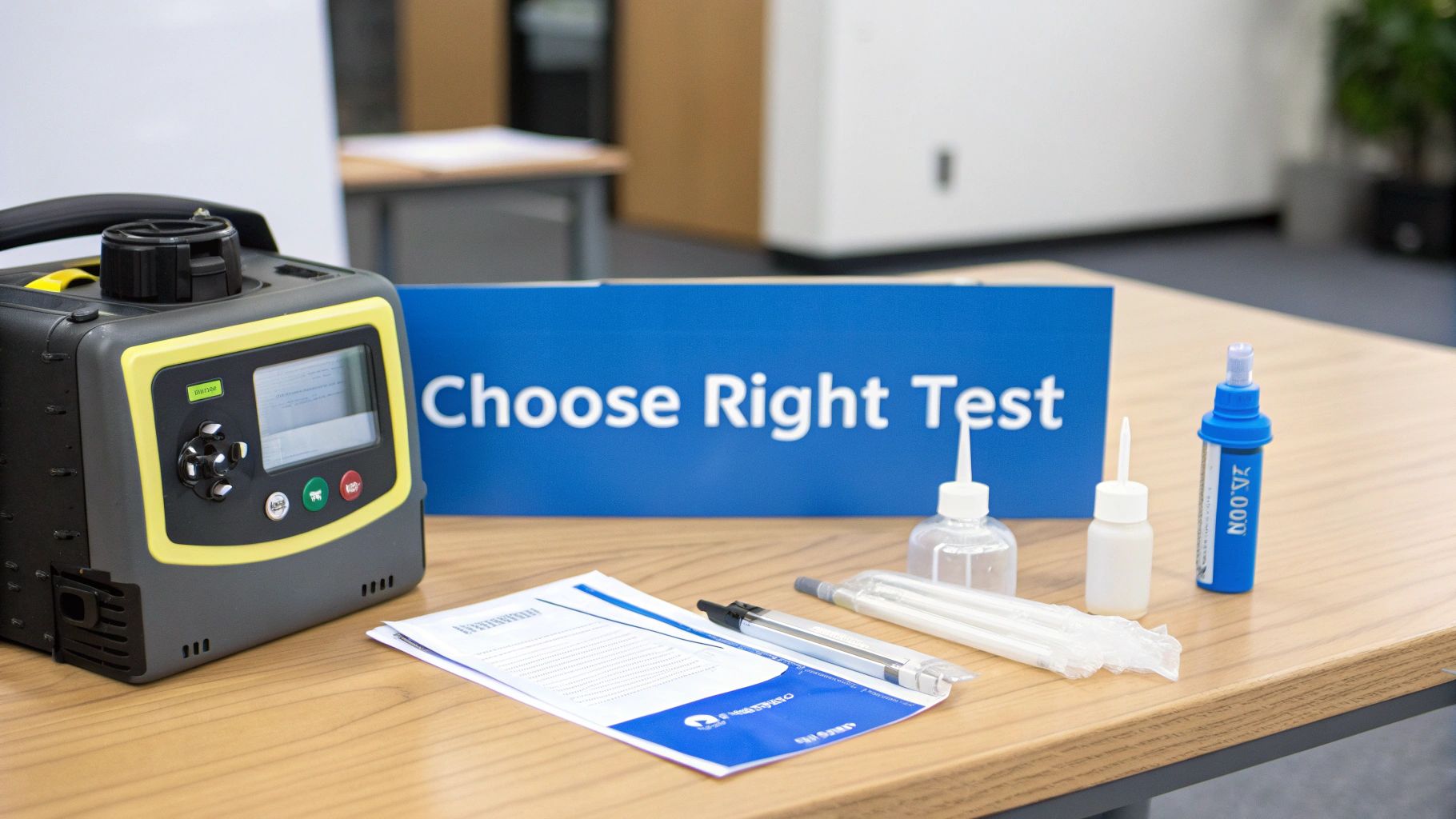
Getting a handle on the main types of tests will help you have a much more productive conversation with a professional. It ensures you get the right "diagnosis" for your home's health. Not every situation calls for the same tool, so let's break down the most common methods we use for professional indoor air quality testing near me.
Airborne Mold Spore Traps
A spore trap test is like taking a quick "snapshot" of the air you're breathing at a specific moment in time. Using a calibrated air pump, an inspector pulls a measured amount of air through a sticky cassette. This little trap catches any airborne particles floating by—mold spores, pollen, dust, you name it.
This method is absolutely essential for finding problems you can't see with the naked eye. For instance, mold growing behind a wall can pump millions of spores into your living space, causing health symptoms long before you ever spot a single dot on the drywall.
The samples are then sent to an accredited lab where trained technicians identify the types of mold present and count the spores per cubic meter. By comparing what's inside your home to an outdoor control sample, an inspector can tell if your indoor mold levels are abnormally high.
Surface Sampling for Direct Analysis
When you can actually see what you think is mold, surface sampling gives you a definitive answer. This is less like a snapshot and more like taking a direct fingerprint of the problem area. An inspector might use a sterile swab or a special tape lift to collect a physical sample right from the growth.
This test answers one very specific question: "What is this stuff growing on my wall?" The lab analysis will confirm whether it's mold and identify the specific genus, which is critical for understanding any potential health risks.
- Swab Samples: These are best for collecting material from surfaces that are wet or slimy.
- Tape Lifts: Perfect for getting a clean sample from dry, dusty, or fuzzy-looking growth on a flat surface.
To help you see how these different tests fit together, we’ve put together a simple comparison chart. This should clear up which test is right for which situation.
A Practical Comparison of Indoor Air Quality Tests
| Test Type | What It Measures | Ideal For | Sample Method |
|---|---|---|---|
| Spore Trap | Airborne mold spore concentration and types | Identifying hidden mold sources and assessing overall air contamination | Air is pulled through a sticky cassette |
| Surface Sample | The specific type of mold growing on a surface | Confirming visible growth and identifying the mold genus directly | A sterile swab or tape lift is applied to the growth |
| VOC Test | Airborne chemical gases (e.g., formaldehyde) | Detecting invisible chemical pollutants from new furniture, paint, or renovations | Air is collected in a specialized canister or tube |
| ERMI Test | DNA of 36 mold species in settled dust | Getting a historical "mold footprint" of a home; often used for health-sensitive individuals | Dust is collected via vacuum from carpets or floors |
Each of these tests tells a different part of your home's story. A good inspector knows which ones to use to get you the complete picture.
VOC Testing for Chemical Pollutants
Not all air quality problems are biological. Volatile Organic Compounds (VOCs) are gases that off-gas from all sorts of man-made products. If you’ve recently renovated, painted, or bought new furniture, your home could have high levels of chemicals like formaldehyde or benzene floating around.
VOC testing is the only way to measure these invisible chemical threats. An inspector uses a special pump to gather an air sample in a canister or tube, which is then sent off for detailed lab analysis. This test is crucial after a renovation or if you're experiencing symptoms like headaches or dizziness without any obvious signs of mold. Understanding the full spectrum of pollutants is a key part of our approach to comprehensive house environmental testing.
This specialized field is growing fast. Industry research projects the global market for these testing instruments to hit roughly USD 604 million by 2025, driven by a much bigger focus on health in buildings.
ERMI Testing for a Historical View
An ERMI (Environmental Relative Moldiness Index) test provides a historical "mold footprint" of a property. Instead of capturing what’s in the air right now, it analyzes settled dust to identify the DNA of various mold species that have been present over a long period. This test is incredibly sensitive and is often used during real estate deals or for people with severe health sensitivities who need to know a home's complete history.
What Happens During a Professional Air Quality Inspection
So, you’ve decided to call in a pro. What actually happens next? Inviting an inspector into your home can feel a little mysterious, especially when you’re worried about what they might find. Let's pull back the curtain on the process.
A real inspection is much more than just taking a few air samples and calling it a day. It’s a systematic investigation, kind of like detective work, designed to uncover the root cause of your air quality concerns.
Think of a certified inspector as a detective for your home’s health. They show up with a full toolkit—not just air pumps, but specialized gear designed to see what’s invisible to the naked eye. The investigation starts the moment they arrive, usually with a detailed conversation to understand your specific concerns, any health symptoms you've noticed, and the history of your home (like past water damage or weird musty odors).
The Critical Visual Assessment
First thing’s first: a thorough visual assessment of the entire property. This isn't a casual walkthrough. An experienced inspector methodically examines every area known to harbor moisture, since water is the primary fuel for mold growth. They’re searching for clues.
They’ll check all the usual suspects, including:
- Beneath sinks and around plumbing fixtures, where slow, sneaky leaks often go unnoticed.
- Attics and crawl spaces, looking for signs of roof leaks, condensation, or poor ventilation.
- Basements and window sills, where moisture loves to accumulate.
- Around HVAC systems, which can become a super-spreader for mold spores if contaminated.
This hands-on inspection is fundamental. It provides the context needed to figure out where to test and which types of samples will actually give us useful answers.
Using Advanced Diagnostic Tools
After the visual check, it's time to bring out the high-tech gear to find hidden moisture. A moisture meter lets an inspector measure dampness levels inside drywall, wood, and other building materials. This confirms if a structure is wet even when it feels totally dry to the touch.
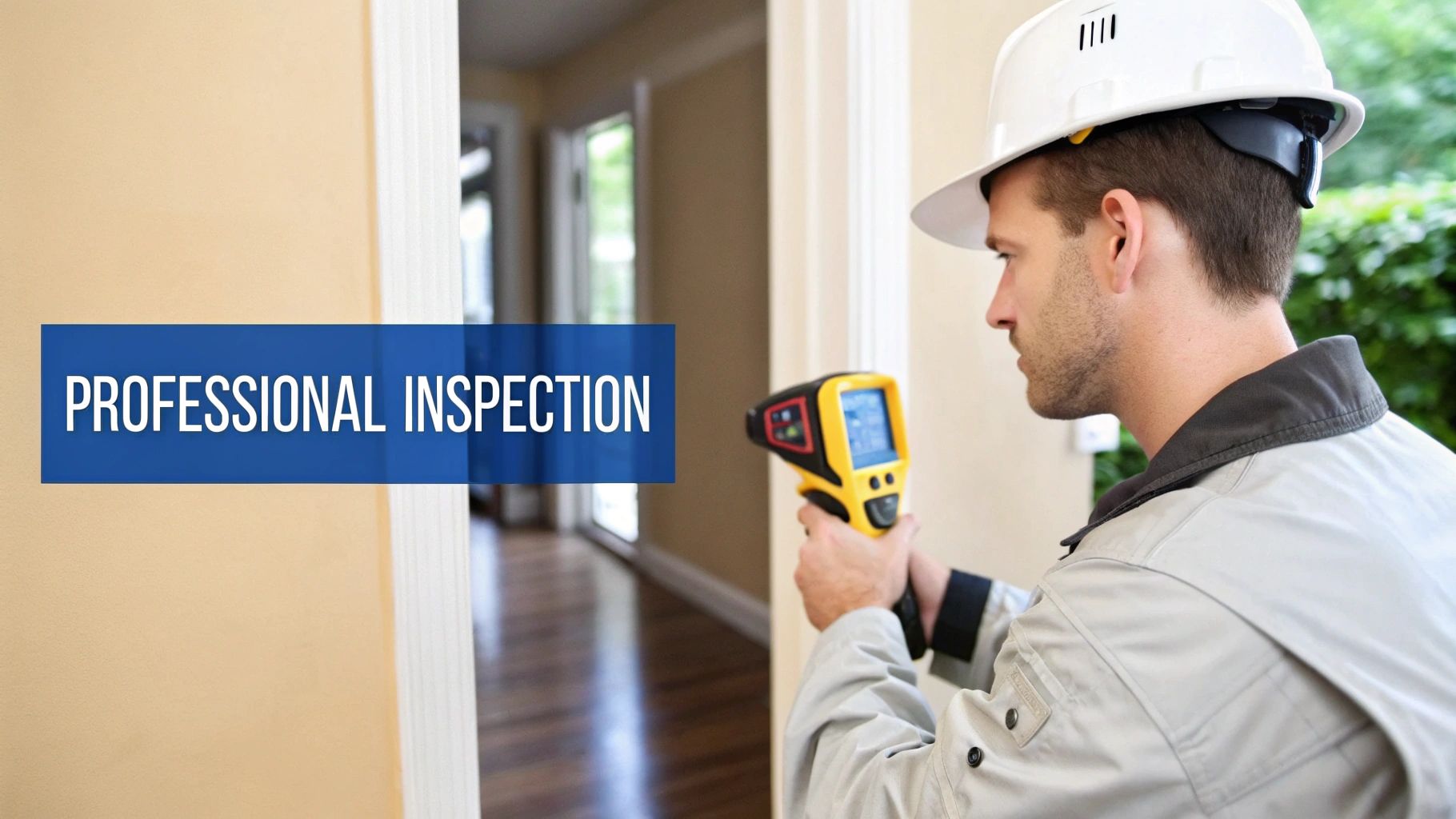
Another powerful tool in the arsenal is a thermal imaging camera. This device reveals subtle temperature differences on surfaces. Because wet materials are often cooler due to evaporation, thermal imaging can light up hidden water intrusion behind walls or under floors—problems that would otherwise be completely invisible. It helps pinpoint the exact source without tearing your walls apart.
A professional inspection is a process of elimination. The goal isn't just to find mold, but to find the water source feeding it. Without addressing the source, the problem will always return.
Strategic Sample Collection
Once all the detective work is done, the inspector can collect samples strategically. This isn't random. Based on the visual assessment and instrument readings, they’ll choose the best locations for air or surface sampling to get meaningful data.
For example, an air sample will always be taken near a suspected problem area, and just as importantly, it will be compared against an outdoor "control" sample to create a baseline.
This methodical process is the foundation of all our indoor air quality inspections. It turns guesswork into a clear, scientific diagnosis, giving you the reliable answers you need to get back to a healthy home environment. appeared first on Pacific Mold Pros.
Making Sense of Your Lab Report and Spotting Red Flags
Getting a lab report back can feel a bit like trying to read a foreign language. It's pages of scientific names and numbers, and it’s easy to feel overwhelmed. But this report is the key to understanding your home's health, so let's break down what it all means in plain English.

First things first: mold is everywhere. Spores are a totally natural part of our environment, both inside and out. The goal of air quality testing isn't to achieve a count of zero—that's impossible. What we're really looking for are abnormal types and concentrations of mold inside your home compared to the outside.
The All-Important Outdoor Control Sample
This is why a professional inspector always takes an outdoor "control" or "baseline" sample. Think of it like the control group in a science experiment. It gives us a snapshot of the normal, background mold levels in your specific neighborhood on that particular day.
We then compare your indoor samples directly against this baseline. A healthy home should have a similar mix of mold types and roughly the same (or even lower) total spore counts as the air right outside your door. It's the major differences that signal a problem.
Want to go deeper? Check out our detailed guide on understanding mold test results.
"Context is everything. An elevated spore count means nothing without a baseline for comparison. The outdoor sample provides that critical context, turning raw data into meaningful insight."
Key Metrics to Look For (And What They Mean)
When you scan your report, you'll see a list of mold genera (types) and their concentrations, usually measured in spores per cubic meter (spores/m³). You don't need to become a mycologist overnight. Instead, just focus on these key indicators:
-
Total Spore Counts: Is the total number of spores inside way higher than outside? If your living room has 20,000 spores/m³ while the outside air only shows 1,500 spores/m³, that’s a huge red flag. It points directly to an active mold source growing inside.
-
Dominant Spore Types: Are certain types of mold showing up in huge numbers indoors but are barely present outdoors? For example, if Penicillium/Aspergillus makes up 80% of your indoor sample but only 10% of the outdoor one, it’s a strong sign that a colony is thriving somewhere in the house.
-
Presence of Water-Damage Indicators: Finding specific molds like Chaetomium or Stachybotrys (the infamous "black mold") is a serious concern, even in small amounts. These types need a lot of constant moisture to grow and almost never show up indoors unless there's a significant, ongoing water issue. Their presence is a five-alarm fire, telling us we need to find that moisture source immediately.
Choosing a Qualified IAQ Inspector in Santa Barbara and Ventura
Finding the right professional when you're searching for indoor air quality testing near me is just as important as the test itself. Let’s be honest, not all inspectors bring the same level of expertise or ethical standards to the table. Picking the wrong one can lead to bad results, a ton of unnecessary stress, and some seriously costly mistakes.
Think of it like hiring a specialized mechanic for a high-performance car; you wouldn’t trust just anyone. You want an expert with the right training and tools, not a generalist. The same exact principle applies to the health of your home. A truly qualified inspector combines deep local knowledge with industry-recognized credentials.
Credentials and Certifications Matter
First things first, check an inspector's qualifications. You’ll want to look for professionals who hold certifications from respected, non-profit organizations that set tough standards for the industry.
Here are a few key credentials to ask about:
- ACAC (American Council for Accredited Certification): This group offers board-awarded certifications like the Certified Indoor Environmentalist (CIE).
- IICRC (Institute of Inspection, Cleaning and Restoration Certification): While they're well-known for remediation, their certifications prove a solid understanding of water damage and mold science.
These credentials aren't just a bunch of letters after a name. They represent a real commitment to ongoing education and ethical practices. They’re your assurance that the inspector understands the complex science behind moisture intrusion, fungal ecology, and the right way to collect samples. This need for skilled pros is growing fast—the global IAQ monitoring system market was valued at about USD 2.21 billion in 2024 and is projected to hit around USD 3.92 billion by 2032, according to Fortune Business Insights.
The Unbiased Advantage: Third-Party Labs
An ethical, trustworthy inspector will always send samples to an independent, accredited third-party lab for analysis. This is non-negotiable.
This step guarantees that your results are completely unbiased and based purely on scientific data. It gets rid of any potential conflict of interest and ensures the report you get is a true, accurate reflection of your home's environment.
The single biggest red flag to watch out for is a company that does both the testing and the remediation work. This creates a direct financial incentive for them to "find" a problem, which can easily lead to exaggerated reports and recommendations for expensive repairs you might not even need.
Choosing a company that only does testing ensures you get an objective assessment. To learn more, check out our guide on selecting the right indoor air quality testing companies. An inspector's job is to give you clear, unbiased data so you can make an informed decision—not to sell you a follow-up service.
So, you’ve done your homework and now you understand what goes into a proper indoor air quality assessment. The last piece of the puzzle—and honestly, the most important one—is finding the right local expert to give you clear, reliable answers.
If you’re in Santa Barbara or Ventura counties and find yourself searching for "indoor air quality testing near me," you've come to the right place. Pacific Mold Pros is the trusted, test-only specialist for a reason.
Our entire business is built on a simple promise: scientific integrity. We’re here to give you a completely unbiased assessment, free from any conflict of interest.
We don’t do remediation. Our one and only job is to deliver accurate, data-driven reports from accredited third-party labs. That way, you have the facts you need to make confident decisions for your property and your family’s health.
Your Local IAQ Experts
Choosing an inspector who truly gets our unique coastal climate isn't just a bonus—it's essential. We have years of hands-on experience with the specific environmental factors in Santa Barbara and Ventura that lead to moisture and air quality problems.
This local knowledge is what allows us to cut through the noise. We take you from suspicion and worry to a clear action plan, all based on solid evidence.
Ready to get the answers you deserve and start breathing easier? Contact Pacific Mold Pros today to schedule your consultation. Let's get you the unbiased data you need.
Your Top Questions About Air Quality Testing Answered
Even with a clear process, it's totally normal to have questions about the practical side of things. Here are some straightforward answers to the questions we hear most often from folks in Santa Barbara and Ventura.
How Much Does Air Quality Testing Cost?
The final cost really depends on the size of your property and which specific tests we need to run. For a standard-sized home, a baseline inspection with the essential air samples usually starts around a few hundred dollars.
If the situation is more complex and calls for a bunch of samples, surface testing for visible growth, or a specialized VOC analysis, the cost will be higher. At Pacific Mold Pros, we’re all about transparency. We’ll give you a clear, upfront quote based on what your home needs, so you know the exact cost before we even start.
How Long Until I Get My Test Results?
The on-site inspection part is quick—we’re typically in and out in about one to two hours. Once we’ve collected the samples, they’re securely packaged and sent straight to an independent, accredited lab for analysis.
Normally, you can expect a detailed report back in 3-5 business days. We also have rush options available for more urgent situations, like a pending home sale. The minute we get the results from the lab, we'll give you a call to walk you through what it all means.
The most important thing here is accuracy. Rushing the lab's process can lead to bad data, so we strike a careful balance between getting you answers quickly and upholding the meticulous standards of our lab partners.
Are Those DIY Home Mold Test Kits Any Good?
While a DIY kit from the hardware store might seem like a cheap and easy solution, they honestly cause more confusion than they solve. These kits are notorious for picking up common, everyday mold spores that are always in the air, which can cause a false alarm without giving you any real answers.
A professional test is different. We use calibrated, high-tech equipment to measure the exact concentration of spores inside and, crucially, compare it to a baseline sample from outside your home. Most importantly, a real inspector will pinpoint the source of the moisture that's letting the mold grow in the first place—something a plastic dish could never do.