Think of mold environmental testing as getting a full diagnostic report for your house. It’s a scientific deep dive that goes way beyond just looking for visible spots on the wall. We use specialized equipment to actually measure and identify the invisible mold spores floating in your air and sitting on surfaces. This gives you a clear, data-driven picture of your home's indoor air quality—something that’s absolutely critical for protecting your family’s health and the structure of your home itself.
What's Really Lurking in Your Home's Air?
Mold is sneaky. While a dark splotch on the bathroom ceiling is an obvious red flag, the real trouble often lurks where you can't see it—behind walls, under floorboards, or circulating silently through your HVAC system. These hidden colonies are constantly releasing microscopic spores into the air you breathe, and you might not notice a thing until someone starts having allergy-like symptoms or that unmistakable musty odor appears.
This is exactly where professional testing becomes a game-changer. It’s not just a casual search for mold; it's a real investigation designed to answer the big questions:
- Is there actually a problem? Testing compares the spore levels inside your home to the natural levels outside. This tells us if what you have is normal, or if there's a serious imbalance pointing to an indoor source.
- What kind of mold are we dealing with? Identifying specific species like Stachybotrys (the infamous "black mold") or Aspergillus is key to understanding potential health risks.
- How bad is it, and where is it coming from? Taking samples from different areas helps us pinpoint the source and figure out just how far the contamination has spread.
From a Hunch to Hard Facts
Imagine trying to fix your car's engine without any diagnostic tools. You could start guessing and replacing parts, but you’d be flying blind. Tackling a potential mold issue without testing is the same kind of gamble. You can't just start cleaning and hope for the best without knowing what you're up against.
Mold environmental testing takes the guesswork out of the equation and replaces it with objective data. It gives you a clear baseline, confirms if a problem truly exists, and provides the road map for an effective cleanup plan. It's the essential first step to make sure any remediation work is both necessary and successful.
This process is especially crucial in coastal communities like Santa Barbara and Ventura, where the persistent marine layer creates the perfect breeding ground for mold. If you've been dealing with musty smells, have had recent water damage, or can't figure out why your allergies are acting up at home, getting a clear picture of your indoor air quality is the only way to get real answers.
To get started, it helps to learn more about the specifics of household environmental testing. Professional testing gives you the peace of mind that comes from knowing exactly what's in your air, empowering you to take precise and effective action.
Decoding the Different Mold Testing Methods
When we investigate a potential mold issue, we don't just show up and take a wild guess. Think of it like a detective arriving at a crime scene—there’s a whole toolkit of scientific methods we use to build a complete picture of your home’s indoor environment. Each test gives us a different clue, and when you put them all together, they tell the full story.
The right mold environmental testing method always depends on the situation. Are we looking at visible growth in a Goleta bathroom, or are we trying to pin down a mysterious musty smell in a Montecito basement? The approach will be different for each.
Ultimately, our goal is to gather hard data that either confirms or rules out a hidden mold source and tells us just how extensive the contamination might be. Let’s break down the main types of professional tests you’re likely to see.
H3: Air Sampling: A Snapshot of What You’re Breathing
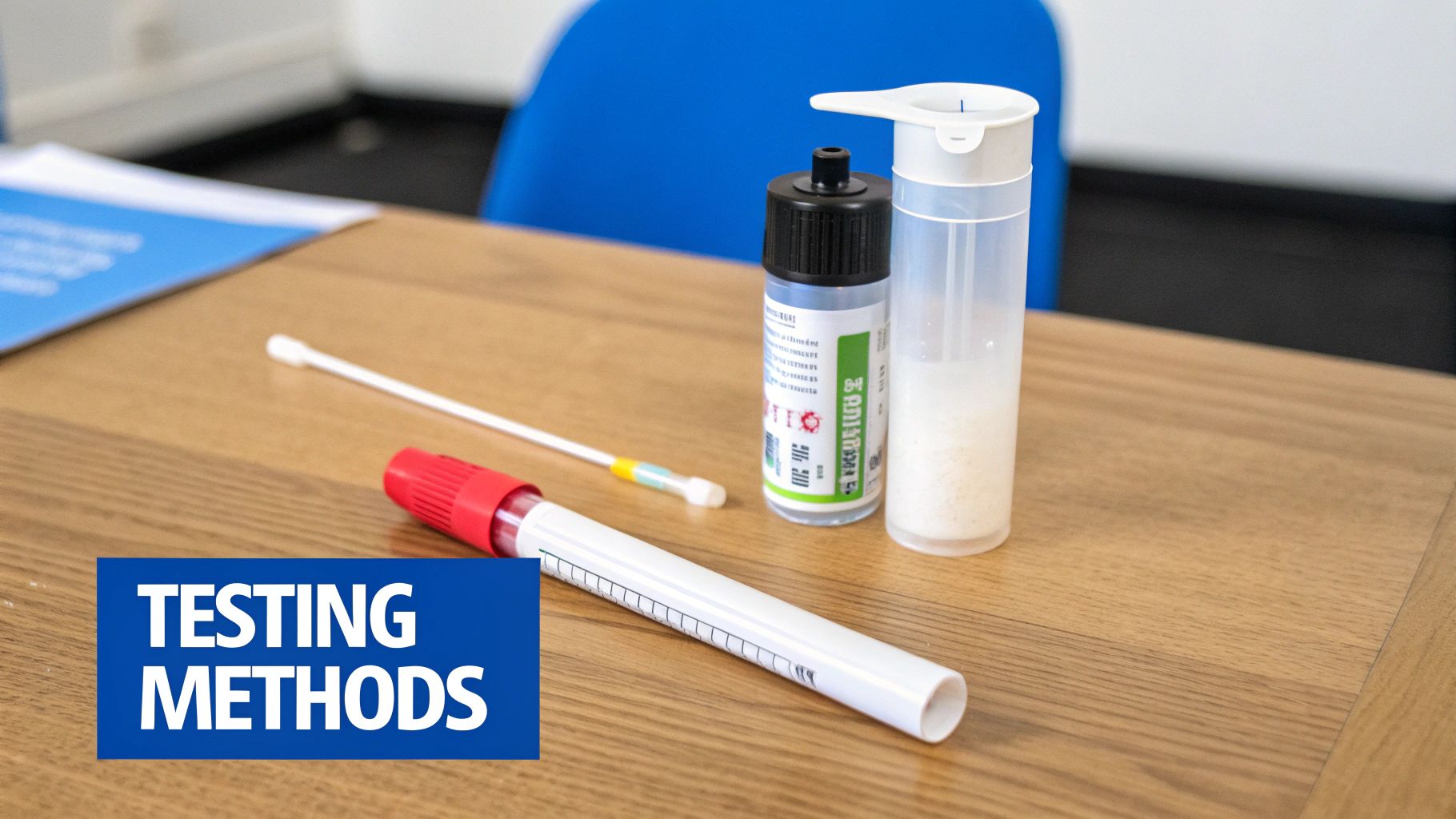
Air sampling is one of the most common and powerful tools in our arsenal. We use a calibrated pump to pull a specific amount of air through a special cassette designed to trap airborne particles—including mold spores. That cassette then heads off to an accredited lab for analysis.
Think of it as taking a snapshot of the air in a room at a single moment in time. That's exactly what an air test does.
But a snapshot without context doesn't tell you much. That’s why an inspector will always take an outdoor "control" sample. This gives us a baseline for what’s considered a "normal" level and type of mold spores in your neighborhood on that specific day. The lab then compares your indoor samples to this outdoor control. If your indoor spore counts are way higher or full of different types of mold, it's a huge red flag that something is growing inside.
Air testing is priceless for sniffing out hidden mold problems you can't see with the naked eye. When indoor spore counts are significantly elevated compared to the outside air, it's a strong sign that a colony is hiding somewhere in your home.
H3: Surface Sampling: The Fingerprint of Visible Growth
When you can actually see discolored spots or what looks like fuzzy growth on a surface, we use surface sampling to get definitive answers. While air sampling tells us what's floating around, this method identifies what's physically growing on a material.
We have two go-to techniques for this:
- Swab Sampling: A sterile cotton swab is gently wiped across the suspicious area. It’s a lot like taking a DNA sample—it’s perfect for getting a precise identification of the mold species present.
- Tape Lift Sampling: We use a special piece of clear, sticky tape and press it against the surface. This lifts a sample of the growth right off the material. This method is great because it keeps the mold’s structure intact, letting lab analysts see not just the spores, but how they’re clustered and growing.
This kind of testing is the only way to know for sure if that weird stain is actually mold and, if so, exactly what kind you’re dealing with.
H3: Dust and Material Sampling: Uncovering a Home's Mold History
Sometimes, the most telling clues about a home’s long-term mold situation aren’t in the air or on a surface, but hiding in the dust or deep within the building materials themselves.
ERMI (Environmental Relative Moldiness Index) is a sophisticated test developed by the EPA that analyzes settled dust. We collect a dust sample from a carpet or another surface, and it’s analyzed using DNA technology to identify the presence of 36 different mold species. Because dust builds up over months or even years, an ERMI test gives us a historical look at a home’s mold exposure, not just a snapshot from one day.
While some DIY kits for this exist, professional interpretation is absolutely critical to understanding the results. If you're weighing your options, our guide on choosing the best mold test kit for home use can offer some valuable pointers.
Another method is bulk sampling, where an inspector takes a small physical piece of a building material, like drywall or insulation. We only do this when a material is clearly contaminated, and it helps us understand just how deep the problem goes.
Each testing method gives us a unique piece of the puzzle. Here’s a quick rundown of how they compare:
Comparing Common Mold Testing Methods
This table breaks down the key testing methods, how they work, and what they can tell you about your indoor environment.
| Testing Method | How It Works | When It Is Used | What It Tells You |
|---|---|---|---|
| Air Sampling | A pump draws air through a collection cassette, trapping airborne spores for lab analysis. | To find hidden mold, assess overall air quality, or verify post-remediation success. | If indoor spore counts are elevated compared to the outdoors, suggesting an active indoor source. |
| Swab Sampling | A sterile swab is wiped across visible growth to collect a sample for identification. | When you see a suspicious spot and need to confirm if it's mold and what type it is. | The specific species of mold growing on a surface. |
| Tape Lift | A piece of sticky tape is pressed against visible growth to capture an intact sample. | To identify visible mold while preserving its physical structure for lab analysis. | The type of mold and its growth pattern, which helps confirm active colonization. |
| ERMI (Dust) | A dust sample is collected and analyzed for the DNA of 36 different mold species. | To get a historical overview of a property's mold exposure over time. | A "moldiness index" score and the presence of specific water-damage indicator molds. |
| Bulk Sampling | A small piece of contaminated material (like drywall) is physically removed for analysis. | To confirm the extent of contamination within building materials that need to be removed. | The type and concentration of mold that has penetrated a material. |
By using the right combination of these tools, a professional inspector can move beyond guesswork and create a clear, data-driven plan to get your home’s environment back to a healthy state.
Key Signs You Need a Mold Inspection
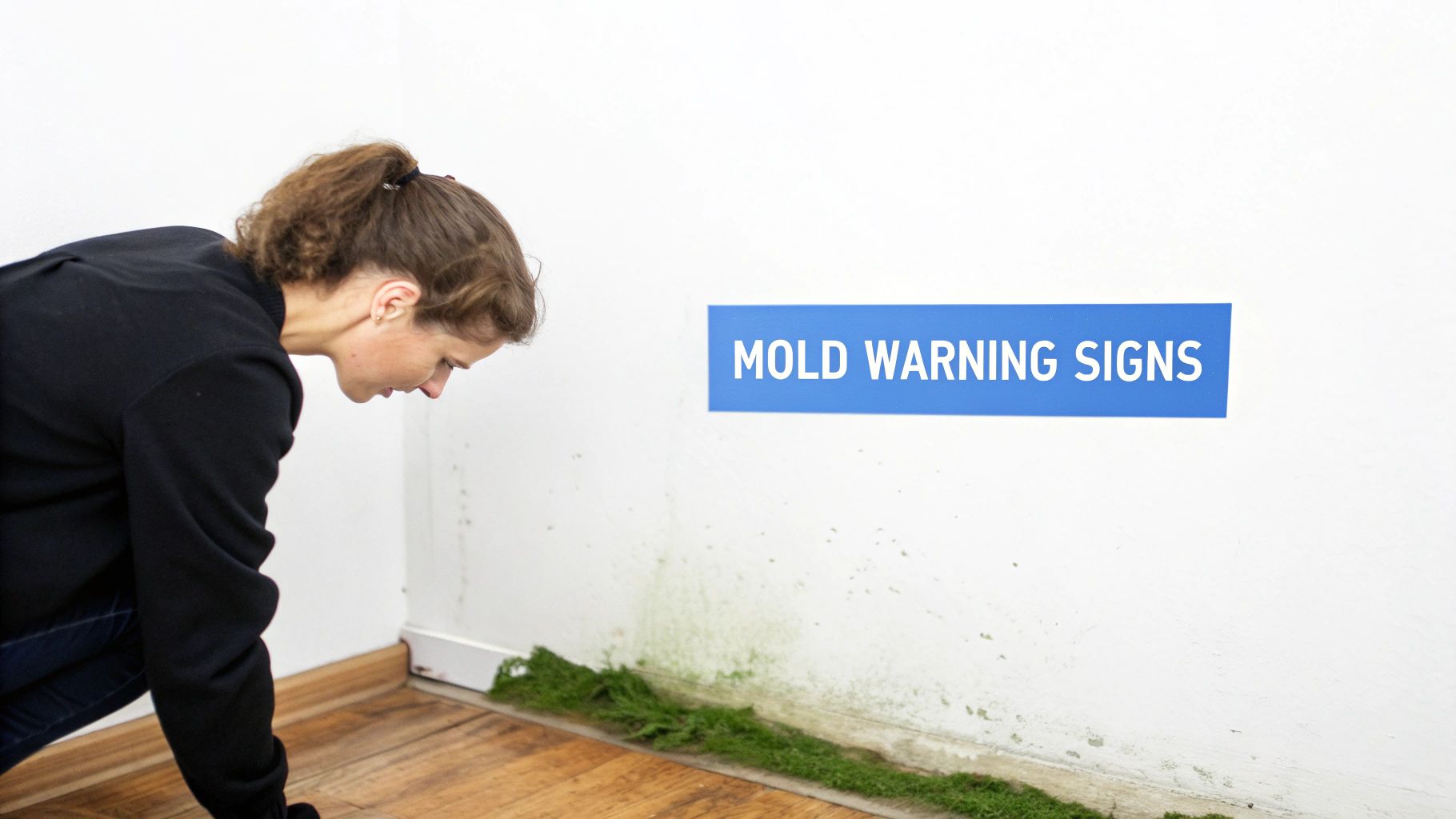
So, how do you know when it’s time to call in a professional for mold environmental testing? While stumbling upon a big, fuzzy patch of black mold is an undeniable red flag, the real clues are often much more subtle. Here in coastal communities like Santa Barbara and Ventura, it’s not uncommon for homeowners to live with low-grade mold issues for years without even realizing it, brushing off the warning signs as just part of life.
Learning to spot these clues is the first step toward protecting your home and your health. Being proactive means you can tackle a potential problem before it balloons into a major health hazard or a wallet-draining remediation project.
Unexplained Musty Odors
Your nose often knows first. If you keep smelling a persistent earthy or musty odor that you just can’t seem to track down or clean away, that’s one of the strongest indicators of hidden mold. That signature scent is caused by microbial volatile organic compounds (MVOCs)—basically, gaseous byproducts released during the mold’s life cycle.
The smell might be stronger in certain spots, like a basement, the laundry room, or even inside a specific kitchen cabinet. Don't just light a candle and ignore it. That odor is a direct signal that mold is actively growing and pumping compounds into your air.
Recent Water Damage or Leaks
Water is the number one ingredient for a mold problem. Any time you have water intrusion that isn't dried out completely within 24-48 hours, you're rolling out the welcome mat for mold. You should seriously consider getting a test after events like these:
- A burst pipe or a slow plumbing leak
- Roof or window leaks, especially after a big storm
- Flooding in your home or crawlspace
- An overflow from a bathtub, sink, or toilet
- Constant condensation on windows or pipes
Even a tiny, slow drip behind a wall can fuel a massive, hidden mold colony. Professional testing is the only way to know for sure if that past water event has turned into a current air quality problem.
A history of water damage is the single biggest predictor of an indoor mold problem. If your home has ever had a significant leak, flood, or moisture issue, professional mold environmental testing is a wise investment in your peace of mind.
Persistent Health Symptoms
Sometimes, the first signs of mold aren't in your house at all—they're in your own body. If you or your family are dealing with ongoing allergy-like symptoms that magically seem to get better when you leave home, mold could be the trigger. These health clues are frustratingly easy to mistake for seasonal allergies or just a lingering cold.
Keep an eye out for these key symptoms:
- Chronic stuffiness or a constantly runny nose
- Itchy, watery eyes
- Unexplained coughing, wheezing, or shortness of breath
- Frequent headaches or migraines
- Skin rashes or irritation
The connection between moisture, mold, and health is a huge reason for environmental testing. National data from the U.S. suggests that roughly 20% of homes have a mold issue, often tied to leaks or poor ventilation. The U.S. Centers for Disease Control and Prevention confirms that mold exposure can trigger a range of respiratory issues and that about half of all asthma cases might be worsened by damp, moldy indoor environments.
Real Estate Transactions
Buying or selling a home is another critical time to bring in a mold inspector. As a buyer, the last thing you want is to inherit a dangerous—and expensive—hidden problem. A standard home inspection often flies right past the subtle signs of mold that a certified inspector is trained to catch.
For sellers, being proactive with testing can save a deal from collapsing at the eleventh hour. Finding and fixing a mold issue beforehand shows transparency and protects your property’s value. It gives you documented proof that the home’s air is healthy and safe for the next family. If you're not sure what else to look for, you can learn more about the various signs of mold in a home to be better prepared.
How to Interpret Your Mold Test Report
Getting that lab report back from a mold environmental testing company can feel like trying to decipher a secret code. It’s a swirl of scientific names, columns of numbers, and technical terms that might leave you more confused than when you started. But once you know what to look for, that intimidating document becomes a clear, actionable roadmap to a healthier home.
Think of the report as telling the story of your home’s indoor air. The main characters are the different types of mold, and the plot revolves around how their populations inside your house stack up against the natural world right outside your door. The key is simply learning how to read that story.
The Outdoor Control Sample: Your Baseline for "Normal"
The single most important piece of information on your entire report is the outdoor control sample. This is the air sample taken from outside your property on the very same day as the indoor tests. Why is this so critical? Because mold is everywhere in our natural environment; spores are always floating in the air.
This outdoor sample sets the stage—it tells us what a “normal” mold profile looks like for your specific neighborhood at that exact moment. It’s our scientific control group. Every single indoor sample is then compared against this baseline.
A healthy indoor environment should essentially be a mirror of the outdoors. What your report is designed to spot are the major differences. Are the spore counts inside dramatically higher than outside? Or are there types of mold growing indoors that simply don’t belong there?
Understanding Spore Counts and Concentrations
On your report, you'll see a list of mold types followed by a jumble of numbers. These numbers are the spore count, usually measured as spores per cubic meter of air (spores/m³). It’s easy to see a big number and panic, but context is everything. A count of 500 spores/m³ for Cladosporium might be perfectly fine if the outdoor sample shows 800 spores/m³.
On the other hand, if that same indoor sample shows 5,000 spores/m³, we have a problem. That kind of spike tells us there’s likely an active mold colony inside your home pumping out its own spores—and that’s exactly what professional testing is meant to uncover. For a deeper dive, our guide on understanding mold test results breaks the numbers down even further.
Identifying Key Mold Types
While there are thousands of mold species out there, your report will likely focus on a handful of common players. Some are everyday molds you’d expect to see, while others are known as "water-damage indicators"—they only show up when there's a serious moisture problem.
Here are a few names to watch for:
- Aspergillus/Penicillium: These two are incredibly common and almost always show up in both indoor and outdoor samples. Their presence alone isn't a red flag, but if the indoor counts are way higher than the outdoor counts, it points directly to a water issue.
- Cladosporium: This is the most common outdoor mold in the world. Seeing it on your report is completely normal, and low levels indoors are expected.
- Stachybotrys: Often called "black mold," this one is a major red flag for significant, long-term water damage. Finding any amount of Stachybotrys inside when it's not outside is a serious concern that demands immediate action.
- Chaetomium: Much like Stachybotrys, this mold is a clear sign of water-soaked building materials. It's not something you want to find in your indoor air.
Putting It All Together: What to Look For
When you sit down with your inspector to go over the report, you’ll be looking for a few key patterns that signal trouble. Don't try to go it alone; a certified professional is trained to connect the dots between the lab data and what they physically saw during the inspection.
Here’s a simple checklist for making sense of the findings:
- Compare Indoor vs. Outdoor Counts: Are the total spore counts inside your home significantly higher than the outdoor control sample?
- Look for Indicator Molds: Are problem molds like Stachybotrys or Chaetomium present indoors but absent outdoors?
- Check for Imbalances: Is one particular mold type, like Aspergillus, exploding in concentration indoors compared to outside, even if the others seem normal?
- Review the Inspector's Notes: The lab data is only one part of the story. It must be paired with the inspector’s visual findings, moisture readings, and thermal imaging results.
Your lab report is the final piece of the puzzle. It validates suspicions, shows the true scale of a problem, and gives you the hard evidence needed to create a smart, effective plan to get your home back to being a healthy space.
So you’ve got the lab report, and it’s positive for mold. That confirmation can feel heavy, but it’s actually the first concrete step toward a solution. This isn't the end of the story; it's the start of an informed action plan. Now you have the data you need to take care of the problem for good.
It's tempting to want to fix it immediately. You might think, "I'll just grab some bleach and scrub it away." While that can-do spirit is great, it’s a risky move for anything more than a tiny spot of surface mold. Trying to clean up a significant mold problem on your own can disturb the colonies, sending a massive cloud of spores into the air. This doesn't solve the problem—it spreads it, turning a contained issue into a home-wide headache.
Why Professional Remediation Is Non-Negotiable
When mold environmental testing uncovers a real contamination issue, calling in the pros isn’t just a good idea—it’s the only truly safe and effective path forward. Certified technicians don't just "clean" mold. They follow a strict, science-based protocol designed to completely remove the contamination and make sure it doesn’t come back.
This isn’t just wiping down a wall. The process is meticulous and involves several critical steps:
- Containment: The first thing they'll do is seal off the affected area using plastic sheeting and negative air pressure machines. This creates a quarantine zone to stop spores from escaping into the rest of your home.
- Removal: Any porous materials damaged by mold, like drywall or insulation, are carefully cut out, placed in sealed bags, and removed from your property.
- HEPA Filtration: Throughout the process, high-efficiency particulate air (HEPA) vacuums and industrial air scrubbers are running constantly, capturing microscopic airborne spores you can't even see.
- Cleaning: Non-porous surfaces like wood framing or concrete are treated with specialized antimicrobial agents to kill any remaining mold.
The gulf between DIY scrubbing and professional work is huge. To really get a handle on the specific protocols and why each step matters, it’s worth understanding the difference between mold removal vs. remediation. This process is part of a massive industry focused on keeping buildings healthy. In fact, the global mold remediation market is expected to hit around USD 1.75 billion by 2032, with residential water damage projects being a major driver. You can learn more about the scale of the mold remediation service market and its growth on coherentmarketinsights.com.
The Final Step: Post-Remediation Verification
Once the remediation crew packs up and leaves, how do you really know the job is done right? You can’t just trust your eyes. The only way to be certain the mold is gone and your air is clean is through post-remediation verification, often called "clearance testing."
Clearance testing is a follow-up mold environmental test performed by an independent, third-party inspector after the remediation work is finished. It’s the unbiased, scientific proof that the mold has been successfully removed and the indoor air quality is back to a safe, normal state.
This step is absolutely critical—don’t let anyone tell you otherwise. It provides the documented proof that the problem was solved, which is vital for your family's health, your own peace of mind, and the value of your property. If you're ever selling your home, a clearance report is often required to prove a known mold issue was professionally handled. Skipping this final test is like taking a round of antibiotics but never going back to the doctor to confirm the infection is truly gone. You’re just hoping for the best and leaving the door wide open for the problem to return.
How to Choose a Certified Mold Inspector
Picking the right professional for mold environmental testing is hands-down the most important decision you'll make in this entire process. A seasoned, unbiased inspector is the key to getting reliable data to protect your family and property. A bad choice, on the other hand, can lead you down a rabbit hole of inaccurate results, wasted money, and a false sense of security.
Think of it like getting a second opinion from a doctor. You want an expert whose only job is to diagnose the problem, not someone who also happens to sell the cure. This clear separation of duties is the bedrock of any trustworthy inspection.
The Conflict of Interest to Avoid
The golden rule of mold testing is simple: the company that inspects should never be the company that remediates.
When one firm offers to do both, a massive conflict of interest is created. They have a direct financial incentive to find a problem—or blow a small one way out of proportion—just to sell you on their expensive cleanup services.
An independent inspector’s only job is to give you the unvarnished truth. Their loyalty is to the scientific data, making sure you get a completely objective assessment of your home’s condition. This ethical boundary is non-negotiable if you want a reliable inspection.
An inspector’s role is to be an impartial investigator who gathers evidence. A remediation company’s role is to be the specialized crew that fixes the problem. Never hire one company to do both jobs.
Essential Credentials and Experience
Not all inspectors are created equal. To make sure you’re hiring a true professional, especially here in the Santa Barbara area, you need to look for specific qualifications that prove they know what they're doing.
Your checklist should include:
- Industry Certifications: Look for credentials from respected, non-profit organizations like the American Council for Accredited Certification (ACAC) or the Institute of Inspection, Cleaning and Restoration Certification (IICRC). These aren't just fancy letters; they show a real commitment to industry standards.
- Specialized Tools: A modern inspector brings more than just a flashlight. They should show up with advanced gear like thermal imaging cameras to spot hidden moisture behind walls and digital moisture meters to get precise readings on dampness in building materials.
- Local Knowledge: Experience with the types of homes built along the California coast is a huge advantage. An inspector who knows the regional construction styles—and the quirks that come with them—knows exactly where moisture problems love to hide.
The demand for qualified inspectors reflects a much bigger trend. The global mould detection service market was valued at around USD 1.2 billion in 2023 and is expected to nearly double by 2032 as more people become aware of indoor air quality. You can see more about this global market trend on dataintelo.com. Choosing a certified professional ensures you're getting the expertise that's driving this growth.
Your Top Mold Testing Questions, Answered
When you're dealing with potential mold, questions are bound to come up. It's a world most homeowners hope they never have to navigate. Here are some clear, no-nonsense answers to the questions we hear most often from folks here in Santa Barbara and Ventura.
How Much Should I Expect to Pay for Professional Mold Testing?
Investing in professional mold testing is really an investment in certainty. For a typical home, the initial inspection and a few key samples will generally run between $300 and $700.
Of course, a few things can shift that number:
- The Size of Your Home: A larger property with more nooks, crannies, and HVAC systems to check will naturally take more time and effort.
- How Many Samples Are Needed: Every air or surface sample we collect goes to a lab, which adds to the cost. A good inspector will recommend the absolute minimum needed for a reliable picture—usually an outdoor control sample plus one for each area you're worried about.
- The Type of Test: While standard air and surface samples are the go-to, more advanced methods like ERMI dust analysis are more specialized and come with a higher price tag.
Do I Really Need Mold Testing When Buying a Home?
While it's not always a legal requirement, getting a dedicated mold inspection before you buy is one of the smartest moves you can make. Your standard home inspector is a generalist; they’re not equipped to hunt for hidden mold. A certified mold inspector brings specialized gear like moisture meters and thermal imaging cameras to uncover problems others would easily miss.
Finding a mold issue before you sign the papers is a game-changer. It gives you real leverage to ask the seller to handle the cleanup or to adjust the price so you can cover it yourself. If you skip this step, you could be unknowingly walking into a very expensive and unhealthy situation.
How Is a Mold Inspection Different from a Regular Home Inspection?
Think of it this way: a home inspector is like your family doctor, giving you a general check-up. They'll look over everything from the roof to the foundation and might flag obvious signs of water damage.
A mold inspector, on the other hand, is the specialist you see afterward. They’re focused entirely on one thing: diagnosing the health of your indoor environment.
A home inspector points out the symptom—like a water stain on the ceiling. A mold inspector runs the diagnostic tests to find the root cause, telling you exactly what’s in your air and how bad the problem really is.
I’m a Renter. What Are My Rights?
If you suspect mold in your rental, you absolutely have rights. In California, landlords are required to provide a safe and "habitable" place to live. This is known as the "implied warranty of habitability." A significant mold problem that stems from a building issue—like a leaky roof or a busted pipe—is typically considered a breach of that warranty.
Your first step should always be to notify your landlord in writing. Document everything with photos and a clear, calm description of the problem. If they don't take action, you have options, which can include withholding rent or even breaking your lease. However, you have to follow the legal process carefully. We always recommend getting in touch with a local tenant rights group to understand the best steps for your specific situation.