Figuring out the cost of a mold inspection can feel like a guessing game, but it’s more straightforward than you might think. For most homes, you're looking at a range of about $300 to $650. This covers a professional evaluation, but the final price tag can shift depending on how big your home is and what kind of testing is needed.
How Much Should You Expect to Pay for a Mold Inspection?
Think of a mold inspection like a health check-up for your house. A basic visual scan gives you one level of insight, but detailed lab work gives you the complete picture. Your final investment really just depends on how deep you need to go.
The first step is almost always a basic visual inspection. A certified inspector—like our team here at Pacific Mold Pros—will walk through your property looking for telltale signs: visible mold patches, musty smells, or evidence of past or present water damage. This is the most affordable route and is a great fit when you can already see a potential problem.
Moving Beyond a Visual Check
The tricky part is that most mold problems aren't out in the open. Mold loves to hide behind walls, creep under floorboards, or settle into your HVAC system. That's when a more thorough inspection with scientific testing becomes non-negotiable. This is where we collect physical samples to truly understand what's going on.
A comprehensive inspection is your best tool for uncovering hidden moisture sources and identifying specific mold types. It transforms guesswork into a clear, actionable plan for remediation.
The type and number of samples we take will directly affect the cost. The most common methods include:
- Air Samples: These tests trap airborne spores, telling us the concentration and types of mold floating around in your indoor air.
- Surface Samples: We use special swabs or tape lifts on discolored spots to confirm if what you're seeing is actually mold.
Estimated Mold Inspection Costs at a Glance
To give you a clearer idea, here's a quick breakdown of what you can generally expect to pay for different levels of service.
| Service Type | Typical Cost Range (National Average) | Best For |
|---|---|---|
| Visual Inspection Only | $300 – $400 | Situations with clearly visible mold or obvious water damage. |
| Inspection with Air Sampling | $400 – $700 | Musty odors without visible mold, or for allergy/health concerns. |
| Comprehensive Inspection | $700 – $1,000+ | Large homes, complex moisture issues, or real estate transactions. |
These national averages give you a solid baseline for budgeting.
Understanding the National Averages
The cost for these services lines up with what people are paying across the country. The average price for a mold inspection in the U.S. falls between $300 and $650, with many homeowners landing right around the $450 mark. For most homes under 4,000 square feet, you can expect to pay between $300 and $400. Of course, for larger properties or situations that require extensive sampling, the cost can climb to $1,000 or more.
Ultimately, what you pay for a mold inspection reflects the level of certainty you get in return. For those of us in coastal communities like Montecito and Goleta, where humidity is a constant battle, a professional assessment is a smart investment in your property's value and your family's health. You can learn more about how we determine the cost of a mold inspection in our detailed guide.
The Key Factors That Determine Your Final Cost
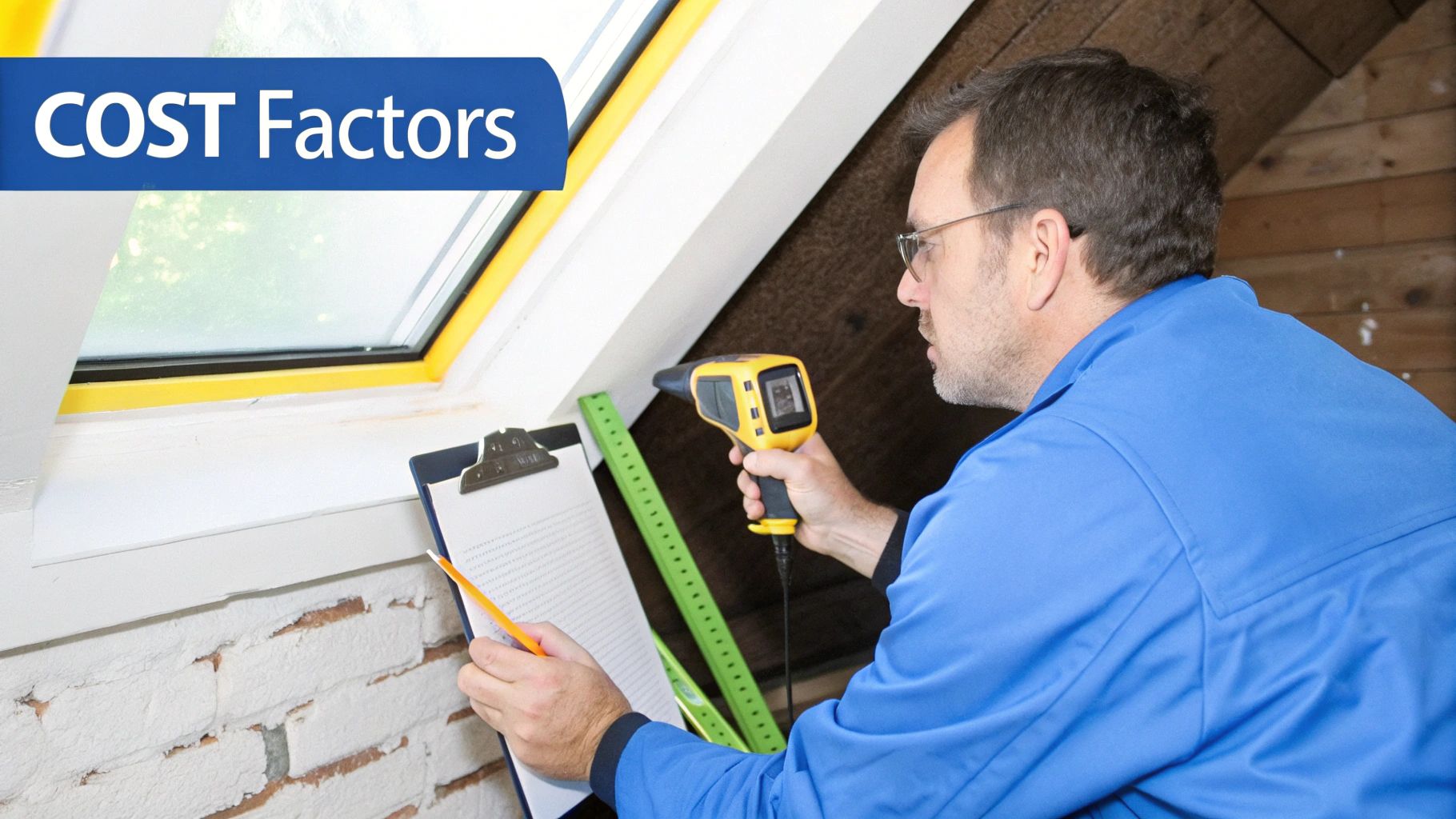
When you start asking about the mold home inspection cost, you’ll find there’s no simple, flat-rate answer. Think of it like taking your car to a mechanic—an oil change has a set price, but figuring out a weird engine noise takes more time and specialized tools, which changes the final bill. The same idea applies here. Several key variables will shape the quote you receive.
The biggest one, right off the bat, is the size of your property. A 1,500-square-foot condo in downtown Santa Barbara is a much quicker job than a sprawling 4,500-square-foot home up in Montecito. More square footage means more rooms, more potential moisture spots, and just more ground to cover, all of which adds to the time needed for a proper assessment.
But it's not just about size. The complexity of your home’s layout also plays a huge part. If a house has tricky-to-reach areas like a tight crawl space or a cramped attic, that requires more physical effort and sometimes different equipment. Getting into those spots safely and effectively adds to the inspection timeline and, as you can guess, the overall cost.
The Role of Sampling and Lab Analysis
A visual check can only tell us so much. To get a real, scientific answer about what’s in the air you're breathing, we often need to take samples and send them off for lab analysis. This is a major factor in the final mold home inspection cost because each sample has an analysis fee from a certified, third-party lab.
We never take samples just for the sake of it. The number and type we collect are based entirely on what we find and what questions we need to answer. Here are the main types we use:
- Air Samples: These are a must when you can smell that musty odor but can't see any actual mold. We use a special pump to capture airborne spores, which lets us compare the mold levels inside your home to the levels outside.
- Surface Samples: If we find a suspicious-looking spot, a quick swab or tape lift will confirm whether it's mold and tell us exactly what kind we're dealing with.
- Bulk Samples: In some situations, we might need to take a tiny piece of contaminated material—like drywall or carpet—for a more in-depth analysis.
Each sample costs money to process at the lab, usually somewhere between $50 to $100 per sample. A straightforward inspection might only need two or three samples, but a more complex situation could require several more, which will directly bump up your total. You can read more about our scientific approach in our guide to environmental mold testing.
Advanced Tools and Their Impact on Cost
A modern mold inspection is about more than just a good flashlight and a sharp eye. We rely on advanced diagnostic tools that, while they add to the expense, are absolutely essential for finding hidden problems that would otherwise be missed. Think of it as a small investment that could save you thousands down the road.
Using advanced technology like thermal imaging is not an upsell; it's a fundamental part of a modern, accurate mold inspection. It allows us to see behind walls and find the moisture source, which is the key to preventing mold from returning.
One of our most important tools is the thermal imaging camera. This lets us see tiny temperature differences on surfaces, which often point to hidden moisture behind walls, under floors, or in ceilings. Finding the water source is every bit as important as finding the mold itself.
We also use moisture meters to get exact readings of the moisture content in materials like drywall and wood. This data helps us map out the full extent of any water damage and know exactly which areas need to be addressed. While using these tools adds to the initial mold home inspection cost, they give us the critical information needed for a truly effective remediation plan.
Ultimately, the scope of the inspection is what really drives the price. National data shows that while costs vary, whole-home assessments can range from $1,150 to $3,400. For homes larger than 4,000 square feet, fees can get up to $700 to $1,000. Most homeowners, however, find their costs land somewhere between $303 and $1,044, which just shows how much these different factors can influence the final number.
What a Professional Mold Inspection Report Delivers
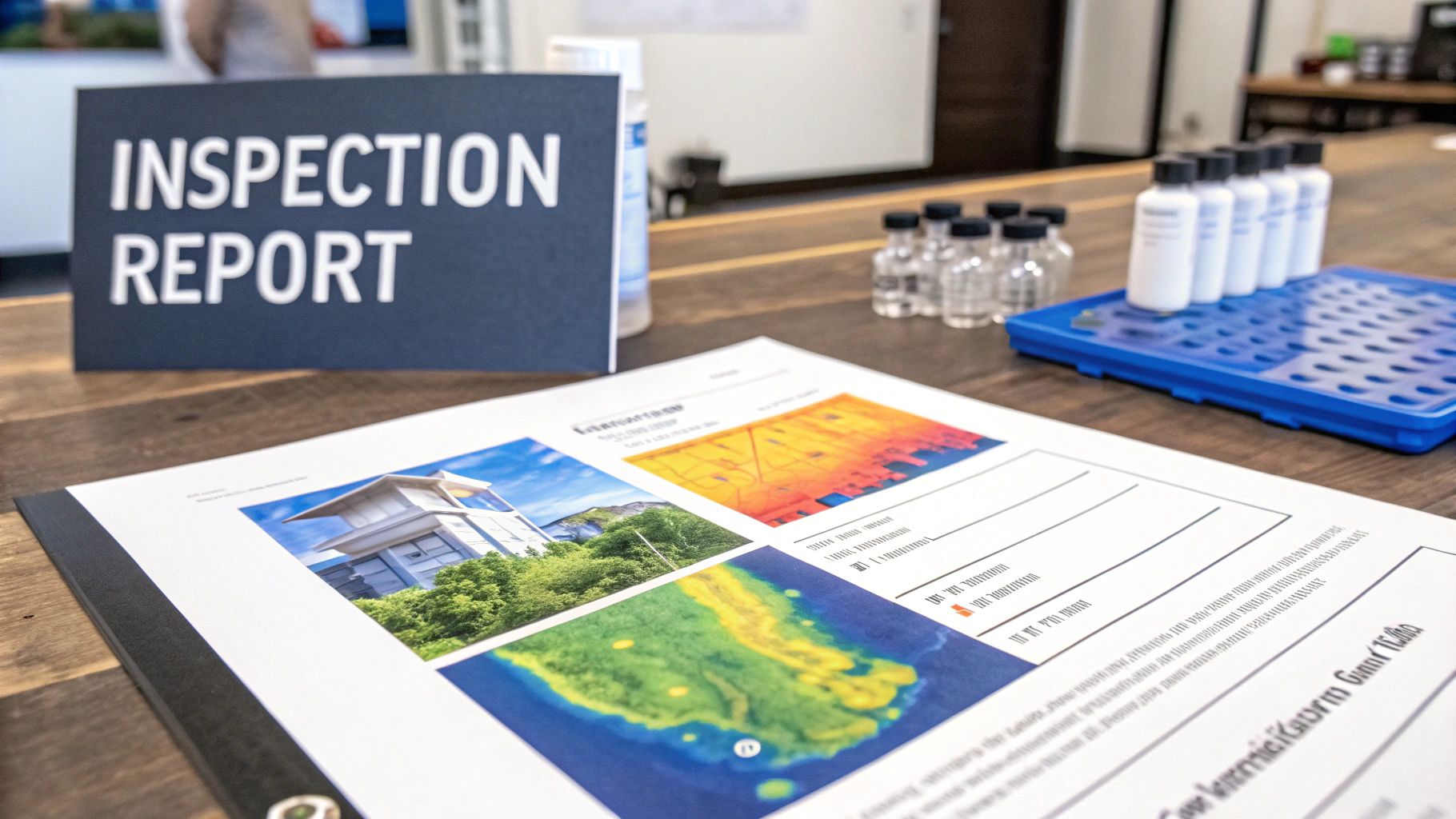
The mold home inspection cost isn't just for someone to poke around and confirm your suspicions. You’re paying for a detailed, actionable blueprint to get your home's air healthy again. Think of the final report as a complete health chart for your property, one that goes way beyond a simple "yes, you have mold."
A professional report tells the whole story, from the initial on-site assessment to a clear, step-by-step game plan. This document is where you see the real value of your investment, turning that feeling of uncertainty into a concrete path forward.
Visual Findings and Environmental Data
The first part of any quality report lays the groundwork. It details everything our inspector saw, smelled, and measured during the visit. This isn’t just a random list; it’s a collection of critical data points that build a complete picture of your home’s environment.
Here’s what this section typically breaks down:
- Detailed Photographic Evidence: Clear, high-resolution photos of any visible mold, suspicious water stains, or problem areas. Every image is annotated, so you know exactly what you’re looking at and why it matters.
- Moisture Mapping Results: We use professional moisture meters to get specific readings from materials like drywall, wood, and concrete. This creates a "map" that shows us exactly where hidden moisture is lurking.
- Thermal Imaging Scans: Our infrared cameras reveal temperature differences behind walls and ceilings. This is how we spot hidden leaks, condensation, or missing insulation that often lead to mold growth.
Demystifying Laboratory Results
This is where the science comes in, and frankly, it's the part of the report that can be the most confusing without an expert to translate it. A lab analysis full of spore counts and scientific names doesn't mean much on its own. A good report breaks down this complex data into plain English.
You'll get a clear explanation of:
- Mold Types Identified: The report will list the specific types of mold found, like Aspergillus, Penicillium, or the one everyone worries about, Stachybotrys (black mold).
- Spore Concentrations: This is a numbers game. The report shows the number of spores per cubic meter of air and compares your indoor levels to the outdoor "control" sample. This comparison is key to knowing if your indoor air quality is truly a problem.
- Health and Allergenic Potential: We’ll explain what the presence of certain mold types could mean for your family's health, noting which ones are known to produce mycotoxins or trigger bad allergies.
A professional report doesn't just give you data; it interprets it. Knowing your indoor Stachybotrys count is 3,000 spores/m³ while the outside air is only 50 spores/m³ provides the hard evidence you need to move forward with remediation.
The Remediation Roadmap
The final—and most important—piece of the puzzle is the roadmap for what comes next. A trustworthy inspector provides a detailed protocol for remediation, but to avoid a conflict of interest, they shouldn't be the ones doing the cleanup work. This ensures the recommendations are totally unbiased and focused only on what's best for you.
This section outlines the exact scope of work a qualified remediation company should follow, including containment procedures and the criteria for post-remediation testing. It's your guide to getting your home back to a healthy state.
To get a better sense of what our full assessment involves, you can learn more about our professional mold inspection services and see how we deliver clarity and peace of mind.
Why Mold Inspections Are Crucial for Real Estate Deals

In the high-stakes real estate markets of Santa Barbara and Ventura, a mold inspection isn't just another box to check before closing. It’s a strategic move that can literally make or break a deal. Think of it as an insurance policy against one of the most common—and costly—problems a property can hide.
An undiscovered mold issue can quickly send a smooth transaction completely off the rails. For buyers, finding mold after you've already closed means facing down unexpected health risks and a hefty remediation bill. For sellers, a last-minute mold discovery can trigger tense negotiations, major price reductions, or even cause the entire sale to collapse.
Our beautiful coastal climate, with its marine layer and winter rains, creates the perfect environment for moisture to collect in hidden spots. This makes homes here especially prone to mold that grows unseen behind walls, under floors, or in attics. A professional inspection drags these hidden risks out into the open, protecting everyone involved.
Gaining Leverage in Negotiations
For a home buyer, a detailed mold inspection report is one of the most powerful tools you can bring to the negotiation table. It turns vague worries about a "musty smell" into hard, scientific data that a seller can't just brush aside. This evidence gives you clear leverage to ask for repairs or a price reduction.
Imagine this: a home looks perfect during the walkthrough, but a professional mold inspection uncovers elevated spore counts coming from a slow leak behind a bathroom wall. Now, the buyer can hand the seller the inspector's report and a remediation quote, using it to negotiate several thousand dollars off the asking price. Without that report, the buyer would have unknowingly walked right into a significant problem.
This is especially true in fast-paced markets like Montecito or Goleta. A professional, unbiased report provides the solid ground needed for fair, fact-based negotiations, making sure the final price reflects the home's true condition.
Protecting Sellers and Building Trust
It works the other way, too. Smart sellers can use a pre-listing mold inspection to their advantage. By finding and fixing any potential issues before the house even hits the market, a seller can list their home with total confidence. This proactive step just about eliminates any nasty surprises during the buyer's due diligence period.
Think about a seller who gets a "Mold-Free Certification" after a clean inspection. That document becomes a huge selling point, showing potential buyers that the home has been meticulously cared for. It builds trust and can make the property stand out, potentially attracting more offers and a higher final price.
A pre-listing mold inspection is a seller's best defense against last-minute deal complications. It demonstrates transparency and reassures buyers, creating a smoother path to a successful closing.
For homeowners in coastal California, where recent wet winters led to a big jump in mold claims, these inspections are essential. Undetected mold can slash a home's value by 10-20% and scare off buyers in a heartbeat, making a clean bill of health an incredibly valuable asset.
Meeting Tight Escrow Deadlines
Real estate deals run on tight timelines. Escrow periods don't leave much room for delays, which is where having a responsive, local mold expert becomes critical. A big national company might not get the unique environmental pressures of our coastal towns or be able to squeeze you into a tight schedule.
Pacific Mold Pros lives and works in the Santa Barbara and Ventura markets. We get the urgency of real estate transactions and offer rapid response times to help agents, buyers, and sellers hit their deadlines without cutting corners on accuracy. A quick turnaround on the inspection and lab results means negotiations can move forward without a hitch, keeping the whole deal on track. We've detailed the entire process to help you understand why a mold inspection is crucial when buying a house.
Is a Professional Mold Inspection Really Worth It?
When you first suspect mold, heading to the hardware store for a cheap DIY test kit can feel like a smart, proactive move. It seems like an easy way to get answers without spending much money. But does that little petri dish really give you the full picture, or does it just create more confusion?
Let's cut right to it. Using a DIY kit to diagnose a mold problem is like using a web search to diagnose a serious medical issue. Sure, you might get a vague idea of what's going on, but you could also get a terrifying false positive. Even worse, you could get a reassuring false negative that makes you ignore a serious underlying condition. A professional mold inspection, on the other hand, is like seeing a specialist. You get an accurate diagnosis and a clear plan to fix the problem for good.
The Problem with DIY Mold Kits
Those do-it-yourself mold kits you see on the shelf are notoriously unreliable, and here’s why. Most of them involve leaving a petri dish open to collect airborne spores. The issue? Mold spores are literally everywhere, all the time, both inside your home and out.
This means your DIY kit is almost guaranteed to grow something. But that result tells you absolutely nothing useful. It can't tell you if the spore levels in your home are normal or dangerously high. It can't identify the specific types of mold you're dealing with. And most importantly, it can't find the hidden moisture source that's feeding the growth in the first place.
A DIY test only confirms that mold spores exist—which we already know. It can't tell you if you have an active mold problem, where it's hiding, or how to solve it. More often than not, it just leaves you with more anxiety than answers.
To put it simply, there’s a world of difference between a plastic dish and a certified expert with specialized tools. Here’s a quick breakdown of what you get with each approach:
DIY Mold Kits vs. Professional Inspection
| Feature | DIY Mold Kit | Pacific Mold Pros Professional Inspection |
|---|---|---|
| Accuracy | Often misleading. Can produce false positives or false negatives. | Highly accurate. Uses calibrated equipment and accredited labs for definitive results. |
| Scope | Only detects airborne spores in one small area. | A comprehensive, whole-home assessment of visible and hidden areas. |
| Source Identification | None. Cannot find the underlying moisture problem causing the mold. | The primary goal. We use moisture meters and thermal imaging to pinpoint the exact source. |
| Mold Typing | Basic or none. Doesn't identify specific mold species or their risks. | Detailed lab analysis identifies the exact types of mold and their concentrations. |
| Expert Guidance | Zero. Leaves you to interpret confusing results on your own. | Provides a detailed report with clear next steps and professional recommendations. |
| True Cost | Low upfront cost, but can lead to expensive mistakes and unresolved issues. | An upfront investment that prevents thousands in future remediation and repair costs. |
As you can see, a DIY kit is a gamble at best. A professional inspection is an investment in certainty.
The Real Value Is in Prevention
The true worth of a professional inspection isn't just about finding mold that's already there—it's about stopping it from coming back. The upfront mold home inspection cost is a calculated investment to protect your property's value and your family's health from threats you can't see. That small, undetected leak under a sink can quietly fester, turning into a massive remediation project that costs thousands.
A certified inspector uses tools like thermal imaging cameras and moisture meters to find the root cause of the problem. This is what prevents a minor issue from becoming a catastrophe. By mapping out the full extent of the moisture intrusion, a professional gives you the roadmap for a permanent solution, not just a cosmetic fix. This ensures the mold doesn't just grow back a few months later, saving you a fortune in money and stress down the road.
Ultimately, it all comes down to certainty. An inexpensive kit might give you a guess, but a professional inspection delivers the concrete data and expert guidance you need to protect your biggest investment and the air you breathe every day. When you weigh the potential health impacts and the sky-high cost of major remediation, the value of getting it right the first time becomes crystal clear.
Get Your Santa Barbara Mold Inspection Quote
Figuring out the real mold home inspection cost isn't just about a number on an invoice—it's an investment in knowing your property is safe. It's about trading uncertainty for clarity. Let's be honest, navigating hidden moisture, confusing lab results, and remediation plans can feel like a heavy weight. A professional inspection is designed to lift that weight.
The true value comes from having an expert walk through your door with the right tools and a trained eye. It’s one thing to spot visible mold, but it's another to use technology like thermal imaging to find the hidden water sources that are feeding it. This turns a frustrating guessing game into a precise, scientific assessment.
Your Path to a Healthier Home
When you work with a professional service like Pacific Mold Pros, you get more than just raw data. You get a comprehensive, easy-to-read report that lays out exactly what’s happening in your home and gives you a clear, actionable roadmap to fix it. It’s the difference between feeling anxious and feeling empowered.
A quality inspection delivers:
- Certified Expertise: Inspectors who are trained to spot the subtle, often-missed signs of mold and moisture intrusion.
- Advanced Diagnostics: Tools that can see behind walls and under floors to pinpoint the root cause of the problem.
- Detailed Reporting: Straightforward lab results and a step-by-step plan for what to do next.
- Ultimate Peace of Mind: The confidence that comes from knowing your home is truly safe for your family.
Don’t let worries about mold just linger in the back of your mind. Taking that next step is the single best way to protect your family and your property. If you’re ready to ensure your home in Santa Barbara, Ventura, or the surrounding areas is healthy and safe, we're here to help.
We're committed to giving you the information you need to make a confident decision and finally breathe easier in your own home. You can start the process today by requesting a personalized estimate. Learn more about how to get your free, no-obligation mold inspection quote from Pacific Mold Pros. Or, just give us a call directly at (805) 232-3475 to speak with one of our friendly experts.
Got Questions About Mold Inspections? We've Got Answers.
When you're thinking about a mold inspection, a lot of practical questions pop up. It’s totally normal to wonder about the process, how long it takes, and what it all means for your home and wallet. We get these questions all the time, so let’s clear things up.
How Long Does a Typical Mold Inspection Take?
You can expect us to be on-site for about 1 to 3 hours for most homes. The exact time really depends on the size and complexity of your house—an older home with a tricky crawlspace will naturally take a bit longer than a newer, smaller one.
During that window, our inspector is doing a lot more than just looking around. They’re running a full diagnostic, using moisture meters to find hidden dampness, checking airflow, and collecting samples if needed. We aim to be thorough but efficient, getting you the answers you need without turning your day upside down.
Will My Homeowners Insurance Cover the Inspection?
This is a big one, and the short answer is: probably not for a routine inspection. Standard homeowners insurance is designed to cover sudden, unexpected events, not gradual problems or preventative checks.
But there’s a key exception. If the mold is a direct result of a covered event—say, a pipe bursts and soaks your drywall—then the mold home inspection cost might be rolled into your claim. The best move is always to call your insurance agent and ask them to walk you through your specific policy.
Here's a simple way to think about it: Insurance covers the event, not the condition. A storm ripping a hole in your roof that leads to mold? That event is likely covered. A musty smell that's been bugging you for months? That condition probably isn't.
What's the Difference Between a Mold Inspection and Mold Testing?
People often use these terms interchangeably, but they’re two very different things that work together.
A mold inspection is the whole investigation. It's the boots-on-the-ground assessment where a certified expert uses their training and tools to hunt for visual signs of mold and the moisture that feeds it. Think of it as the detective work.
Mold testing, on the other hand, is the forensic science part. It’s when we take physical samples—either from the air or a surface—and send them to a lab. The lab results give us the hard data: confirming if mold is present, what type it is, and how concentrated the spores are.
Should I Stick Around for the Inspection?
Absolutely, and we highly recommend it! Being there while the inspector works is a golden opportunity to see what they see.
You can ask questions on the spot, get a feel for the health of your home, and understand the findings in real-time. It turns a simple service into an educational experience, leaving you feeling more confident and in control of your property.